

The Commissioner Has No Clothes
Birmingham has a new administration, but unelected commissioners still hold the levers. The Oracle man now faces the obvious question: has he fixed it?

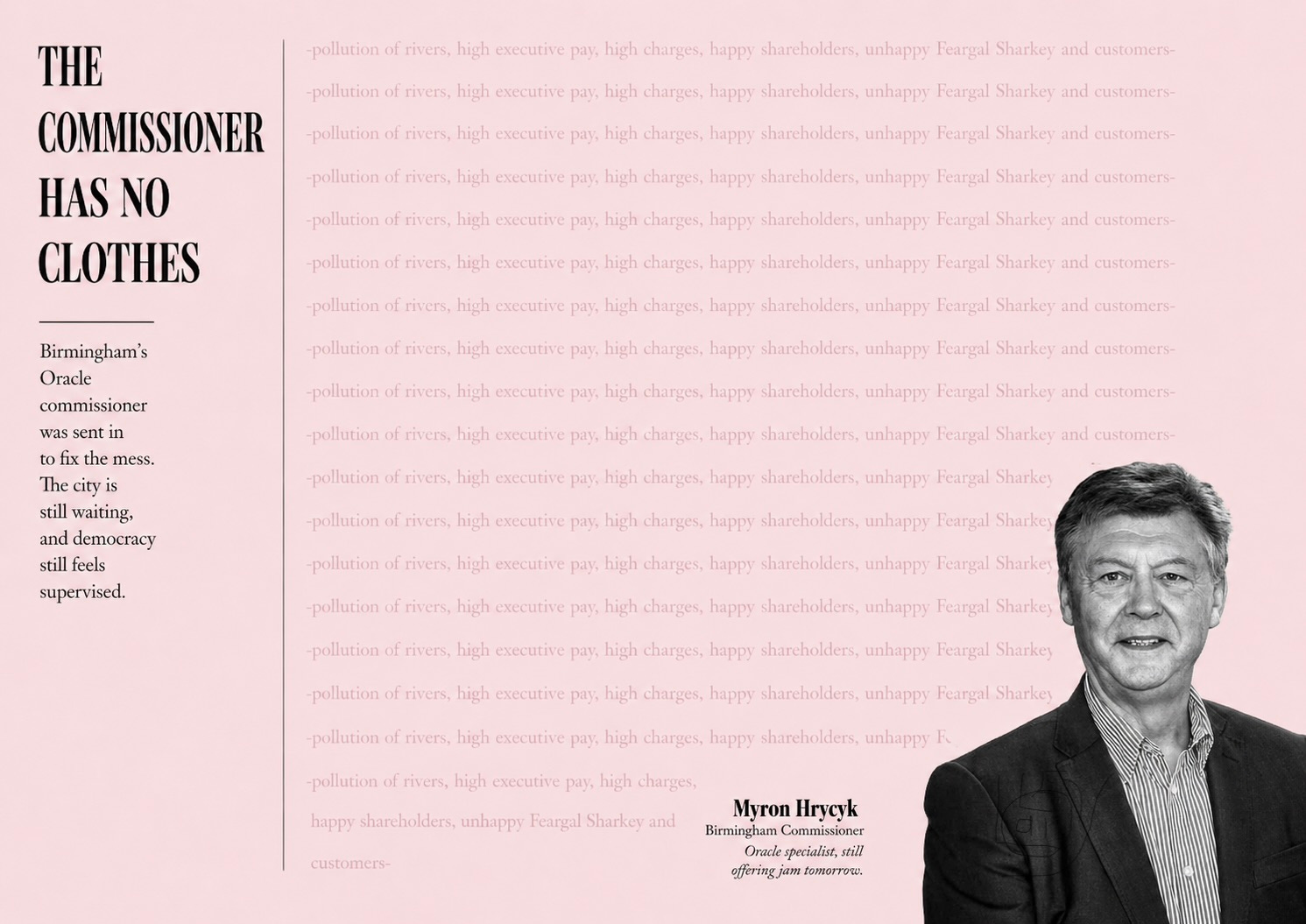
There is something rather useful happening on BBC Radio WM. It is beginning, again, to sound like a station that knows Birmingham exists outside press releases, council statements and carefully managed optimism. Ed James has helped with that. He has a way of letting the city speak without wrapping every answer in studio cotton wool. It feels local, alert and alive, which is exactly what Birmingham needs when the city itself appears to be run by people most residents could not pick out of a police line-up, unless the charge was aggravated use of management jargon.
That is why his recent exchange with Professor David Bailey mattered. Bailey made the case that Birmingham’s voters had sent a message for multi-party politics, and that the new Lib Dem, Green, Independent and Better Birmingham arrangement should be given a chance. I call it the GLIBB Pact, partly because it is shorter, partly because it sounds like something formed late at night in a committee room, and partly because it gives the whole thing the necessary Birmingham flavour of hope, confusion and someone asking where the biscuits went.
But we should not overdo the idea that voters directly chose this exact arrangement. Nobody went into the polling booth and found a ballot paper marked: “Please tick here for a rotating progressive municipal coalition with shared executive responsibility and a constitutional migraine.” Voters chose individual councillors. The pact came afterwards. That is still democracy, but it is not quite the same as the city knowingly ordering the full coalition meal deal, including assembly instructions, missing screws and three people claiming to be in charge of planning.
Where Bailey was absolutely right, and where Birmingham should now focus its anger, is on the commissioners. Because this is the real question: who is actually running Birmingham? Not who has the title. Not who gets photographed near the Council House. Not who issues the statement. Who has the power? Who can stop a deal? Who can block a decision? Who can tell elected councillors that democracy is all very charming, but the grown-ups from Whitehall have not finished with the steering wheel?
The commissioners were sent in after Birmingham’s financial collapse. The official language is improvement, intervention, best value and support. But the old imperial smell still hangs in the room. “Commissioner” is a word with a very British aftertaste. It sounds like someone dispatched from Whitehall to inspect the drains, calm the natives, write a stern report, and remind the locals that self-government is a privilege to be restored only when they have learned to keep quiet and file their paperwork correctly.
That may be unfair. But democracy is allowed to be suspicious of unelected power. Especially when that power sits over the largest local authority in the country, takes decisions affecting more than a million people, and communicates with the public in the manner of a locked filing cabinet.
One of those commissioners is Myron Hrycyk. The name may sound, to the untrained Birmingham ear, like a small Welsh village you pass through on the way to Aberystwyth, but it is not. Myron is a Greek-rooted first name, and Hrycyk appears to be Eastern European, most probably Ukrainian or Polish/Ukrainian in origin. More importantly, he is one of the Government-appointed commissioners placed over Birmingham City Council after the city’s financial collapse. He is not a councillor. He was not elected by Birmingham residents. He was appointed from above, and his particular brief is the one that should make every ratepayer’s ears twitch: Oracle, IT, procurement and commercial recovery.
That matters because Oracle is not some minor back-office inconvenience. It is the council’s financial nervous system, and Birmingham’s version appears to have gone through civic life like a drunk electrician with a hammer. Hrycyk was appointed from 5 October 2023 to 4 October 2028, unless the Secretary of State ends the appointment earlier. His appointment letter says he was expected to focus on helping Birmingham rectify its Oracle issues, improve IT and provide commercial insight. In other words, he was sent in with a very specific suitcase: Oracle, technology, procurement and the big machinery of corporate recovery.
On paper, you can see why Whitehall liked him. He had senior experience at Severn Trent. He had been a Cabinet Office Crown Representative for major suppliers including Oracle, IBM and Microsoft. He knew big systems, big contracts and big transformation programmes. He was, in Whitehall language, exactly the sort of person you send when a council has fallen into an Oracle-shaped hole and is shouting up from the bottom asking whether anyone has seen the ladder.
But Birmingham is entitled to ask the simple question. Has Oracle been fixed? Not improved in a report. Not re-profiled through a programme board. Not turned into a recovery journey with milestones, assurance, senior ownership and enough arrows on a PowerPoint slide to invade Belgium. Fixed. Working. Reliable. Usable. Delivering the basic financial control that a council must have if it is to know what it has spent, what it owes, what it can afford and whether the civic sofa has already been sold to pay for the cushions.
The fair answer is: not in any ordinary public sense. Birmingham has moved towards recovery and reimplementation, but the system did not magically mend because an Oracle specialist commissioner arrived in October 2023. The city is still being asked to wait for the promised cure. That may be serious technical recovery. It may also be the oldest civic product in the Birmingham catalogue: jam tomorrow.
Not ordinary jam, of course. Birmingham civic jam. Jam with governance. Jam with dependencies. Jam with a risk register. Jam that may arrive after another round of patience has been extracted from residents who have already endured service cuts, council tax pain, bins chaos, equal pay fallout, Oracle failure and the strange sensation of being governed by people they did not elect and cannot remove.
This is where Bailey’s attack lands. His language was sharper than mine might be, but the political point is unavoidable. If Birmingham has elected a new administration, that administration cannot spend the next chapter pretending to run the city while commissioners sit behind the curtain holding the actual levers. The GLIBB Pact may be awkward, fresh, fragile and slightly held together with string, but it has one advantage over the commissioners. People voted for its councillors. Nobody in Birmingham voted for a commissioner.
There is also a wider cultural question. Hrycyk came from the privatised utility and big-supplier world: big systems, big budgets, big executive rewards, big promises and a very polished language of transformation. That does not make him responsible for Severn Trent’s environmental record, and it would be unfair to suggest otherwise. He was an IT and procurement figure, not the man personally standing by a pipe with a stopwatch. But Birmingham residents are entitled to ask whether the same managerial culture that promises future efficiency while the public carries present pain is really the culture that should now be sitting above their elected council.
Because this is the deeper democratic problem. Commissioners may be skilled. They may be experienced. They may be decent people doing a difficult job. But they are not accountable to the voters of Birmingham. They are accountable upwards, not outwards. The residents who live with the consequences cannot remove them. The councillors who face the public anger do not fully control them. The city is stuck in a half-democracy, where elected representatives are blamed for outcomes shaped by unelected intervention.
That cannot continue indefinitely. Either councillors are responsible, or commissioners are. Either the new administration is running Birmingham, or it is front-of-house while the real management sits upstairs. Either local democracy has been restored, or it remains in storage somewhere between Whitehall and the Oracle recovery plan.
So here is the respectful suggestion. Myron Hrycyk’s role should now be reviewed. Not abused. Not personalised. Reviewed. If the Oracle commissioner was appointed in October 2023, and Birmingham is still waiting for a clean, functioning recovery years later, then elected councillors should ask whether his work is complete, whether his role remains necessary, and whether the Secretary of State should now end that appointment.
And the same test should apply to the wider commissioner model. What has each commissioner delivered? What remains undone? What powers are they exercising? What are they costing? When does Birmingham get its city back?
The new GLIBB Pact should not waste its democratic moment. It should take its mandate seriously, however imperfectly formed. It should put down a marker that Birmingham cannot be governed forever by remote authority, polite intervention and invisible power. It should demand a timetable for the end of commissioner control, and it should start with the commissioner most visibly tied to the city’s most notorious unresolved technical failure.
The great unwashed may not speak fluent Oracle. They may not know the difference between remediation, reimplementation and civic purgatory with a login screen. But they know when they are being asked to wait. They know when power is being exercised over them. And they know when jam tomorrow has started to smell suspiciously like yesterday’s bin bag.
You buy a system that was already not appropriate to your needs. What do you do? Ditch it or mend it? Mend it but it’s still not appropriate to your needs… who should pay for your decision? Should I expect my neighbours to pay for my mess up? No, it’s my responsibility… the councillors who voted through this system should be surcharged… the officials that allowed this mess up should be surcharged… but they won’t be… they walk away into the setting sun with perks having been evicted from office by a frustrated electorate. Actions don’t have consequences…that is the message from Birmingham or rather actions only have consequences on those who did not take the action. That is the new political law of the 21st century be it here or in Belfast under different circumstances. Politicians decide and if it goes wrong it’s never their fault… and the rest of us have to suffer the consequences.
As to the new Council leadership… you lose 30% of your vote in the election and then you become leader of the Council. The Liberals lost votes throughout Birmingham yet lead the Council… some democracy! Lose and win… actions again don’t have consequences… the voters spoke but. Politicians ignore. Plus ca change!