

The Day Birmingham Broke Starmer
Former Royal Marine Al Carns did not resign against Labour. He resigned for what he believes Labour should stand for. That may prove a far more dangerous act.

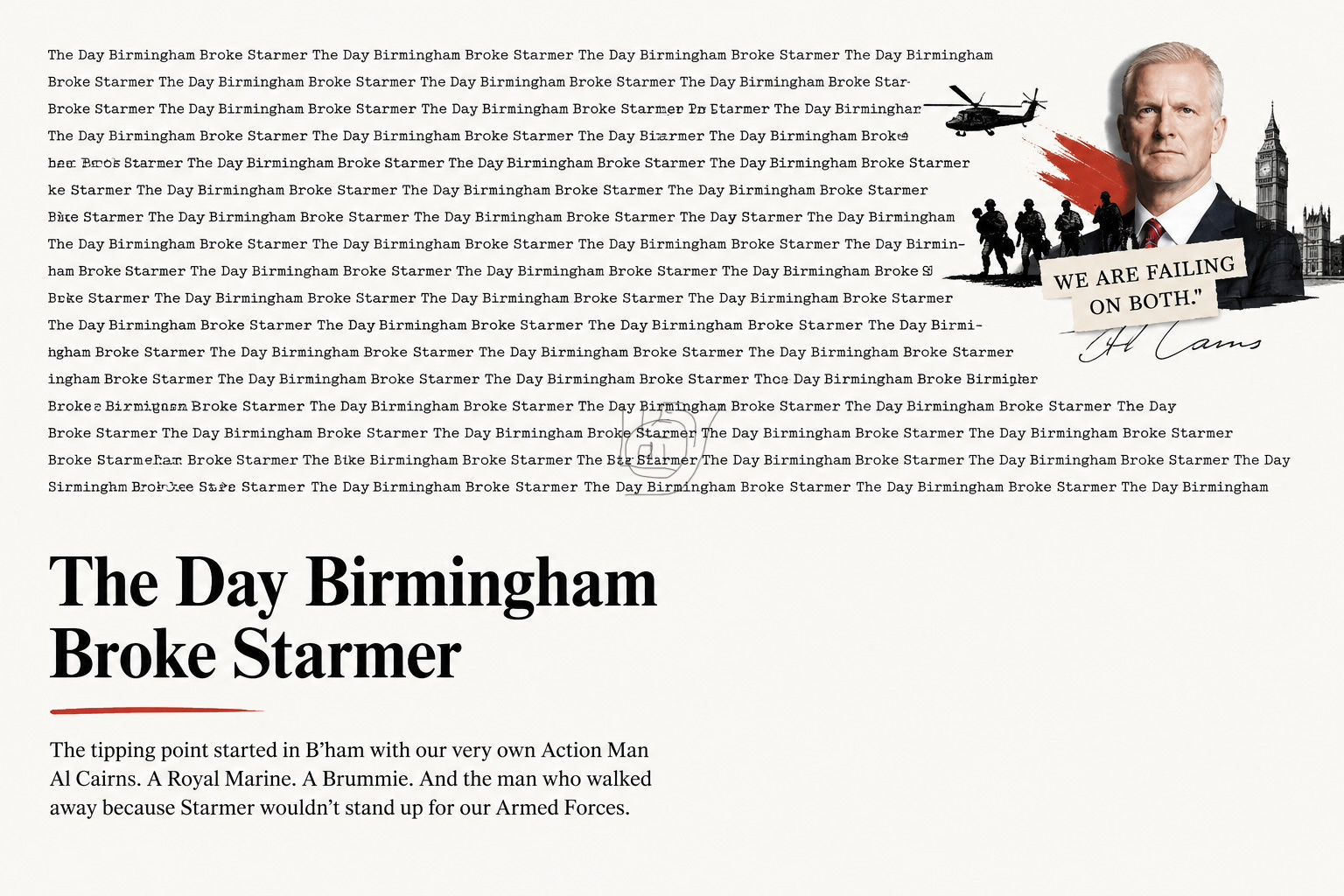
If Sir Keir Starmer’s premiership is now entering its final act, historians may find themselves looking not first to Westminster, not to the Treasury, not to a television studio full of stern-faced political editors, but to Birmingham. More precisely, they may find themselves looking to Selly Oak, where our very own political Action Man, Al Carns MP, appears to have done something rather unfashionable in modern politics. He looked at power, weighed it against principle, and walked away.
I instinctively like Al Carns because of my dad’s service as a Royal Marine. That does not mean he gets a free pass. It does mean I start from a position of respect. Royal Marines are not usually fragile creatures given to dramatic exits because the coffee machine in Whitehall has run out of oat milk. They are trained to endure, to persist, to obey difficult orders and to carry burdens that most of us would rather discuss from the safety of a warm room with a decent biscuit. So when a former Royal Marine resigns from government saying Britain is failing those who serve, the grown-ups in the room should stop pretending this is just another day in the Westminster tumble dryer.
John Healey’s resignation as Defence Secretary was bad enough for Starmer. Healey is not a lightweight, a mischief-maker or a man permanently searching for a camera. He is one of those serious Labour figures who gives the impression that he actually reads the brief before appearing on television. His resignation letter was devastating because it used two words that may now hang around Starmer’s government like damp in a council flat: “unable” and “unwilling”. Unable to commit what is needed. The Treasury unwilling to provide it. That is not a routine resignation. That is a senior minister saying the government is failing in the first duty of the state.
Then came Carns. Not as some noisy backbench insurgent. Not as a man seeking a better job. Not as an act of rebellion against Labour, but arguably as an act of loyalty to the Labour tradition that once understood national defence, working-class service and the dignity of those who put on a uniform. Carns said we owe those who serve the kit to do the job and the loyalty to stand by them when it is done, and that we are failing on both. There is no clever way to spin that. A serving Armed Forces minister, a former Royal Marine, looked at the government’s position and concluded he could no longer defend it.
This is why Birmingham matters in the story. The West Midlands has always contributed more than its fair share to Britain’s Armed Forces. Our region has sent sons, daughters, fathers, uncles, brothers and neighbours into uniform for generations. Birmingham may look like a city currently being run by a committee of lost sat-navs and broken photocopiers, but when the nation has needed people to serve, this place has never been missing. We build, we graft, we serve, we grumble, and then we serve again. So when the MP for Selly Oak resigns over defence, it is not some remote Westminster melodrama. It lands here with a different force.
There is a brutal simplicity to the argument now. The first duty of government is not messaging. It is not triangulation. It is not giving a minister a shiny new job title and hoping everyone forgets the previous promise by teatime. The first duty of government is to protect the nation. If a Prime Minister cannot convince his own Defence Secretary and his own Armed Forces minister that he is prepared to fund that duty properly, then he has a problem deeper than opinion polls. He has a legitimacy problem.
Dan Jarvis now inherits the job, and he too comes with serious military credentials. That makes the appointment clever in one sense and dangerous in another. Starmer can point to another veteran and say defence is in safe hands. But veterans understand the gap between words and capability. They understand that rhetoric does not buy ammunition, that warm statements do not repair military housing, that patriotic speeches do not retain trained personnel, and that apprenticeships, useful though they are, do not replace ships, aircraft, equipment, stockpiles and serious long-term planning.
That is the trap now. Starmer can reshuffle the faces, but he cannot reshuffle the facts. Healey walked. Carns walked. Jarvis arrives. The question remains exactly where it was before the Downing Street machine started moving the furniture around. Will this government fund defence properly, or will it ask serious people to front an unserious settlement?
This may be remembered as the tipping point. Not because one resignation automatically ends a premiership, but because some resignations reveal what everyone has been trying not to say. Starmer’s great political offer was competence. Dull perhaps, but competent. Serious perhaps, but competent. Sensible, managerial, steady, grown-up, reassuringly grey. Yet here we are, with senior figures leaving government because they say the state is unwilling or unable to meet its most basic duty.
And if that is true on defence, what else is true?
This is the political danger for Starmer. Once “unable” and “unwilling” attach themselves to a Prime Minister, they spread. Unable to grip the economy. Unable to fix public services. Unable to resolve Birmingham’s municipal collapse. Unable to restore trust. Unwilling to make hard choices. Unwilling to confront the Treasury. Unwilling to tell the country what security actually costs. That may be unfair in parts, but politics is not a seminar in fairness. It is a street fight conducted in suits.
For Birmingham, there is a particular irony. We have become used to being discussed as a problem to be managed. Bankruptcy, commissioners, bins, equal pay, broken governance and all the rest of the grim civic alphabet soup. Yet this week Birmingham may have produced the man who helped expose the central weakness in the Prime Minister’s authority. Not with a speech full of theatrical nonsense, but with the simple act of saying no.
Al Carns may not have intended to see off Starmer. He may not think of himself in those terms at all. That is partly why the resignation matters. It does not look like ambition. It looks like duty. It looks like a man trained in service deciding that staying silent would be worse than losing office. In modern politics, that is dangerously powerful stuff.
So yes, if this is the beginning of the end for Sir Keir Starmer, let Birmingham take its place in the footnotes, preferably in bold and with a decent font. The city did not give him power. It did not write his manifesto. It did not create the Treasury hole, the defence dispute or the slow leakage of authority from Downing Street. But through Selly Oak, through Al Carns, through a former Royal Marine who decided he had heard enough, Birmingham may have provided the moment when the polite pretence finally cracked.
And that is not a bad day’s work for a city Westminster usually remembers only when something has gone wrong.
Richard, ... I think your concern about unequal ward electorates is a fair one and I’ll be interested to see your final analysis. MYonly caution is that low turnout does not necessarily prove that large numbers of registered electors do not live there or are ineligible to vote. It It may point in that direction, but it could equally reflect disengagement, mobility, poverty, language barriers or a host of other factors. If you can evidence the distinction between registered electorate, resident population and actual voting population, you may well have uncovered something very interesting indeed. 🧐
Richard, thank you once again for taking the time to comment.
You ask which party I support. The answer remains Labour, (Only our dear Lord knows why..!!!) although I suspect you already knew that from the latter part of your comment. Loyalty, however, does not require blindness, and I have never felt obliged to cheer every decision made by my own side.
On Myron Hrycyk, the reason I mentioned his name was simply curiosity. At first glance I wondered whether it might be Welsh, then checked and found the background interesting. Had the name been Mohammed Shah, I doubt I would have done the same, because the likely broad origin would have seemed more obvious and less unusual to me. The point was not criticism of foreignness, but a passing observation about a name that caught my eye. Happy to critique foreigners however if they deserve it ..
As for Al Carns, yes, he was parachuted in, and I have expressed reservations about parachuting candidates into seats over the years, of parties . However, when he recently stood down from his ministerial position over defence spending, it suggested to me that he possesses a degree of conviction and courage. Given his military record, I expected him to be brave physically. What interested me was whether he would be brave politically. On that score, he appears to have answered the question. Passed the good guy test if you will
You may well be right that Birmingham is no longer the workshop of the world. Sadly, that is self-evident. But I make no apology for wanting more manufacturing, more apprenticeships and more skilled jobs. If BSA motorcycles were once again rolling off a production line in Birmingham, whether they were motorcycles, drones or something entirely new, I would regard that as progress rather than nostalgia.
On young people, I part company with many of my contemporaries. Every generation since Aristotle has complained that the youth are idle, feckless and doomed. I remember older people saying similar things about my generation, and I disliked it then as much as I dislike it now. I prefer to look at the potential young people have rather than constantly catalogue their fAults.
Where I do worry is not about the young themselves but about the guidance we give them. Too often we seem content to shuffle people onto short-term Mickey Mouse courses and training schemes that generate paperwork and grant claims but little in the way of enduring skills. I would rather see apprenticeships, workshops and industries where people can learn a trade and build a future.
So yup, I am nostalgic in some respects. Not because I believe the past was perfect, but because I am not yet convinced that what we have replaced it with is necessarily better.