

The Day Birmingham’s Bin Cuts Stopped Making Sense
Hours after Birmingham defended bi monthly wheelie bin collections on cost grounds, the Pension Fund surplus raised one unavoidable question. Why cut at all?

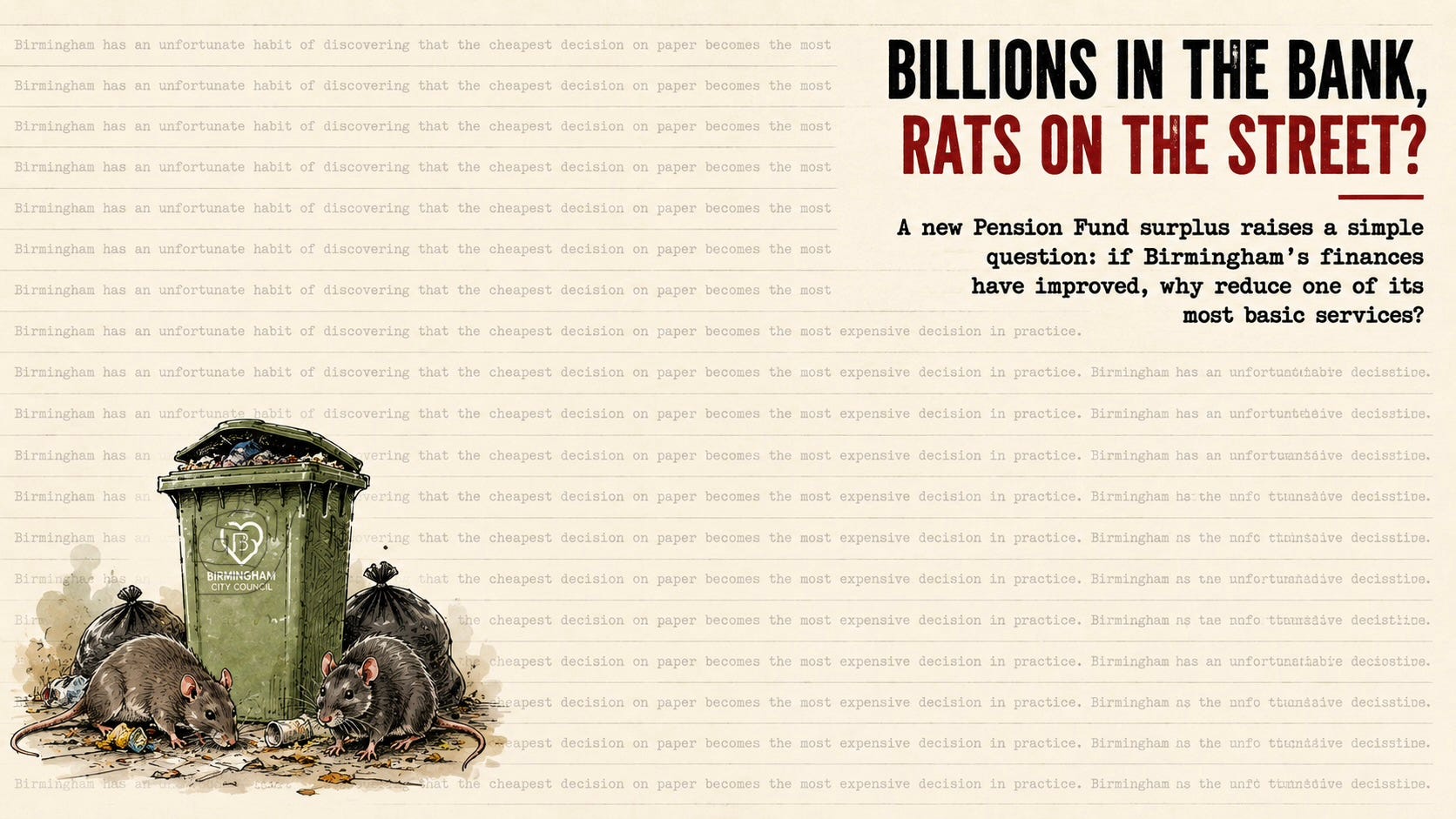
Within a few extraordinary hours, Birmingham was told it had to accept a reduced wheelie bin collection service because money is tight. Then the West Midlands Pension Fund revealed a multi billion pound surplus. Those two stories simply cannot sit side by side without somebody asking whether Birmingham should now change course.
Sometimes journalism writes itself. I woke up this morning expecting to write an article about Birmingham’s controversial decision to introduce bi monthly wheelie bin collections. I even spent a very enjoyable hour yesterday with Conservative Leader Cllr Robert Alden discussing exactly that. We put the world to rights, explored the arguments for and against, laughed at the absurdity of Birmingham politics and, by the time we had finished, I thought I knew exactly where this article was heading. My apologies to Bobby because events rather overtook us. He deserves considerably more space than he receives here and I rather suspect I owe him another coffee and, more importantly, an article worthy of his time he spent with myself. But then something happened that changed the story completely. After I left Bobby the West Midlands Pension Fund published its latest valuation. Professor John Clancy did exactly what many expected him to do. He sat down, studied the figures and reached a conclusion that, if correct, changes the entire debate. Suddenly this was no longer just another story about wheelie bins. It became a story about whether Birmingham still needs to cut one of the most basic public services it provides.
It is only fair to point out that when I interviewed Cllr Alden, none of this information had entered the public domain. The same fairness applies to Cllr Roger Harmer, Cllr Harris Khaliq and every other councillor involved in today’s waste debate. None of them could reasonably have been expected to comment on figures that had not yet been published. That excuse has now disappeared. The figures are now in the public domain. Birmingham’s political leadership has them. The question is no longer whether they knew. The question is what they intend to do next.
Earlier yesterday Birmingham residents began receiving confirmation that the new Green, Liberal Democrat and Better Birmingham administration is pressing ahead with Labour’s plans for bi monthly wheelie bin collections. The argument has been a familiar one. Birmingham is under severe financial pressure. Difficult choices have to be made. Residents must accept a reduced level of service because there is no realistic alternative. It is an argument we have all heard repeatedly over the last few years.
Then came the second announcement.
The West Midlands Pension Fund published a valuation confirming that it now sits on a surplus measured in billions of pounds. Professor John Clancy immediately highlighted what he believes is Birmingham’s share of that improved position, around £1.7 billion. Let us assume, for the purposes of this discussion, that Professor Clancy is right. If he is, then Birmingham is no longer having the same financial conversation it was having yesterday. It is having an entirely different one. If the financial landscape has materially improved, surely the council has a duty to pause, reassess and ask whether decisions made under yesterday’s assumptions are still the right decisions today.
That is not a party political point. It is simply good government.
Collecting household rubbish is not some obscure service hidden away in the depths of a council budget. It is one of the defining reasons local government exists. Long before councils spoke about digital transformation, net zero, inclusive growth or economic strategies, they emptied bins. It is one of the oldest contracts between a council and its residents. We pay our council tax. The council collects our wheelie bins. It is not an unreasonable expectation.
Unfortunately Birmingham has spent months demonstrating exactly what happens when that contract breaks down. Industrial action. Missed collections. Overflowing wheelie bins. Fly tipping. Rats. Foxes. Frustration. Entire neighbourhoods looking as though refuse collection had become an optional extra rather than a statutory function. Residents were looking forward to one thing above everything else, a return to a dependable weekly wheelie bin service. Instead they are now being told that Birmingham’s new normal will involve bi monthly collections because that is what the city’s finances supposedly demand.
Perhaps yesterday that argument stood up. Today it deserves to be tested all over again.
The council says reducing collection frequency will save money. Perhaps it will. But what if it doesn’t? What happens if bi monthly collections create more fly tipping? More side waste? More vermin? More emergency clean ups? More environmental enforcement? More complaints? More pressure on neighbourhood services? Birmingham has an unfortunate habit of discovering that the cheapest decision on paper becomes the most expensive decision in practice. False economies have an irritating tendency to send the invoice later. All our Cllrs know that because frankly we all know that…!!
Cllr Alden believes exactly that will happen. He argues Birmingham is making a serious mistake and that residents will ultimately pay through dirtier streets and increased clean up costs. Whether you agree with him or not almost ceases to matter because today’s Pension Fund announcement changes the context completely. The debate is no longer simply whether bi monthly collections are a good idea. The debate has become whether Birmingham still needs them at all.
There is another point that deserves consideration. Before becoming Leader, Cllr Roger Harmer made clear that Birmingham should not introduce major changes to its waste collection service until residents could rely upon a dependable service. That struck me as a sensible position then and it strikes me as an even more sensible position now. The service is still damaged from one of the longest and most damaging waste disputes in Birmingham’s history. Public confidence remains fragile. If Birmingham’s finances have now materially improved, why rush? Why not pause the introduction of bi monthly collections, settle the industrial dispute once and for all, restore confidence in the service and then decide whether any reduction remains necessary?
Which brings me to one question I would genuinely like to put to Cllr Harmer:
Imagine that, some years from now, you are no longer Leader of Birmingham City Council. Imagine you discover compelling financial evidence that could fundamentally improve the council’s position and potentially save frontline services. Would you expect the new Leader simply to dismiss your analysis because it came from a predecessor? Or would you hope they picked up the telephone, invited you in and seriously examined the evidence?
I suspect every former Leader would expect the latter. If that is true, then surely Professor John Clancy deserves the same courtesy today. Whatever political differences exist, he is a former Labour Leader of Birmingham City Council who has produced a serious analysis based on figures published by the Pension Fund itself. He is now a member of Plaid Cymru, so this can hardly be dismissed as Labour mischief. In any event, party labels are the least important part of this. The mature response is not to brush him aside because of politics, but to examine his conclusions thoroughly, openly and with an open mind.
The same opportunity now presents itself to Cllr Harris Khaliq. Cllr Khaliq has inherited this mess after only a few days as a councillor and now Cabinet Member. During the election campaign he spoke passionately about cleaner streets, reliable waste services and restoring confidence in basic council functions. Nobody doubts those ambitions. Today’s Pension Fund announcement offers him and his Cabinet colleagues an opportunity few administrations ever receive. They can demonstrate that Birmingham’s new leadership is prepared to respond to significant new evidence rather than simply continuing a policy inherited from the previous administration because the machinery of local government has already started rolling.
So here is my proposal. Pause the introduction of bi monthly wheelie bin collections.Bring the industrial dispute to a lawful and lasting conclusion. Just like Cllr Harmer said.
Restore the reliable weekly wheelie bin collection service that politicians across Birmingham said residents deserved.
Then place Professor Clancy’s analysis alongside the council’s own financial assessment of the Pension Fund valuation. If the improved financial position changes Birmingham’s savings programme, say so. If it does not, explain precisely why not. Either way, residents deserve honesty, transparency and evidence before they are asked to accept a permanent reduction in one of the most basic services their council provides.
Good governments are not judged by how stubbornly they cling to decisions made yesterday.
They are judged by whether they have the confidence to change those decisions when tomorrow brings better information.
Today brought better information. Today changed the debate. Now Birmingham’s political leaders have a choice. They can carry on as though nothing has happened.
Or they can acknowledge that the financial landscape has shifted, pick up the telephone, speak to Professor Clancy, test his conclusions rigorously and ask themselves one very simple question.
Do Birmingham residents really need to lose a weekly wheelie bin collection after all?
If the answer is yes, prove it. If the answer is no, have the courage to say so. That is what leadership looks like.