

The Day I Reported a Dead Ape on the A5
A dead ape, or something like it, a 999 call, and a quiet lesson in how Britain still functions.

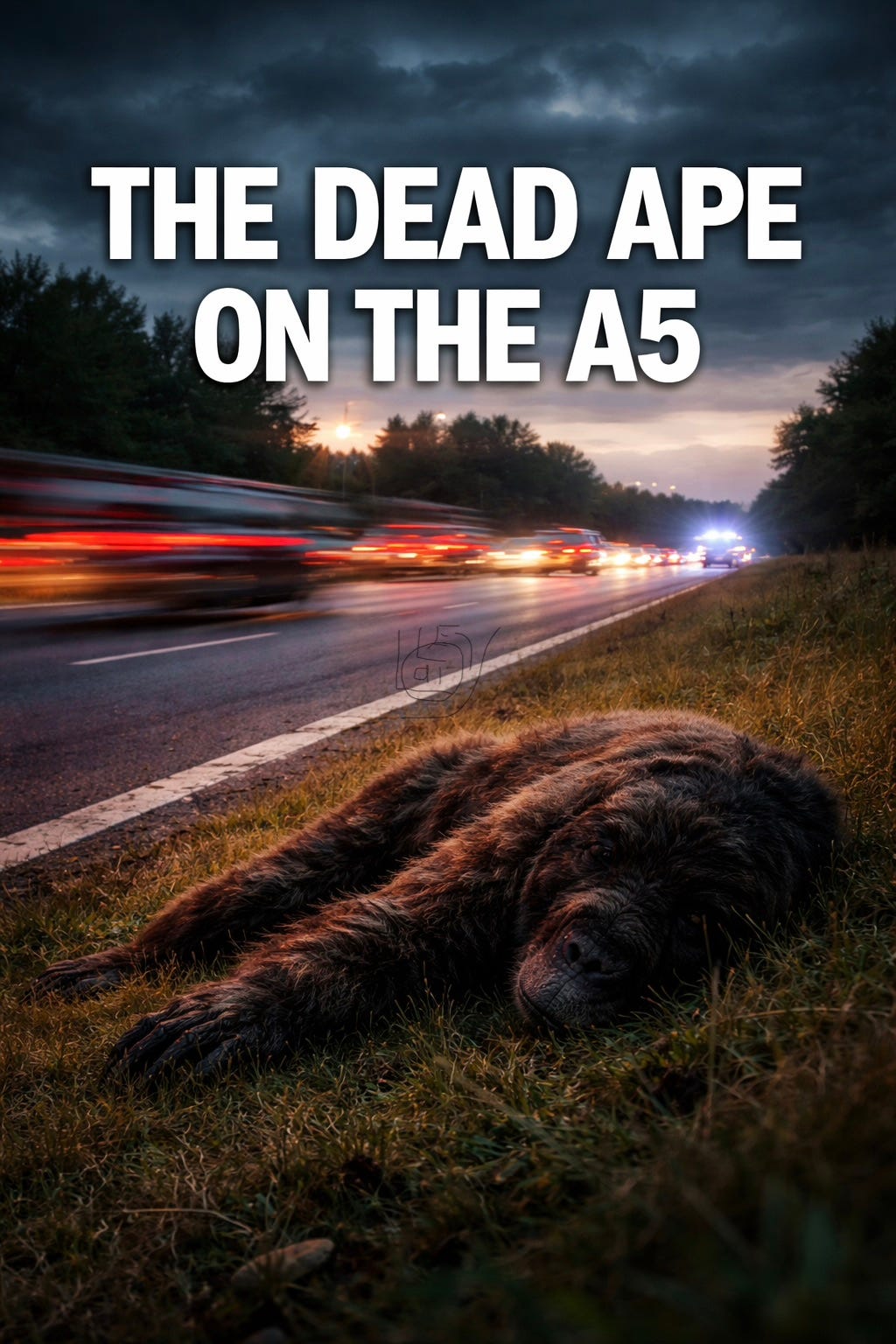
There are moments in life when you find yourself doing something that, even as you do it, feels faintly ridiculous.
Dialling 999 to report what may or may not be a dead ape on the A5 is one of them.
We were heading along Watling Street, that long Roman line that still cuts through the Midlands with the quiet authority of something that has seen empires come and go. My wife was driving when she suddenly said she thought she had just seen a dead ape at the side of the road.
Not calmly.
There was a crack of shock in it.
I dismissed it immediately. Not unkindly, just with the easy certainty of a man who assumes there are no apes lying dead on the A5 on a Tuesday afternoon.
We carried on.
But doubt is a stubborn thing. It lingers. It prods. It makes a quiet nuisance of itself.
So we turned round.
Back to the island, back again, slower this time. My wife still driving, me now paying proper attention. And there it was.
Large.
Wrong.
Unmistakable in shape, if not in species.
I took a video, partly out of disbelief, partly because experience has taught me that if you are going to tell an unlikely story, you had better bring evidence with it. Writing regularly now to a readership that runs into the tens of thousands, you develop a feel for how quickly a story without proof drifts from fact into folklore.
And then came the question.
What do you actually do with a dead ape on the A5?
More to the point, what do you do when you think you’ve seen one?
This is where the British instinct kicks in. You hesitate. You second-guess. You tell yourself not to make a fuss. You definitely do not want to be the man who rings 999 and gets it wrong.
But equally, there it was. Large. Dead. At the side of a fast road.
That is not nothing.
So I asked my wife to pull over a few hundred yards ahead where it was safe, and I made the call.
It lasted twelve minutes.
There may have been the faintest flicker of amusement when I explained. If there was, it was human, and entirely fair.
What followed was something better.
Professionalism.
Calm, steady, unhurried professionalism.
No brushing it off. No irritation. No sense that this was beneath attention. Just clear questions, careful listening, and a quiet determination to deal with what was in front of them, however odd it sounded.
I mentioned the video. They asked for it. Sent, just like that, through a system that now makes even the strangest reports evidential within seconds.
And then came the suggestion.
It might be a deer.
Which, when you say it out loud, does sound rather more likely than an ape taking its final moments beside a Roman road in the Midlands.
I have since watched the video again. It is not conclusive. The size is there. The shape is there. Certainty is not.
So the A5 keeps its small mystery.
But in truth, the animal is not the story.
The story is what happens when an ordinary person is faced with something that might, just might, warrant a call to 999.
Because there is a quiet reluctance in this country. A sense that you should not trouble anyone unless you are absolutely certain. That emergency services are for “real” emergencies, and that you had better be sure before you pick up the phone.
But the road does not care about certainty.
A large dead animal, whatever it is, is a hazard. It is a risk. It is someone else’s accident waiting to happen.
And what mattered in that moment was not whether I had correctly identified the species.
It was that the system worked.
That someone answered.
That they listened.
That they treated the call seriously without making the caller feel foolish.
Twelve minutes on a 999 call about a possible dead ape is not a system failing.
It is a system doing exactly what it is supposed to do.
We spend a great deal of time talking about what does not work. About institutions under strain, services stretched, standards slipping.
All of which may be true.
But every now and then, in the most unlikely circumstances, you are reminded that there are still people on the other end of the line who will take the call, think it through, and deal with it properly.
Dead ape or dead deer, it was not a pleasant sight.
But the response to it was quietly reassuring.
And that, in the end, is the only part of the story that really matters.
Even on the A5.
Even when you think you’ve seen a dead ape.
Arrr yes but that's my dramatic interpretation... I do have a video grab and the limbs are very thin, which does imply a deer. I didn't want to use that as frankly it's a bit sad ... and too real ... you see I act up as an Alpha Male but I'm a bit of a softy really ❤️
At the heart of this lies the salient fact that a dead animal laid along a public road. It must have been a shock to the motorist that hit it - it was a shock to me when I saw it! I do hope that its final moments were peaceful. I am grateful to the Staffordshire Police 999 operator for her cool, calm and supportive response.