

The Disappearing £1 Billion That Is Still There
Birmingham’s accounts show a £994m pension surplus. Then the asset ceiling makes it disappear. But disappearing in the accounts is not the same as disappearing in real life.

There it is, sitting in Birmingham City Council’s own draft accounts, almost glowing in the dark. A Local Government Pension Scheme surplus of £994.1 million. Not a rumour. Not a blog. Not a late-night pension rant from Professor John Clancy after too much coffee and too many spreadsheets. It is there in the council’s own financial papers for the year ended 31 March 2026. The fair value of assets in the Local Government Pension Scheme is shown at £6.004 billion. The present value of the LGPS liabilities is shown at £5.010 billion. The difference is the number nobody in authority has seemed very keen to talk about in plain English: £994.1 million.
Then, almost immediately, the money performs a trick. A note below the table explains that the latest actuarial valuation results in a net pension asset of £1.0447 billion, compared with £598.4 million the previous year. So, by one measure, Birmingham’s pension asset has surged by hundreds of millions in twelve months. Yet after the application of something called the asset ceiling, the accounts then recognise an additional liability, and the final balance sheet position is shown as a pension liability of £86 million. Now you see the billion. Now you don’t. The surplus has not evaporated. It has not been stolen by pension goblins. It has not been spent on a new tram to the moon. It has been restricted by an accounting device.
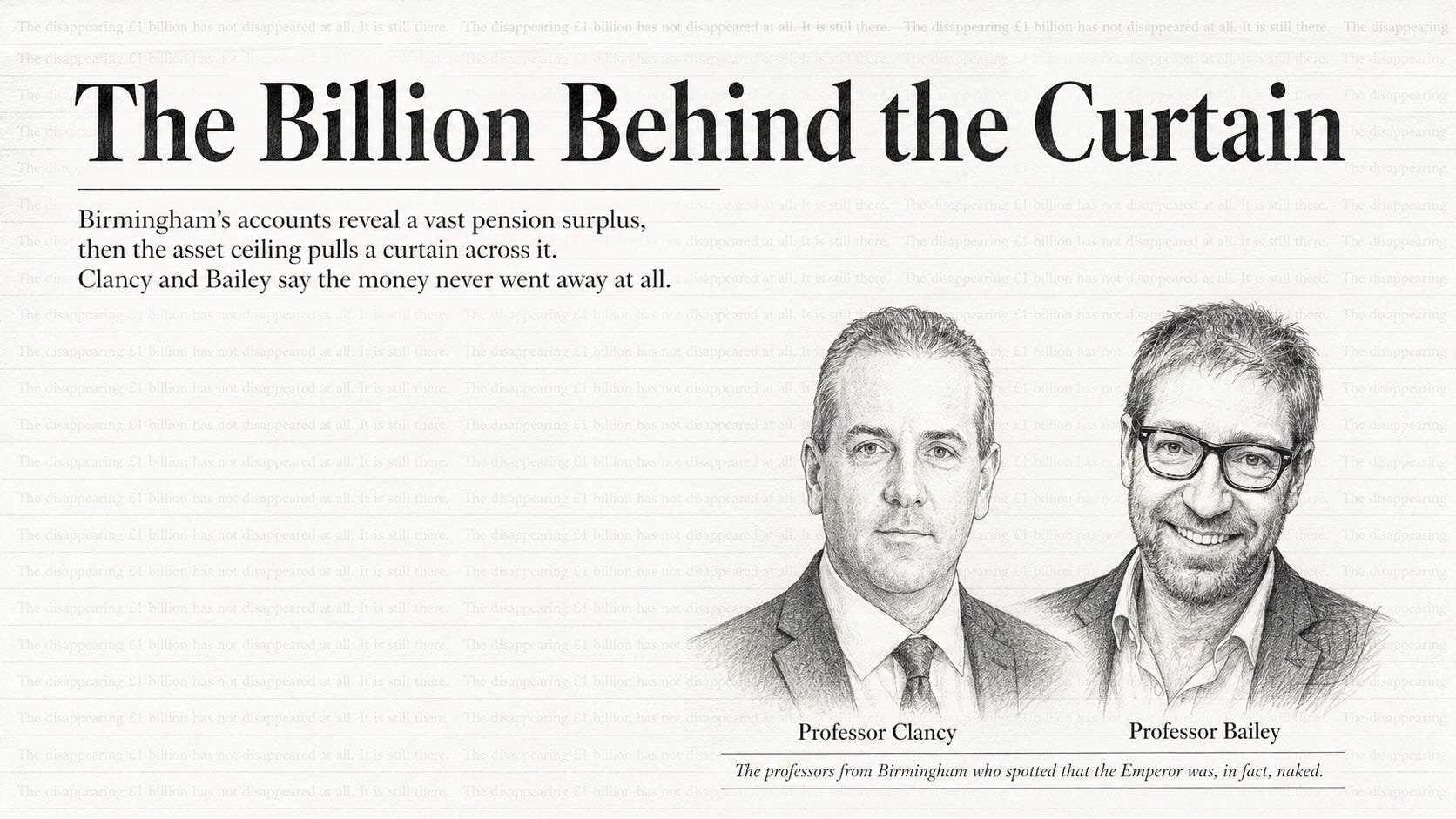
This is the point Professor John Clancy and Professor David Bailey have been making for years, and which the West Midlands Pension Fund world has often treated as if it were an outbreak of academic nuisance. Clancy, former Labour leader of Birmingham City Council and now a member of Plaid Cymru, has been warning that the pension numbers were being misunderstood, misread or presented in a way that caused real-world political damage. Bailey has been alongside him in that argument. They have said, repeatedly, that pension assumptions matter, that over-cautious valuations matter, that employer contributions matter, and that money poured unnecessarily into pension funds is money not available for libraries, youth services, adult social care, street cleaning, schools and everything else local authorities are told they can no longer afford.
The phrase “asset ceiling” sounds harmless enough, which is presumably part of the problem. It sounds like something invented by people who enjoy seminars, mineral water and very small biscuits. But politically it is dynamite. The accounting rule says, in effect, that even where a pension surplus exists, an employer can only recognise that surplus on its balance sheet if it has an unconditional right to benefit from it, either through a refund or through reduced future contributions. That may be perfectly proper accountancy. It may comply with the rules. It may make technical sense to people who can read pension notes without losing the will to live. But to the public, the effect is extraordinary. A billion-pound surplus appears in the note, then an accounting ceiling descends, and the headline position looks like a liability.
That is why this cannot be dismissed as just accountancy. Because council tax is not theoretical. Business rates are not theoretical. Closed libraries are not theoretical. Youth services cut to the bone are not theoretical. People waiting for care packages are not theoretical. If Birmingham has a near-billion-pound pension surplus on one part of the note, and if that surplus can reduce future contributions or otherwise ease the pressure on the council, then the public has a right to know why the city has been behaving for years as if every cupboard was bare. The issue is not whether Birmingham can simply grab the £994.1 million and spend it by Friday. Nobody serious is saying that. The issue is whether Birmingham, and other public employers across the West Midlands, have paid too much, are still paying too much, or are failing to demand the full benefit of a pension position far healthier than they were led to believe.
This is where the old Crazy Clancy briefing starts to look rather tired. I have no doubt that Cllr Roger Harmer, Birmingham’s new leader, will already have heard, or will shortly hear, the familiar officer version. Clancy is obsessive. Clancy is difficult. Clancy does not understand the complexities. Clancy keeps going on about pensions. Clancy is not someone sensible leaders should encourage. That line has been doing the rounds for years. I suspect local journalists have been given it too, which may help explain why the local media has barely laid a glove on one of the biggest public finance stories in the region. Too boring. Too complex. Too actuarial. Too much chance that readers will be asleep before the second subheading.
But here is the problem with dismissing Clancy as a pension bore. Sometimes the bore is right. Sometimes the man reading the appendix everyone else skipped is the only person in the room doing the work. Sometimes the obsessive is obsessive because the numbers justify obsession. Clancy may be the nation’s greatest bore on local government pensions, and I mean that as a compliment. Most of us would rather boil our heads than master this stuff. He has done the opposite. He has read it, understood it, remembered it and then committed the unforgivable sin of explaining it in words normal people can understand.
So Cllr Harmer should pick up the phone to him. Not because Clancy is infallible. Not because Bailey and Clancy should be handed the keys to the council finance department and a ceremonial calculator. But because Birmingham’s own draft accounts have now dragged their argument out of the margins and into the official papers. A leader who wants to understand the city’s real financial position cannot rely only on the same officer culture that failed to get to grips with this for years. Harmer did not create this mess. That gives him the freedom to ask the questions others should have asked before him. What has Birmingham paid into the Fund? What should it have paid? What reductions are now due? What does the asset ceiling hide from the headline accounts? What benefit can Birmingham actually obtain from the surplus? And why were elected members not forced to confront this in plain English years ago?
And this is not only about Birmingham. The West Midlands Pension Fund is administered by Wolverhampton and covers a huge range of employers across the region. That means every West Midlands council leader should now be asking the same questions. Coventry, Dudley, Sandwell, Solihull, Walsall, Wolverhampton and Birmingham should all want their figures. So should schools, colleges, academies, police, fire and the wider family of public bodies tied into the Fund. If there are surpluses attached to employer positions, if contributions can be cut, if money can remain in local services rather than being locked into excessive caution, then the leadership test is simple: ask for it, understand it, and act.
The wider West Midlands Pension Fund valuation already showed the scale of the issue, with reported assets of £21.368 billion, liabilities of £17.037 billion, a surplus of £4.331 billion and a funding level of 125 per cent. It also said average employer contribution rates had reduced, mainly because assumed future investment returns had increased. That is not some tiny technical adjustment. That is the heart of the Bailey and Clancy argument. Assumptions changed. Contributions changed. The supposed pension burden looked very different. And now Birmingham’s own accounts show a near-billion-pound surplus being pushed through the asset ceiling trapdoor.
Of course the Fund and the council will say caution is needed. They will say pensions are long-term. They will say markets move, assumptions change, liabilities fluctuate and accounting standards must be followed. Fine. Put all of that on the record. Nobody is arguing for recklessness. But caution is not the same as silence. Prudence is not the same as hiding behind fog. Complexity is not a democratic exemption certificate. If public bodies have been overpaying, or if they are now entitled to major reductions, then domestic and non-domestic ratepayers have been carrying a burden they deserve to see explained.
That is the scandal. Not that an accounting rule exists. Not that pension accounting is complicated. The scandal is that a city told it was broke can now see, in its own accounts, a pension surplus of nearly £1 billion appear and then disappear behind technical language. The money is still there in the pension position. The question is who gets the benefit, when, how, and why it took Clancy and Bailey years of shouting to force the issue into daylight.
The disappearing £1 billion has not disappeared at all. It is still there. And this time nobody can say they were not told.
This is a major issue - looking to do a fresh angle on this next week ...
Ask, ask, ask, until you're blue in the face!