

The End of the Old Order?
A by-election in Manchester may signal something far bigger for Britain, and the West Midlands could feel it first.

By-elections are supposed to bruise, not break.
They are safety valves. Voters vent. Governments wobble. Oppositions posture. Then the system resets and the Westminster machine carries on.
Gorton and Denton did not feel like that.
It felt heavier. Not a tantrum. Not mid-term mischief. Something colder. Something structural.
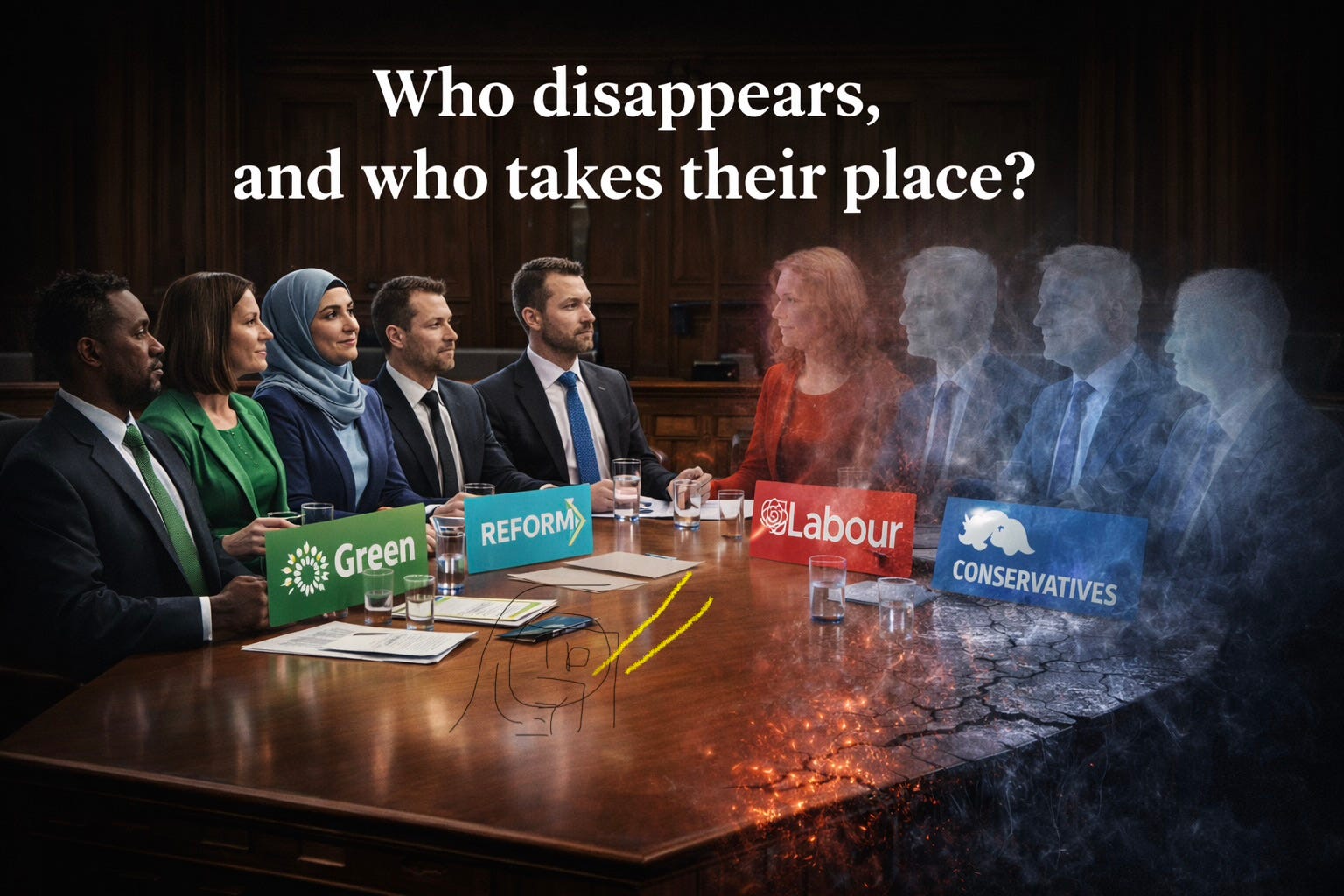
When the result was projected nationally, even under the usual “for illustration only” disclaimer, the image was arresting. Reform surging into territory once treated as permanently Labour or safely Conservative. Labour collapsing. The Conservatives diminished. The old duopoly looking fragile in a single frame.
Projection maps are not predictions. But they reveal something important: imagination. Once voters can imagine a different political map, they begin to vote as if it might be possible.
That is when protest turns into realignment.
Anger Is Not the Same as Withdrawal
There is a difference between anger and rejection.
Anger still assumes relationship. Rejection ends it.
For years, voters have been irritated with Labour and the Conservatives. But irritation is manageable. It can be soothed with leadership changes, sharper messaging, policy tweaks.
What Gorton suggested was not irritation. It was emotional withdrawal.
Reform’s surge did not look like a passing flirtation. It looked like a statement: if the established parties are no longer credible, then alternatives become necessary.
That is far more dangerous than a protest vote.
The Architecture Under Threat
This is not just about MPs.
Across the United Kingdom, Labour and the Conservatives together account for roughly 11,500 councillors. Labour holds around 6,500 to 7,000. The Conservatives roughly 4,000 to 4,500. Between them they form the operational backbone of local British politics.
Labour controls 107 councils. The Conservatives control 33.
That is the structure.
If that structure begins to fracture in meaningful numbers, the consequences will not be cosmetic. They will be systemic.
Because councils are not theoretical. They decide planning. Housing. Social care. Local taxation. They are where politics becomes lived experience.
If voters have begun withdrawing trust nationally, that withdrawal will filter downwards quickly.
The Compliance Culture
For two decades, advancement inside both major parties has tended to reward similar traits.
Message discipline.
Internal compliance.
Caution.
Safe positioning.
That system produces stability. It also produces sameness.
Politics became professionalised. Candidates increasingly emerged from advisory pipelines and internal networks. That does not make them incompetent. Many are hardworking and capable. But it narrows lived experience and sharpens insulation.
Voters sense that insulation.
And when politics begins to feel like a closed profession rather than a form of representation, resentment follows.
The response from party leaderships is familiar.
We must reconnect.
We must communicate better.
We must sharpen delivery.
But this does not feel like a communication problem.
It feels like a credibility problem.
Are the Parties Adapting?
History is not kind to parties that mistake permanence for entitlement.
The Liberal Party once dominated British politics. It fractured and faded.
Labour itself suffered catastrophic defeat in 1931, reduced to a parliamentary rump during the crisis of the National Government. In that same year it lost Gorton and Denton. At the time, it looked as if Labour might never recover. It did, but only after profound upheaval.
The Conservative tradition is also a story of reinvention after deep splits and structural change.
No party is guaranteed survival.
The question now is simple.
Are Labour and the Conservatives adapting fast enough?
At present, it does not look like it. Both appear to respond to electoral tremors with managerial adjustments rather than cultural change. That may no longer be sufficient.
The Liberal Democrats, interestingly, may be more agile. Having lived through near-extinction, they rebuilt locally, ward by ward. Survival forced adaptation.
Labour and the Conservatives still behave like institutions that assume alternation is inevitable.
The electorate may have other ideas.
What Happens to the Political Class?
If margins shrink and seats fall, the focus shifts to the 11,500 councillors who represent the existing local establishment.
Three outcomes are possible.
Some will attempt to migrate. Reform and the Greens become obvious destinations.
Some will attempt internal reform, pushing their parties towards sharper positions.
Many will leave politics entirely.
Migration, however, is not simple.
Reform’s appeal rests partly on bluntness and anti-establishment energy. The Greens trade on conviction and identity politics. If large numbers of managerial, risk-averse councillors arrive carrying the same cautious culture that voters resent, insurgent parties risk becoming diluted versions of what they replaced.
There is a tension here.
Experience is valuable. But experience without authenticity has been part of the problem.
If Reform and the Greens absorb the old compliance culture wholesale, they lose their edge. If they resist it, they accelerate the emergence of a new political class.
That may be where this is heading.
The West Midlands: Early Shock Zone
If this is a realignment moment, the West Midlands will feel it quickly.
The region blends industrial memory, economic strain and cultural complexity. It has already proven itself politically volatile in recent years.
Start with the Black Country and outer Birmingham.
Dudley. Walsall. Sandwell. Wolverhampton. Parts of Erdington, Northfield and Sutton Coldfield.
These are areas where working households feel stretched and politically overlooked. Where frustration with Westminster is not theoretical. Where Reform’s message resonates directly.
If momentum holds, these wards could consolidate sharply behind Reform.
Now turn to Birmingham and Solihull’s current Green-held seats.
Here lies the paradox.
Some of the Greens’ existing councillors in Birmingham and Solihull sit on fragile coalitions, built partly on protest energy and soft Labour disaffection. If protest voters pivot towards Reform in certain semi-suburban or mixed wards, Green wipe-outs are entirely plausible.
Not erosion. Wipe-outs.
Yet simultaneously, the Greens are positioned for growth elsewhere.
Moseley. Kings Heath. Selly Oak. Parts of Edgbaston.
In these wards, Labour’s centrism can feel managerial rather than moral. Disillusion does not drift rightwards. It drifts environmentally and socially left.
The Greens may lose in one part of Birmingham and rise in another.
That is not contradiction. It is relocation.
Solihull could see a similar reshuffle. Established Green footholds erode in some areas while demographic change opens new possibilities elsewhere.
Then there are wards such as Sparkbrook and Sparkhill, where large Kashmiri Muslim communities shape politics through identity and trust networks. These areas do not follow neat national scripts. They may fragment. They may consolidate. They may produce independents.
Birmingham may not swing.
It may reassemble itself.
Reform Consolidation, Green Rebirth, Labour Squeeze
Put the regional pieces together and a clear pattern emerges.
Reform consolidating outer Birmingham and much of the Black Country.
Green wipe-outs in certain Birmingham and Solihull wards at the same time as Green rebirth in progressive inner-city areas.
Labour squeezed from both flanks.
Conservatives reduced to pockets rather than pillars.
Council chambers would look different. More individualistic. Less scripted. Possibly more volatile.
The old committee-room tone may give way to sharper voices.
That may be renewal.
It may be turbulence.
It will not look like the politics of the past twenty years.
When Voters Decide
British voters are not sentimental about institutions.
They tolerate parties so long as they feel represented. Once that feeling fades, the verdict is delivered bluntly.
As the old line goes, in its typically dry British way, the people have spoken, the bastards.
It is a joke. But it carries a warning.
When the electorate speaks in that tone, it is not asking for better messaging.
It is changing the map.
Gorton and Denton may prove to be a moment of noise.
Or it may be remembered as the tremor before structural change.
If the old compliance culture continues unchallenged, and if voters continue to withdraw emotional loyalty, the next set of council elections in the West Midlands may not simply alter colours.
They may alter the political class itself.
And once that process begins, it rarely stops halfway.