

The Envelope Through the Letterbox
A council-backed solar scheme promising cheaper panels has landed on thousands of Birmingham doormats. But behind the leaflet lie questions about procurement and the fate of local installers.

It arrived like thousands of others across Birmingham.
A plain white envelope. No name. Just two words in the window.
“The Occupier.”
Inside was a glossy leaflet carrying the crest of Birmingham City Council. The message was upbeat and reassuring. Residents were invited to join “Switch Together West Midlands”, a scheme promising cheaper solar panels and battery storage through collective buying.
The idea sounded simple enough.
Register your interest. Let the organisers run an auction among installers. The winning contractor offers discounted systems. Residents save money and help the climate.
A tidy little story.
Except that once you begin to pull on the thread, the story becomes rather more complicated.
A Council Badge and a Dutch Platform
Despite the council branding, the scheme itself is not run by Birmingham City Council.
It is organised by a private company, iChoosr, a Dutch platform that specialises in running group buying energy schemes across Europe. Founded in the Netherlands, the company operates similar programmes in several countries and claims to have helped organise more than a million household energy installations through collective purchasing auctions.
The model works like this.
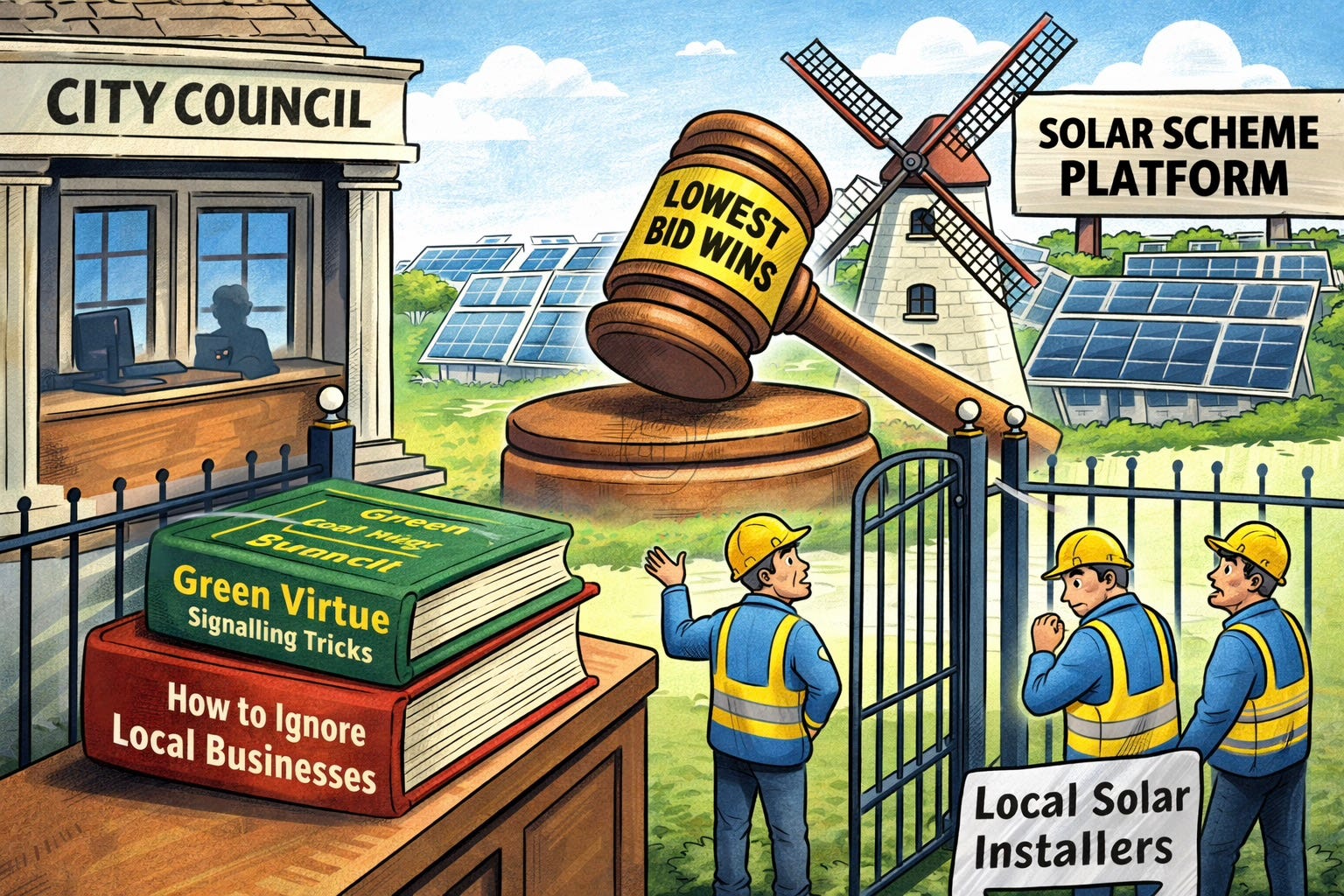
Residents sign up through the platform. Installers then bid in a reverse auction to win the contract for the region. The winning bidder becomes the official contractor for that round of the scheme.
On paper it looks like a bargain hunt.
In reality it is something else entirely: a large-scale procurement exercise where installers compete to offer the lowest price for hundreds, sometimes thousands, of installations.
Supporters say this drives down costs.
Critics say it risks becoming a race to the bottom.
The Question of Local Installers
Birmingham is not exactly short of solar expertise.
Industry directories suggest the city has around thirty locally based solar installation companies, employing several hundred engineers, surveyors and technicians. When the wider West Midlands supply chain is included, the number rises further.
These firms install solar systems house by house, roof by roof. They survey properties, design bespoke layouts and maintain long term relationships with customers.
The Switch Together model, however, takes a different approach.
Instead of dozens of companies competing for individual customers, the scheme funnels participating households towards one contractor selected through a regional auction.
That contractor must then deliver installations across multiple local authorities, often covering an entire region.
It is a structure that inevitably favours firms with scale. Large operators capable of deploying multiple teams across an entire region have an obvious advantage over smaller local businesses.
The question, therefore, becomes an awkward one.
Is Birmingham City Council inadvertently sidelining its own local renewable energy sector?
A Precedent in London
The structure of the scheme has already been tested elsewhere.
In London, a similar programme known as Solar Together generated hundreds of complaints from residents after a contractor failed to deliver installations on time and struggled with communication and accreditation issues.
The London Assembly described the episode as a “customer service car crash.”
Customers reported delays, missed appointments and difficulties obtaining refunds after paying deposits.
Eventually the contractor involved had its accreditation suspended and work was halted.
The incident did not destroy the scheme entirely. But it did raise uncomfortable questions about oversight and accountability when council endorsed programmes rely on external contractors selected through competitive auctions.
Following the Money
Another issue concerns finances.
Residents pay installers directly for the systems they purchase. Installers, however, often pay participation or referral fees to the organising platform.
In some regional consortium schemes, councils also receive administrative or referral payments tied to completed installations.
That raises a straightforward question.
Does Birmingham City Council receive any financial benefit from the scheme it is promoting to residents?
To find out, Midlands GRIT wrote to the cabinet member responsible for the environment, Majid Mahmood, asking for clarification.
The questions were simple.
Does the council receive any financial return from installations arising from the scheme?
Was the partnership formally approved by Cabinet or authorised through delegated powers?
And has the council assessed the impact the scheme might have on Birmingham’s local solar industry?
The Carbon Question
There is another wrinkle in the story.
If the winning contractor for the region turns out not to be a Birmingham company, installation teams may travel significant distances to carry out work across the city.
That may not sound like much, but multiply it by hundreds of installations and the miles begin to add up.
In a city committed to ambitious climate targets, it raises a curious paradox.
A programme designed to reduce carbon emissions might simultaneously increase them through the transport footprint of large external contractors.
Again, Midlands GRIT asked the council whether any such assessment had been made.
The Silence
The deadline for response passed at 5 pm on Tuesday.
No reply arrived.
No clarification on finances.
No explanation of procurement.
No comment on the impact on local installers.
And no answer to the simplest question of all: whether the councillor himself would install solar panels through the scheme he is promoting to Birmingham residents.
Until those questions are answered, residents are being asked to trust a programme whose financial structure, procurement process and economic impact remain largely opaque.
A City Full of Roofs
None of this is an argument against solar power.
Quite the opposite.
Birmingham has thousands of suitable rooftops and a growing renewable sector capable of installing systems across the city.
Solar technology is improving rapidly, costs are falling and battery storage is becoming more practical.
The transition to cleaner energy is both necessary and inevitable.
But the way that transition is organised matters.
When public bodies lend their authority and branding to commercial schemes, transparency becomes essential.
Residents deserve to know how those schemes work, who benefits financially and whether local businesses are being supported or sidelined.
The Envelope Again
For now the envelope remains on the desk.
Plain white. Two words in the window.
“The Occupier.”
Somewhere across Birmingham thousands of households will be weighing the same leaflet and the same promise of cheaper solar power.
They deserve to know exactly how the scheme behind it works.
And who, ultimately, stands to gain.