


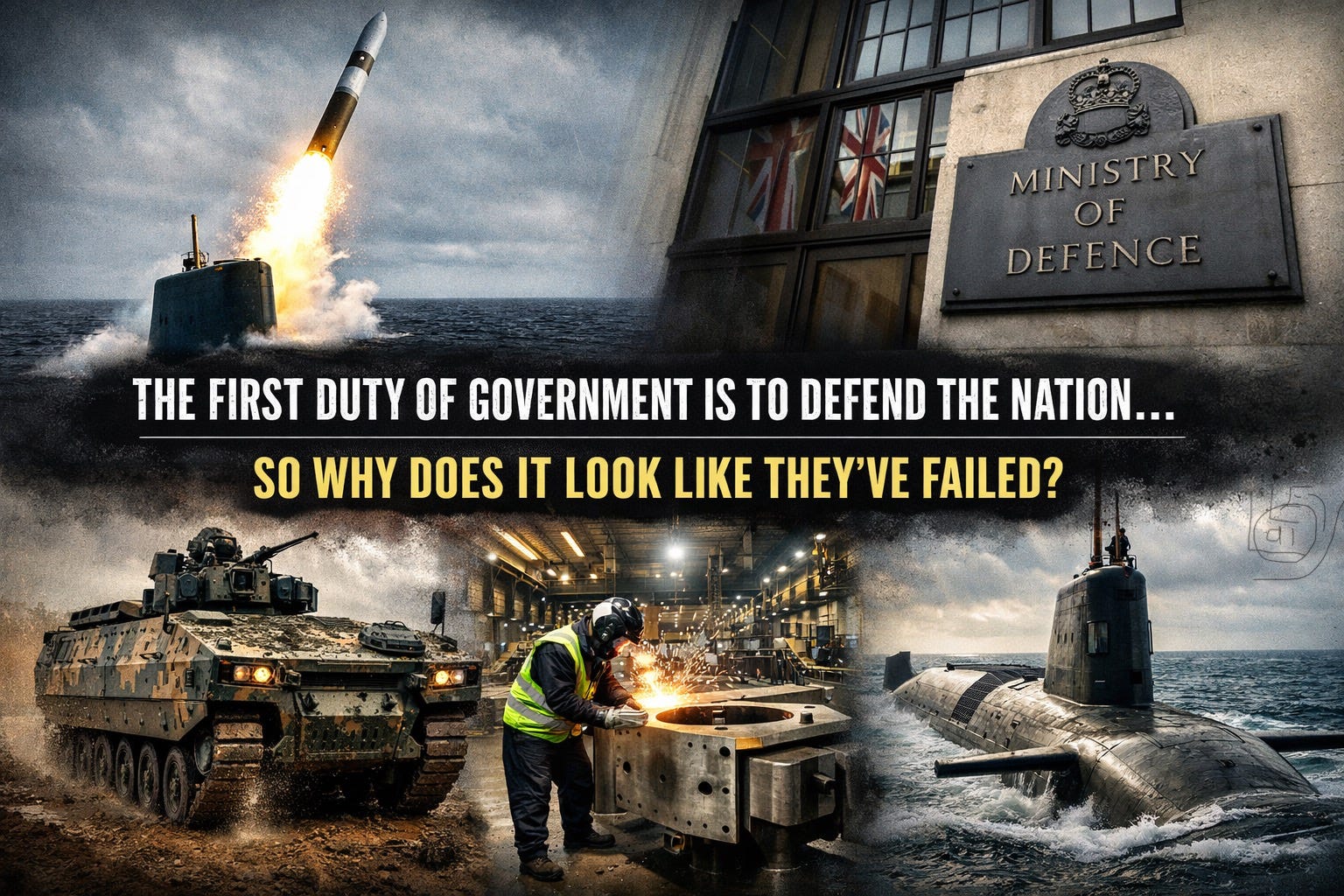
“The first duty of government is to defend the nation.”
So Why Does It Look Like They’ve Failed?
It is one of the oldest principles of the British state. Everything else government does, welfare, growth, public services, rests on that foundation. When defence fails, or worse, when it is mismanaged and quietly explained away, the failure is not technical. It is political.
And today, after years of problems under Conservative governments and now early warning signs under Labour, it is increasingly hard to avoid a blunt conclusion: Britain’s defence governance is failing, and neither main party has yet shown the will to confront that fact honestly.
This matters acutely in the West Midlands. Our people volunteer for frontline military service in disproportionately high numbers. Our economy underpins defence through advanced manufacturing, engineering, and supply chains. When defence fails, we pay twice, in risk and in livelihoods.
Trident: when it happened, and why it mattered
The most visible crack in Britain’s defence credibility came with failed Trident missile test launches.
In 2016, a Trident II D5 missile test launched from HMS Vanguard veered off course shortly after launch and had to be destroyed.
In January 2024, another Trident II D5 test, again from HMS Vanguard, failed shortly after launch and fell into the sea off the coast of Florida.
Two failures, eight years apart, might be dismissed individually. Together, they form a pattern that cannot be ignored.
The response from the Ministry of Defence was carefully scripted. The failures were described as “anomalies”. The deterrent, the public was told, remains “safe and effective”. Details were withheld on national security grounds.
No serious person expects every test to succeed. But when the delivery system for the UK’s nuclear deterrent fails more than once, and when the response is reassurance rather than scrutiny, the issue stops being engineering and becomes institutional.
At that point, the question is unavoidable.
Are these tests about proving capability, or about managing perception?
Measured reporting by Jane’s Defence Weekly has long documented technical risk and programme fragility without political rhetoric. At the other end of the spectrum is Dominic Cummings, the former Downing Street chief adviser under Boris Johnson, who has argued bluntly that the Ministry of Defence is structurally incapable of reform and protected by a culture of evasion.
Cummings is not a defence specialist and is often abrasive. But his relevance lies in this: he has seen the machinery of government from the inside, and his critique is about institutional failure, not ideology.
Different tones. Same concern. Reassurance without accountability.
Trident is not the exception. It is the symptom.
It would be comforting to believe Trident is a one-off embarrassment. It is not.
One of the clearest examples is the Ajax armoured vehicle programme.
Ajax was intended to replace ageing reconnaissance vehicles. Instead, it became notorious for excessive noise and vibration, injuring soldiers, damaging hearing, and rendering vehicles unsafe to operate. Trials were halted. The programme ran years late and billions over budget. Only after sustained pressure did the Ministry of Defence fully acknowledge the scale of the failure.
Ajax was not a battlefield defeat. It was a management failure that persisted because warnings were ignored, risks were downplayed, and accountability was deferred.
From Ajax to aircraft availability, from warship readiness to basic logistics, the pattern repeats. The Ministry of Defence absorbs failure, manages the language, and carries on.
At what point do we stop calling this complexity and start calling it systemic?
Why this matters to the West Midlands
This is not a Westminster parlour game. It lands directly in the West Midlands.
The region supports tens of thousands of defence-related jobs. It contributes several billion pounds a year to defence and defence-adjacent supply chains. It hosts firms embedded in aerospace, vehicle systems, advanced materials, and precision engineering. It supplies disproportionately high numbers of armed forces personnel and reservists.
When defence procurement fails, West Midlands firms lose contracts, skills pipelines weaken, and long-term industrial capacity erodes. When confidence in defence governance collapses, it is our people who carry the risk.
That is why silence matters.
Support for the forces is not scrutiny of the Ministry of Defence
There is a damaging confusion in British politics between supporting the armed forces and holding the Ministry of Defence to account. They are not the same thing.
Supporting service personnel and veterans is easy and universal. Scrutinising procurement, readiness, and institutional competence is harder and politically uncomfortable.
Too often, criticism of the Ministry of Defence is treated as disloyalty to the forces. It is not. It is essential civilian oversight.
How power slipped away: mandarins without masters
This is where the argument must deepen.
The problem is not that senior civil servants somehow seized power. No one gives you power. You take it, or you allow it to be taken.
Over time, politicians have allowed power to drift.
Decades ago, ministers ran departments. Civil servants executed policy, but they did so under clear political authority. When programmes failed, senior officials could be removed. Ministers sometimes resigned. Responsibility was visible.
Today, that chain has snapped.
Defence secretaries rotate rapidly. Junior ministers come and go. Political attention moves on. Senior officials remain. Failure becomes survivable. Language replaces consequence.
This did not happen because mandarins are uniquely malign. It happened because politicians stopped using the power they already had.
The result is a system where failure is managed, not punished, candour is risky, and accountability is optional.
The mandarins did not overthrow ministers. Ministers stepped back.
Suited mediocrity: a political failure
It is tempting to blame the civil service alone. That is a mistake.
The real suited mediocrity sits in politics.
Ministers who do not stay long enough to own outcomes. Leaders who fear confrontation with their own departments. Parties that talk reform but practise avoidance.
This is political abdication, not bureaucratic conspiracy.
Who still challenges this?
There are exceptions.
Lord Spellar, formerly Labour MP for Warley, has consistently pressed defence procurement and delivery issues in Parliament and the House of Lords.
Khalid Mahmood served for over two decades in the Commons, representing Birmingham Perry Barr and later Birmingham Selly Oak. He was never a headline critic, but he used parliamentary questions and his brief shadow defence role to probe procurement and equipment issues on the record.
They understood a basic principle: loyalty to the country sometimes requires discomfort for the department.
The military MP paradox in Selly Oak
Birmingham Selly Oak is now represented by Al Carns, a former Royal Marines officer with a distinguished service record.
He does represent a Birmingham constituency, but he is not Birmingham-rooted. He was selected as a high-profile candidate to bring military credibility to Labour’s defence offer. That is not, in itself, a bad thing.
But it does raise a legitimate question, particularly for a region with real skin in the game.
Is military credibility being used to strengthen scrutiny of the Ministry of Defence, or to soften it?
So far, the emphasis has been on support, symbolism, and alignment with official messaging. What has been largely absent is sustained public challenge to defence governance itself.
Military experience should sharpen accountability, not blunt it.
When do we say “no more”?
How many missile failures, procurement disasters, and quietly shelved programmes does it take before Parliament stops accepting “lessons learned” and starts demanding consequences?
The Conservatives talked about reform and failed to deliver it. Labour talks about competence and stability. But competence without control is managed decline.
Until politicians take back the authority they have surrendered, the pattern will continue.
The first duty, revisited
The first duty of government is to defend the nation.
That duty is not discharged by press releases, uniforms, or managed language. It is discharged by competent institutions, honest leadership, and real accountability when things go wrong.
If missile systems fail and Parliament barely flinches, the problem is not technical. It is political.
Power was not stolen.
It was allowed to drift.
And until someone decides to take it back, Britain’s defence failures will continue to be explained away rather than confronted.