
The Girl from Druids Heath
She became a mother at sixteen, survived domestic abuse and now leads Birmingham Labour. I expected a council row. I found the person behind the politics.

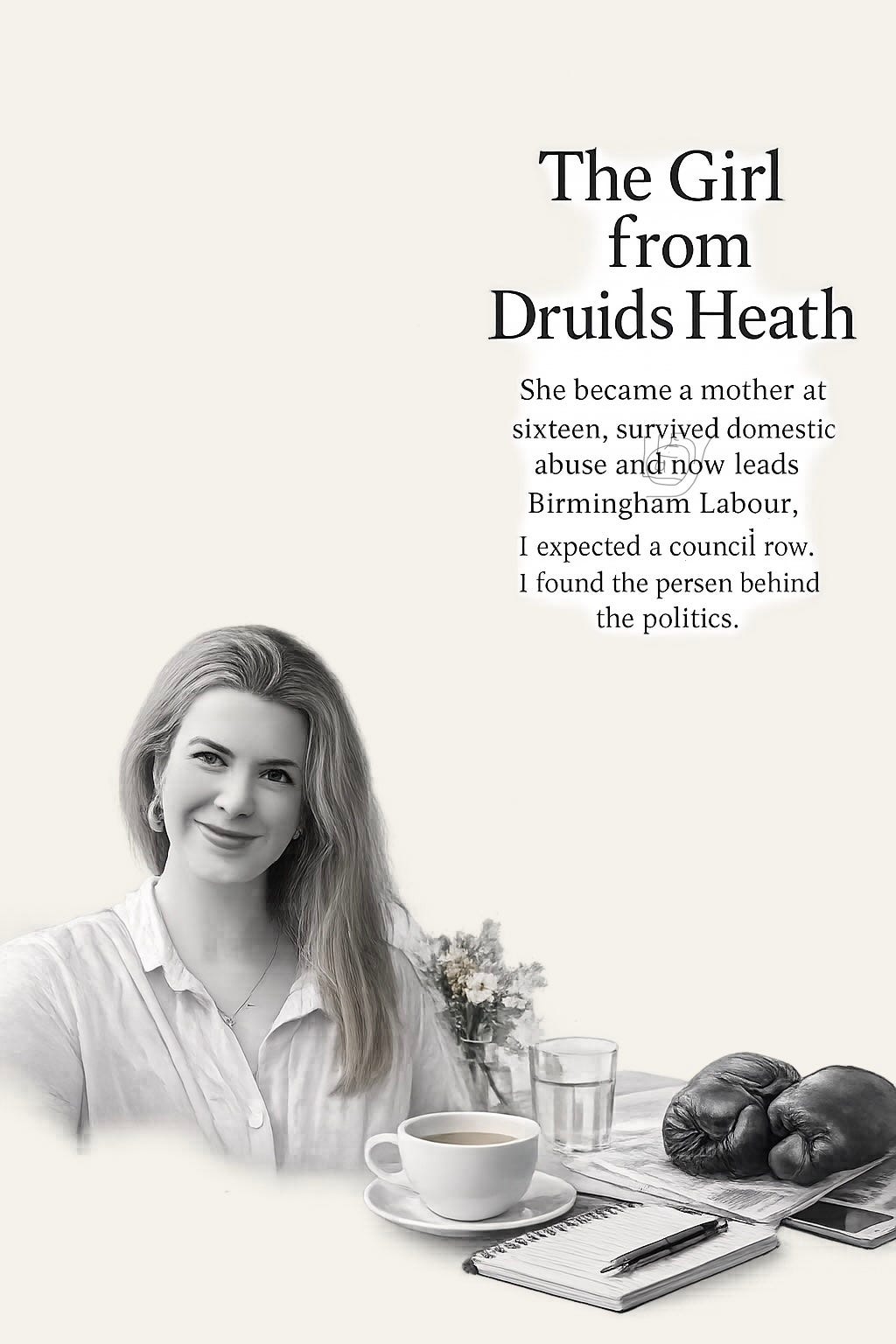
Nicky Brennan has become Leader of Birmingham Labour at the worst possible moment, or perhaps the most revealing one. Labour has lost control of the council, Birmingham remains under commissioners, and one of her first controversies has already involved Reform UK, scrutiny committee chairs and a row inside her own Bournville Labour Branch.
Yet when I met her, the most interesting story was not the political row. It was the life that brought her to this point.
We met in one of Birmingham’s busy city centre coffee bars. She arrived a few minutes late, having innocently found the wrong branch first, and apologised warmly. While I settled for coffee, Brennan chose a can of Sanpellegrino Limonata. Mrs Olley would have approved immediately. In our house, that is never a bad way to begin a conversation.
The relaxed atmosphere continued throughout our meeting. Brennan laughs easily and answers questions directly. She does not appear to spend precious seconds searching for the safest political answer. Instead, she dives straight into the heart of the question before beginning to build her reply. There was no sense of someone hiding behind carefully rehearsed lines. Whether readers ultimately agree with her politics or not, she gave the impression of someone comfortable defending her beliefs.
Long before she became Leader of Birmingham Labour, however, she was simply a sixteen-year-old girl from Druids Heath whose life took a path few would have chosen.
Becoming a mother so young brought responsibility, pressure and, inevitably, judgement from others. Yet rather than allowing circumstance to define her future, Brennan threw herself into education. During her pregnancy she studied relentlessly, leaving school with an impressive collection of qualifications. Looking back, she speaks without bitterness or self-pity. Instead, there is a quiet determination that seems to have remained with her throughout her life.
Raised in a Labour family on Druids Heath, politics was never entirely absent from home. Yet listening to Brennan, it became clear that party loyalty alone was not what anchored her to Labour. As a young mother and survivor of domestic abuse, she found practical support through public services that expanded during the governments of Tony Blair and Gordon Brown. One observation stayed with me throughout our conversation. She told me she did not fully appreciate what those years had provided for her and her child until much of it began to disappear. She mentioned Sure Start in particular. It was only when services were taken away that she realised how profoundly they had helped her build a future for herself and her family.
It is difficult not to conclude that those experiences still shape her politics today.
As Brennan spoke about domestic abuse, I found myself thinking less as a journalist and more as a husband, a father and a former second row forward who spent years in rugby scrums and, in younger days, boxing rings. I have never struggled to understand physical strength. Quite the opposite. What I have never understood is how any man can use that strength against a woman.
To me, strength carries responsibility. It exists to protect those who are vulnerable, not to exploit them. There is nothing masculine about intimidating someone physically weaker. There is nothing courageous about it either. Real strength is measured by self-control, restraint and respect.
Perhaps that is why Brennan’s story resonated so strongly. Listening to her describe domestic abuse, I found myself thinking of my own father and grandfather, both of whom carried invisible wounds from their wartime experiences. The causes were entirely different, but the lasting effects shared familiar characteristics. Trauma has many origins, but it often leaves remarkably similar footprints.
Domestic abuse is not simply a criminal offence. It is an assault on confidence, dignity and hope. Those wounds can take years to heal, and sometimes never fully do. It also explained something else. Brennan’s determination to stand alongside women living through those experiences is not rooted in political fashion. It comes from having walked part of that road herself.
Our conversation eventually turned towards electoral politics. Brennan had represented Sparkhill before deciding to seek selection for Bournville and Cotteridge, the community where she lives. When the previous councillor stood down, she saw an opportunity to become the local representative for her own neighbourhood, believing that living among those you represent brings its own advantages in understanding constituents and family life.
It was, however, something of a political gamble. Sparkhill remained comfortably Labour after her departure. Bournville and Cotteridge was anything but comfortable. Brennan scraped home by just three votes. Had two people made different decisions that Thursday, Birmingham Labour might have been looking for an entirely different leader. Politics, like life, often turns on remarkably small margins.
That narrow victory was quickly followed by another important moment. After Labour lost control of Birmingham City Council, Brennan emerged as the only candidate put forward through the Labour Party’s selection process for group leader. She was interviewed through the party’s national procedures before her name went to the Labour Group itself, which then voted to endorse her leadership.
Interestingly, Brennan is also clear that she would like to see Labour members themselves playing a stronger role in choosing candidates in future. She accepts the process that brought her into leadership but believes members should have a meaningful voice in selecting those who represent them. At a time when candidate selection is becoming an increasingly lively debate within Labour nationally, that is an interesting position to take.
Leading Birmingham Labour today bears little resemblance to leading it only a few months ago. The party has moved from administration into opposition. Brennan spoke about the challenge of rebuilding confidence, retaining experienced councillors and restoring trust, both inside the Labour Party and among Birmingham voters. Her approach appears straightforward. Support the administration when it gets things right. Hold it firmly to account when it gets things wrong. Opposition, she argues, should not simply become opposition for opposition’s sake.
That philosophy was quickly tested.
One of Brennan’s first political controversies centred on Birmingham City Council’s scrutiny committee chairs. Following the council’s Annual General Meeting, Labour faced criticism from some members and political opponents over proposals that would have seen scrutiny responsibilities shared across opposition parties, including Reform UK. The criticism became sufficiently strong that Brennan’s own Bournville Labour Branch later passed a motion expressing concern about what it described as political accommodation with Reform UK.
Brennan rejects that characterisation entirely.
Her argument is not that Labour should work politically with Reform. Quite the opposite. She insists Labour will continue to challenge Reform wherever it believes Reform is wrong. The issue, she says, was never about supporting Reform policies. It was about ensuring that scrutiny reflected the breadth of opposition voices rather than allowing every scrutiny chair to fall into the hands of a single opposition party.
The eventual arrangement saw the scrutiny chairs go to Conservative councillors with the support of the Liberal Democrats, Greens and Independent councillors. Brennan believes that outcome weakened the principle of broad, independent scrutiny. Others clearly take a different view. Readers will reach their own conclusions.
Away from the politics, another impression lingered.
Nicky Brennan is unmistakably a working-class Brummie. She is approachable, thoughtful and considerate. She has an engaging habit of getting straight to the point rather than circling around it, even when the questions become uncomfortable. Yet it would be a serious mistake to confuse warmth with weakness.
Life has already tested her long before politics ever did. She has known responsibility at an age when many teenagers are still discovering themselves. She has experienced domestic abuse. She has rebuilt her life. She has dedicated much of her career to helping others facing similar circumstances.
Remarkably, none of that appears to have made her cynical. She still speaks about Birmingham with optimism rather than resignation. She still believes politics can improve lives because, in her own case, she believes it once did.
My own impression is simple. Do not mistake kindness for softness. Behind the relaxed conversation, the easy smile and the can of Sanpellegrino Limonata sits someone with a remarkably strong core. Those who mistake courtesy for weakness, or imagine they can take unfair advantage of her, may eventually discover there is considerably more steel than first meets the eye.
When I arrived, I thought I was meeting the Leader of Birmingham Labour. As I walked away, I realised I had spent rather more time meeting the girl from Druids Heath.
Whether Nicky Brennan succeeds in rebuilding Birmingham Labour will be decided by voters and by events still to come. That is politics. The journey that brought her here, however, deserves to be understood in its own right. In the end, perhaps every political story begins there, not with the chamber, the vote or the row of the week, but with the life that made the person who walks into the room.
What an engaging piece Mike ! I feel like I know her and admire and respect her grit ! Look out Birmingham !!