


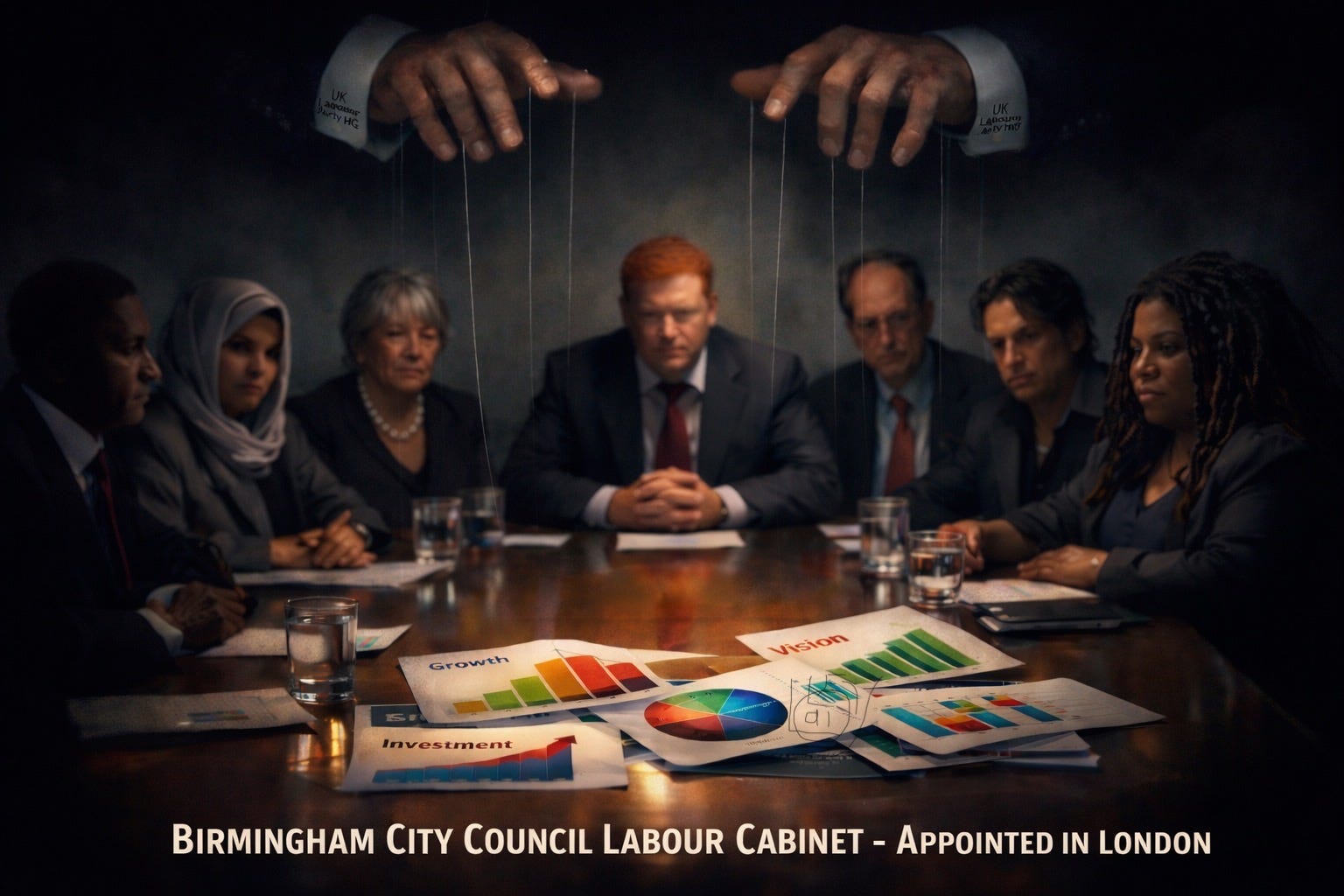
This Boxing Day I write this as a Labour man, not as a critic looking in from the outside, but as someone who has lived this movement from the inside. I have worked alongside Labour councillors, as a Labour councillor myself, officers, as an officer myself, activists, as an activist myself, and organisers for years. I know the hours they put in. I know the pressure they are under. I know most of them care deeply.
Which is precisely why the publication of the English Indices of Deprivation, IoD, 2025 should have landed like a thunderclap.
This was not a think-tank report. Not a newspaper exposé. Not an opposition attack. It was the UK Labour government, through the Department for Levelling Up, Housing and Communities, marking Birmingham’s homework.
And the verdict was grim.
Birmingham remains one of the most deprived local authorities in England. Second nationally by the proportion of neighbourhoods in the worst ten per cent. First for income deprivation. Persistently poor outcomes across employment, health, education, and opportunity.
These are not arguable facts. They are the UK state’s own measurements of how people’s lives are actually going.
If this were a school report, it would not be dressed up with talk of potential. It would trigger intervention.
Yet Birmingham’s leadership response has largely been to carry on regardless, talking up investment summits, growth plans, and future opportunity. That sort of language has its place, but when it is not anchored to present reality, it starts to look like painting the front door while the roof is falling in.
Residents, voters, Birmingham folk are not stupid. They know the difference.
Reform’s Open Goal
This is political open territory. Manor for heaven.
Reform UK do not need a detailed policy platform in Birmingham. They barely need a leaflet. All they need to do is stand in ward after ward and point to the UK government’s own figures and verdict on Birmingham’s Labour councillors.
Labour runs the council. Labour is in government nationally. And yet whole communities remain stuck in entrenched deprivation.
That argument will land, not because Reform have good answers, but because Labour is failing to confront the scale of the problem honestly.
This is not about ideology. It is about lived experience.
Respect Must Flow Outward
I want to be absolutely clear. Councillors and officers deserve respect and dignity. The job, for most, is brutal. Resources are stretched. Criticism is relentless.
But respect is not a one-way flow upwards through the system.
When leadership continues to big up selective positives while official data confirms that large parts of the city are among the worst off in England, it begins to feel as though constituents are being managed, not served.
That is not Labour.
Labour does not exist to curate optimism. It exists to change lives.
The Bin Bags and the Balance Sheet
Let us bring this down from abstraction.
Take the bin strike. Whatever the rights and wrongs of the industrial dispute, the optics were, and remain, devastating. Piles of rubbish in inner-city neighbourhoods, many of them already among the most deprived in the country, became a national symbol of a council struggling to cope.
Now place that image alongside the IoD 2025 data, which tells us those same areas are already suffering high income and employment deprivation.
You cannot preach opportunity while basic services fail visibly. The contradiction is fatal.
The Alcoholic Moment
There is an old truth about recovery. An alcoholic can only begin to recover once they admit they are an alcoholic.
Denial is not optimism. It is avoidance.
The Indices of Deprivation 2025 are Birmingham’s admission moment. They confirm, officially and beyond dispute, that the strategies of recent years have not delivered for the people Labour exists to serve.
Not because councillors are lazy. Not because officers do not care. But because outcomes are what they are, and at some point outcomes become the only honest judge.
So the real question is not who to blame. It is what happens next.
Who Actually Runs Birmingham Labour
This is where we need to stop pretending.
In my day, Labour trusted its party members. Members selected candidates. Councillors elected their leader. It was messy, but it was democratic, and it rooted accountability outward, towards the electorate.
That is no longer how Birmingham Labour operates.
Today, the national party does not fully trust Birmingham to manage its own affairs. Leadership is managed. Selections are shaped. Oversight is heavy.
At the centre of that system sits the regional director.
Sam Donoghue.
Let us be fair. Sam is not a rogue figure. He operates under instruction from the national party. He does not freelance policy. But the regional director role carries enormous influence, and everyone inside the Labour movement knows it.
That post played a decisive role in removing Sir Albert Bore some years back as Birmingham council leader, when the national party concluded Birmingham Labour had failed. Whatever views people take of Sir Albert, that moment established a precedent. When Birmingham Labour is judged to be underperforming, the centre intervenes.
Since then, many of the current councillors have been selected through this managed system. The current council leader emerged from it too. No one voted for John Cotton to be leader of the council. The Labour Party’s management system appointed him. The days when councillors freely chose their own leader are gone.
So here is the unavoidable truth.
If the national party and its regional machinery have shaped who governs Birmingham, then they own the outcomes as well as the process.
You cannot centralise control and decentralise blame.
Erdington: A Canary in the Mine
Nowhere is this more dangerous than in areas like Erdington.
Erdington is not just another constituency. It is one of Birmingham’s bellwethers. A working-class seat with deep pockets of deprivation, long Labour loyalty, and growing frustration.
The IoD data places large parts of Erdington firmly in the worst national deciles. Income deprivation. Employment challenges. Health outcomes. All the ingredients of political volatility.
Live in Erdington and the chances are your life will be harder and you will die earlier. It is stark. It is disturbing. It is ugly. And according to the Labour government’s own data, it is true.
As a result of these hard truths, and numerous other considerations, there is a real risk that Labour could lose most of its councillors in Erdington to Reform in the 2026 local elections.
If that happens, it will not just be a local embarrassment. It will place the parliamentary seat itself under acute pressure.
Paulette Hamilton MP knows this. Labour knows this. The party machine knows this.
Yet instead of urgency, what Erdington residents are offered is glossy messaging and abstract talk of future growth.
That is not good enough.
If Erdington goes, it will not be because Reform inspired people. It will be because Labour stopped listening.
Enough Bigging Up. Where Is the Action?
This is the point where loyalty demands honesty.
Those who stand to lose their positions, their influence, and yes, their comfortable numbers, need to stop pretending this can be managed with presentation.
The IoD report is not a communications problem. It is a governance problem.
What is needed now is not another summit or slogan, but action that residents can feel.
That means:
• Publishing a clear response to the IoD report, ward by ward and constituency by constituency.
• Naming Erdington and other high-risk areas explicitly, not burying them in averages.
• Setting hard targets on income, employment, and health outcomes, with timelines.
• Redirecting resources towards the worst-off areas, even if that upsets comfortable arrangements elsewhere.
• Making it clear who is accountable if those targets are missed.
And yes, it means the national party and the regional director stepping in again if local leadership cannot bring itself to confront reality.
Not to punish. Not to humiliate. But to reset.
The Choice
Labour in Birmingham has a choice.
It can continue to talk up the future and hope loyalty holds.
Or it can treat the Indices of Deprivation 2025 as the moment of truth they are, admit that things have gone wrong, and act decisively.
If it does not, voters will do the assessment instead.
And Reform will be waiting.
As a Labour man, that prospect fills me with sadness.
But sadness is not the enemy.
Denial is.
I truly hope your Christmas was a marvellous memory. Just a thought: if Labour in Birmingham do not change their ways, the electorate will change them, are there only 132 days left for Labour in Brum?
A very Happy New Year ❤️