

The Green and the Great Sentencing Confidence Trick
Andy Burnham was right to pause early prisoner releases. Now he should end the dishonest sentencing system that tells the public one thing while quietly doing another.

Imagine climbing into bed tonight and taking a long look at the person beside you. Husband, wife, partner, duvet thief. Sleep well, because when people are murdered the person responsible is often not a tattooed stranger behind a bus stop but somebody they know. We talk about “killers” as though they are identical. They are not. During my legal training I knew of a woman who waited for her husband to return from the pub and stabbed him as he entered their home. She did not go to prison. He habitually came home, beat her and raped her. The law recognised the difference. Taking a life cannot be reduced to one word and one moral category.
Which brings me, by a route only a Brummie could regard as direct, to Andy Burnham. The Prime Minister has paused plans due to begin in September that could have allowed thousands of prisoners out earlier than the public expected. The row erupted when it emerged that Albert Bowers and Jessie Cole, each serving thirteen years for the manslaughter of PC Andrew Harper, might benefit. Harper, a 28-year-old Thames Valley officer, was dragged to his death behind a getaway car after responding to a quad-bike theft. His widow called the prospect deplorable. Burnham stopped, listened and ordered an urgent review. Good. Politicians tell us they are listening while continuing in the same direction. Pressing pause was not weakness. It was sensible.
Here in Birmingham, prison is not an abstract Whitehall concept. We have The Green, as Brummies know HMP Birmingham. When inspectors arrived in October 2025 it held 976 men, only 21 below its reduced capacity. Around 5,000 passed through its gates in a year and 222 were released each month. Most were on remand, unsentenced or recalled. The Green is New Street Station with higher walls and worse coffee. Yet inspectors found nineteen prisoners had been released after their lawful date. Ministers were preparing to let some people out too early while Birmingham managed to keep others too long. If British justice entered the Olympics, it would finish fourth in a three-horse race.
The national prison population stood at 87,342 on 31 March 2026, including 16,025 on remand. Those are not decorative figures. They mean crowded cells, exhausted officers, delayed transfers and neighbourhoods receiving people back without proper preparation. In Birmingham, every release eventually becomes somebody’s neighbour, passenger, employee or the chap behind you in Aldi with frozen chips. The object is not to lock every offender away forever. It is to punish properly, protect the public and reduce the chance of another victim.
I could begin solving much of this overnight with a thing governments treat as faintly obscene: money. Whenever anybody suggests spending on justice, somebody cries “waste”. Waste? Do me a favour. Look in your kitchen bin at the food you bought and never ate. Open your wardrobe and count the shirts, frocks, jackets and shoes unseen since Theresa May was prime minister. Humans waste money. Governments do too, often after commissioning a report explaining why they need another report. The question is whether spending properly on justice costs less than overcrowding, reoffending, emergency releases, ruined lives and victims carrying the consequences long after the Treasury congratulates itself on a saving.
We need a quality prison estate, courts capable of trying cases promptly, properly funded probation, addiction treatment, education, useful work and experienced prison officers paid enough to stay. We treated experienced officers and their knowledge as expensive inconveniences. Then we wondered why prisons became harder to control and replacing experience proved more difficult than replacing a light bulb. Money alone will not reform every offender, and cells are no substitute for preventing crime. But neither can we empty prisons to disguise the fact that we refused to provide enough space and staff. Early release is not weather drifting in from Wales. It is a political decision produced by earlier political decisions.
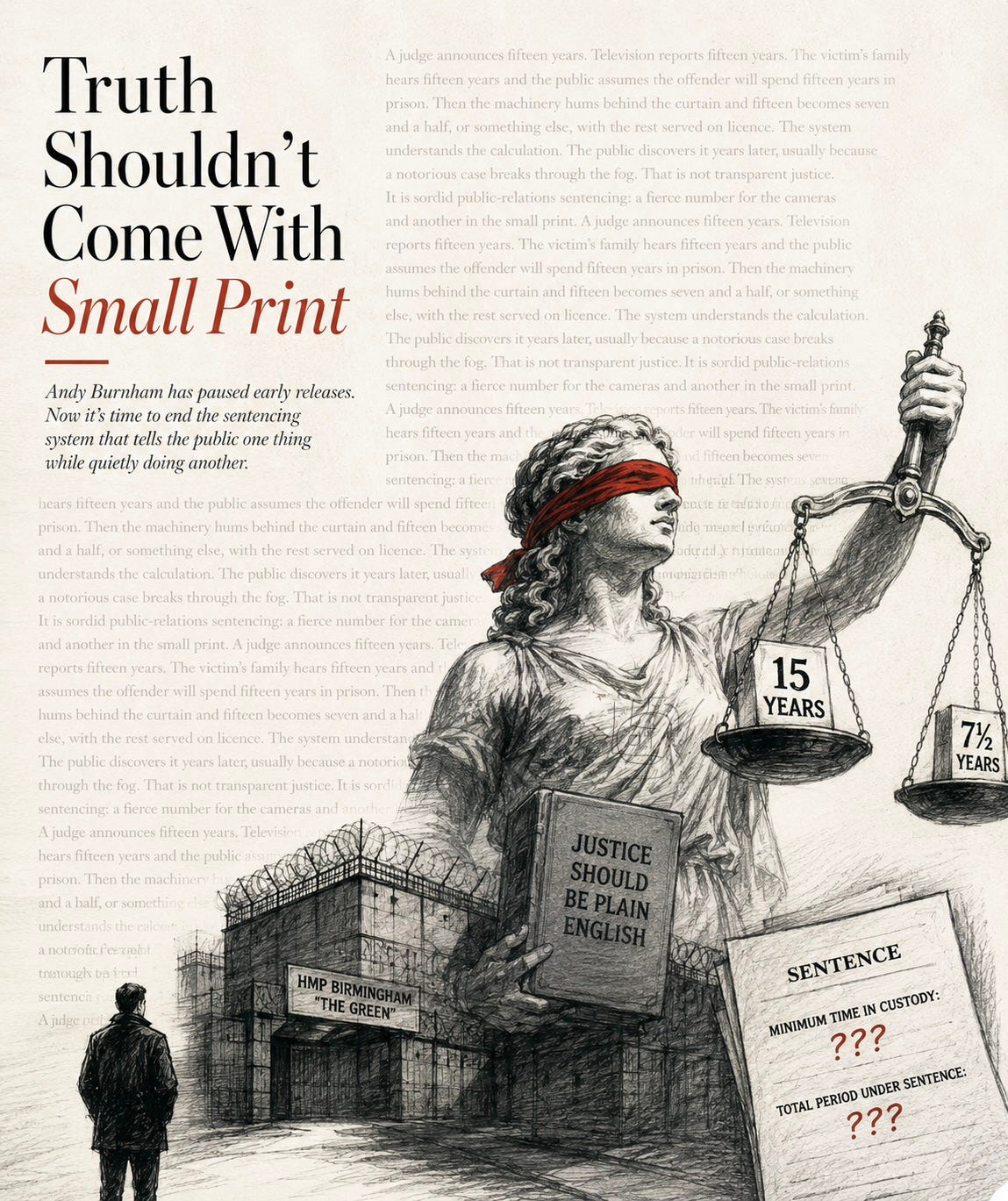
What angers people most is the twisted language of sentencing. A judge announces fifteen years. Television reports fifteen years. The victim’s family hears fifteen years and the public assumes the offender will spend fifteen years in prison. Then the machinery hums behind the curtain and fifteen becomes seven and a half, or something else, with the rest served on licence. The system understands the calculation. The public discovers it years later, usually because a notorious case breaks through the fog. That is not transparent justice. It is sordid public-relations sentencing: a fierce number for the cameras and another in the small print.
We Brummies are straightforward. Tell us five years and we assume five years. Tell us fifteen and we assume fifteen. I want courts to sentence as the public reasonably understands sentencing, while recognising that not all crimes, killers or circumstances are alike. Announce plainly the minimum time to be served in custody and the total period under sentence. Put both figures in the judge’s remarks and every report. Let victims know the tariff. Let offenders know it. Let government know exactly what it is doing in our name. No hidden arithmetic, no ministerial conjuring trick and no justice carrying an asterisk saying terms and conditions apply.
Andy Burnham was right to pause September’s releases. Now I hope he goes further and stops the confidence trick that made them possible. If honest sentencing requires more prison places, build them. If it requires more well-paid officers, recruit them. Justice is expensive, but injustice sends a larger bill to victims, families, police and communities. I do not want cop killers serving a few years because Whitehall failed to provide enough cells. Nor do I want every person who causes a death treated as morally identical. I want judgment, punishment, rehabilitation and plain English. Burnham has pressed pause. He should now press reset, because justice does not become cheaper when government shortens the sentence. It merely sends the bill somewhere else.