

The Honeymoon Is Over. Welcome to Birmingham’s Question Time.
Manifestos are easy. Supplementary questions are much harder. Birmingham’s new councillors have discovered that the honeymoon ends the moment Full Council begins.

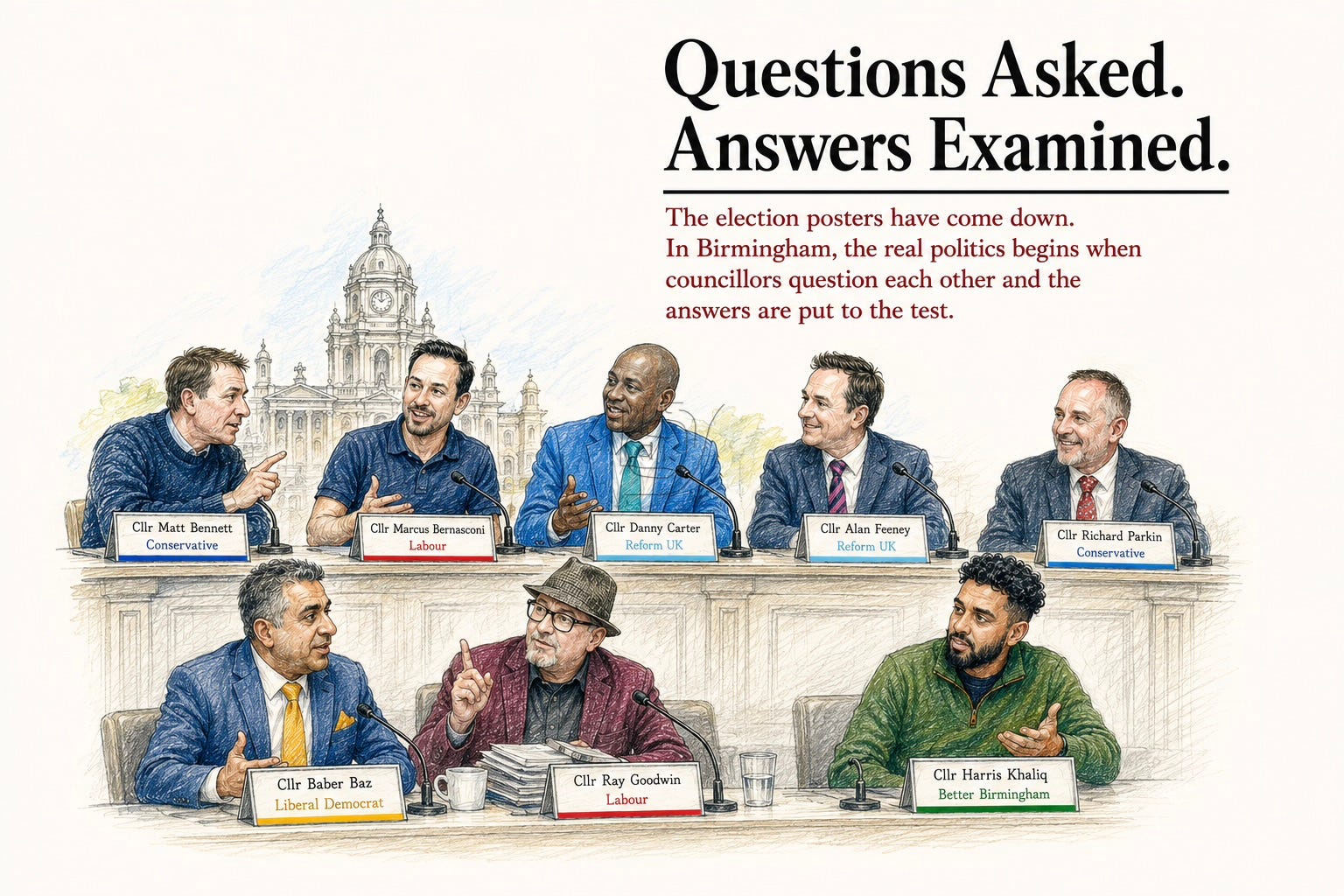
Politicians are at their most impressive immediately after an election. Every problem has a solution, every promise is deliverable and optimism fills the air. Then comes the first proper Full Council meeting. Sixty-four days after Birmingham’s political earthquake, the honeymoon is over. The speeches have finished. The supplementary questions have begun.
Watching Full Council is rather like watching an open-book examination. Cabinet members arrive armed with substantial briefing folders prepared by officers, anticipating almost every conceivable question and providing carefully crafted answers. There is absolutely nothing wrong with that. It is how modern local government works. The difficulty comes when councillors ask supplementary questions that weren’t on page seventeen. That is when the interesting politics begins, and Tuesday’s meeting produced several moments that showed Birmingham’s new administration is beginning to discover the difference between campaigning and governing.
The first smile of the afternoon belonged to Labour Councillor Marcus Bernasconi, who had clearly been doing a little homework before turning his attention to Reform UK Councillor Danny Carter, Chair of the Pype Hayes Ward Forum. Bernasconi had noticed that Councillor Carter’s website appeared to claim he had carried out 340 ward surgeries in just 64 days. By my arithmetic, that works out at more than five every single day. Even the NHS might struggle to maintain that pace. How, he asked, did Councillor Carter ever find time to sleep? To his credit, Carter took the question exactly as it was intended. The figures, he explained with a smile, were simply dummy text on a website still under construction and would shortly disappear. It was an honest answer, the chamber enjoyed the exchange and everyone moved on. It was also a useful reminder that in politics your own website can sometimes become a more effective opposition than the people sitting across the chamber.
Next came Reform UK Councillor Alan Feeney, who asked what sounded like one of the simplest questions of the afternoon. Addressing Conservative Councillor Richard Frederick Jex Parkin, chairman of one of Birmingham’s scrutiny committees, he asked him to identify one measurable improvement his committee’s work would achieve. A perfectly fair question, you might think. The answer, however, took a different route. Rather than identifying a measurable outcome, Councillor Parkin used the opportunity to criticise Reform, pointing to Sandwell where scrutiny arrangements have been delayed until September and suggesting Reform lacked developed policies. Readers can decide for themselves whether that answered the original question. It did make me wonder, though, whether politics is entering a curious new age. For years parties have been criticised for making promises they later struggle to keep. Perhaps the winning strategy is to promise less in the first place. Cynical? Possibly. But modern voters are not renowned for believing every manifesto that lands on the doormat.
Then it was the turn of Labour Councillor Ray Goodwin, who caused a small moment of confusion before he had even spoken. Regular followers of Birmingham politics will know Ray is almost inseparable from his trademark hat. On Tuesday, however, the hat had apparently taken the afternoon off. Fortunately, his supplementary questions had not. Goodwin challenged Liberal Democrat Cabinet Member for Housing and Homelessness, Councillor Baber Baz, over the administration’s ambition to improve housing standards two years ahead of previous targets. Councillor Baz replied confidently that the administration was on course and that further updates would follow. Given that the administration has occupied the benches for barely two months, it was certainly an ambitious statement. Goodwin’s supplementary gently pulled him back to the original question. Was the target genuinely being brought forward by two years? The second answer was noticeably more cautious. Councillor Baz argued that the administration was still clearing up problems inherited from Labour and was determined to improve matters as quickly as possible. It was a textbook example of how supplementary questions often reveal considerably more than the original answer.
The liveliest exchange of the afternoon belonged to Conservative Councillor Matt Bennett, questioning Better Birmingham Cabinet Member for City Operations and Digital, Councillor Harris Khaliq, on Birmingham’s continuing bin dispute. Bennett momentarily stumbled over Councillor Khaliq’s surname before announcing, with impeccable comic timing, that he would simply call him “Councillor Bin Face.” The chamber laughed. Councillor Khaliq laughed too. Then the mood changed. Bennett’s question concerned the Government-appointed commissioners and the questions they had raised about the dispute. What progress had been made in responding to them? Councillor Khaliq replied that negotiations were continuing and that providing a running commentary risked undermining discussions with the workforce. Bennett’s supplementary neatly exposed the distinction. He wasn’t asking for a running commentary. He was asking whether the commissioners’ requests had actually been complied with. “It’s a bit rubbish, isn’t it?” he observed, producing probably the biggest laugh of the afternoon without anyone being entirely sure whether it had been deliberate. He then asked the more serious question. Did Councillor Khaliq know who was actually in charge of bringing the dispute to an end and, more importantly, when would that happen? Councillor Khaliq maintained his good humour, repeated his commitment to finding a resolution acceptable to all concerned and promised to write to Councillor Bennett with a fuller response.
If there was one lesson from Tuesday afternoon, it was that Birmingham’s politics has settled into its new shape remarkably quickly. Labour is scrutinising. Conservatives are scrutinising. Reform is scrutinising. Cabinet members are finding that carefully prepared briefing notes only take you so far before a well-aimed supplementary question requires you to think on your feet. That is no criticism. It is exactly how local democracy is supposed to work.
There was humour. There was the occasional political jab. There were answers that wandered gently around the question before eventually arriving somewhere in the same postcode. Above all, there was scrutiny. Real scrutiny.
Sixty-four days ago Birmingham elected a very different council.
On Tuesday, it finally started behaving like one.
Two councillors become one? 'Next came Reform UK Councillor Alan Feeney, who asked what sounded like one of the simplest questions of the afternoon. Addressing Conservative Councillor Richard Frederick Jex Parkin, chairman of one of Birmingham’s scrutiny committees.