

If the honours system genuinely reflected modern Britain, Birmingham and the West Midlands would be all over it. Not occasionally. Not politely. But loudly, awkwardly, and unmistakably.
Instead, year after year, the region appears only in carefully curated form. Worthy. Safe. Sanitised. Stripped of the very cultural energy that has made Birmingham one of the most influential cities in Britain over the last fifty years.
That tells us everything we need to know.
Because honours are not neutral. They are signals. They tell us what counts, who matters, and which forms of contribution are considered legitimate. And at present, those signals are badly distorted.
Honours Reward Legibility, Not Impact
The modern honours system does not reward impact in the broad sense. It rewards recognised impact.
To receive an honour, your contribution must be legible to committees. It must be documented, vouched for, written up in the right language and endorsed by people who already sit inside institutional networks. It must sound reassuring when read aloud by an official.
This immediately filters out much of Birmingham’s real contribution.
Birmingham’s influence has rarely come from tidy institutions. It has come from culture. Music. Sport. Comedy. Night-time economies. Informal leadership. Scenes rather than structures. Movements rather than committees.
That kind of contribution does not translate well into nomination forms.
Culture the System Cannot Read
Take music alone.
Birmingham helped invent heavy metal, reggae fusion, two-tone, jungle, bhangra crossover and whole strands of British electronic music. These were not polite innovations. They were noisy, disruptive, working-class and often uncomfortable. They shaped global culture.
And yet the honours system struggles with figures who emerge from that world unless they later become institutionally acceptable.
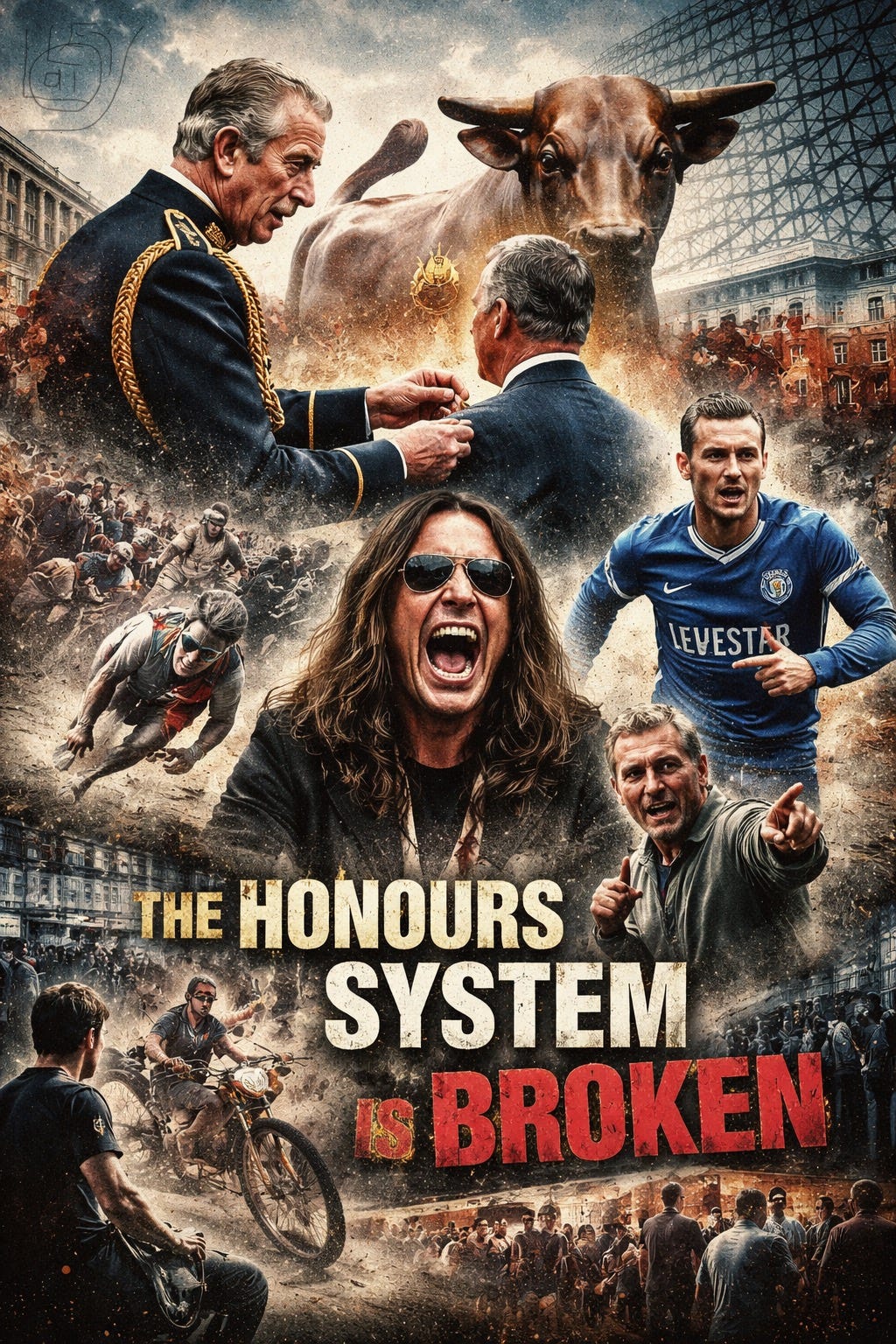
Ozzy Osbourne remains the most obvious example. The most famous Brummie on the planet. A man whose influence on global music is beyond dispute. He helped create a genre that still fills stadiums and shapes identity worldwide.
Love him or loathe him, his cultural impact dwarfs that of most people who have ever received an honour.
And yet the system never quite knew what to do with him.
Why. Because he did not fit the mould. Because he was chaotic. Because he embarrassed polite sensibilities. Because he did not flatter the establishment. Because his contribution could not be framed as service in the approved sense.
This is not about whether Ozzy deserved a knighthood. It is about what his marginalisation reveals.
The honours system does not understand culture when it arrives from the outside.
Sport, Class and the Blind Spot
The same pattern becomes even clearer when you look at sport.
Ask a simple question. Which greyhound trainer has ever received an honour. Which speedway grandee. Which rider, promoter or mechanic who built those sports in working-class towns and cities across Britain.
The answer, in practice, is almost none.
Greyhound racing and speedway were once mass spectator sports. They filled stadiums, sustained local economies and gave working-class communities identity, pride and escape. They were not niche. They were central. Yet they remain almost entirely invisible to the honours system.
That is not because they lacked impact. It is because they lacked respectability.
These sports were noisy, smoky, working-class and culturally unfashionable. They did not sit comfortably with the tastes of those who decide what counts as contribution. So they were quietly written out of the national story.
Football suffered the same fate for decades. For much of the twentieth century, footballers were seen as entertainers at best and vulgar at worst. Honours were rare and grudging. It is only in relatively recent years that football has been partially admitted into the honours ecosystem, and even then the bias remains.
Brian Clough eventually forced his way through that barrier. He was simply too successful, too original and too influential to ignore. Even so, he spent much of his career openly needling the establishment that honoured him, exposing its snobbery and hypocrisy with relish.
The fact that Clough is remembered as an exception rather than the rule tells you everything.
Today, the pattern persists.
Take someone like Jamie Vardy. A global football story. Non-league to Premier League champion. A figure who shattered assumptions about class, talent and progression. Hugely influential culturally, not just on the pitch.
And yet figures like this still sit awkwardly with the honours system. Their stories do not originate in the right places. Their accents are wrong. Their paths are untidy. Their success feels accidental rather than managed.
The system prefers football once it has been smoothed, managerialised or repurposed as ambassadorial. Raw working-class success still makes it uneasy.
Diversity That Never Discomforts
Every year we are told the honours list is diverse. And in a narrow sense, it often is.
Different sectors. Different professions. Carefully balanced representation.
But what is missing is diversity of class, of dissent, of cultural energy and of disruption. Diversity that never discomforts power is not diversity. It is branding.
The system is comfortable honouring those who improve the system from within. It is deeply uncomfortable honouring those who expose its limits, its hypocrisies or its failures.
As a result, Birmingham appears in honours lists as a place of worthy initiatives, not as the cultural engine it actually is.
Reconstruction, Not Abolition
This is not an argument for scrapping honours. It is an argument for rebuilding them.
A reformed system would do four things differently.
First, it would explicitly recognise cultural impact, not just service.
Second, it would actively seek out contribution that sits outside formal institutions.
Third, it would diversify nominators, not just nominees.
Fourth, it would accept that some honourees will be uncomfortable. That is not failure. That is honesty.
A Final Irony
The honours system was meant to bind the nation together. To recognise contribution wherever it arose.
Today, it increasingly does the opposite. It tells regions like Birmingham and the wider West Midlands that their real contribution is welcome only once it has been tidied up, approved and made palatable.
That is not how you build cohesion. That is how you breed cynicism.
Birmingham does not lack remarkable people. The West Midlands does not lack cultural power.
What it lacks is an honours system brave enough to recognise them as they actually are.
Until that changes, the honours list will remain what it has quietly become. Not a celebration of the nation, but a mirror held up by the establishment to itself.
And the reflection grows less convincing every year.
As Jasper Carrott comments - there goes my knighthood....!!!