

The Man Who Refuses to Stay in His Lane
John Hemming’s latest experiment is not really only about pills. It is about prevention, evidence and whether Britain has become too cautious to test better ways to stay well.

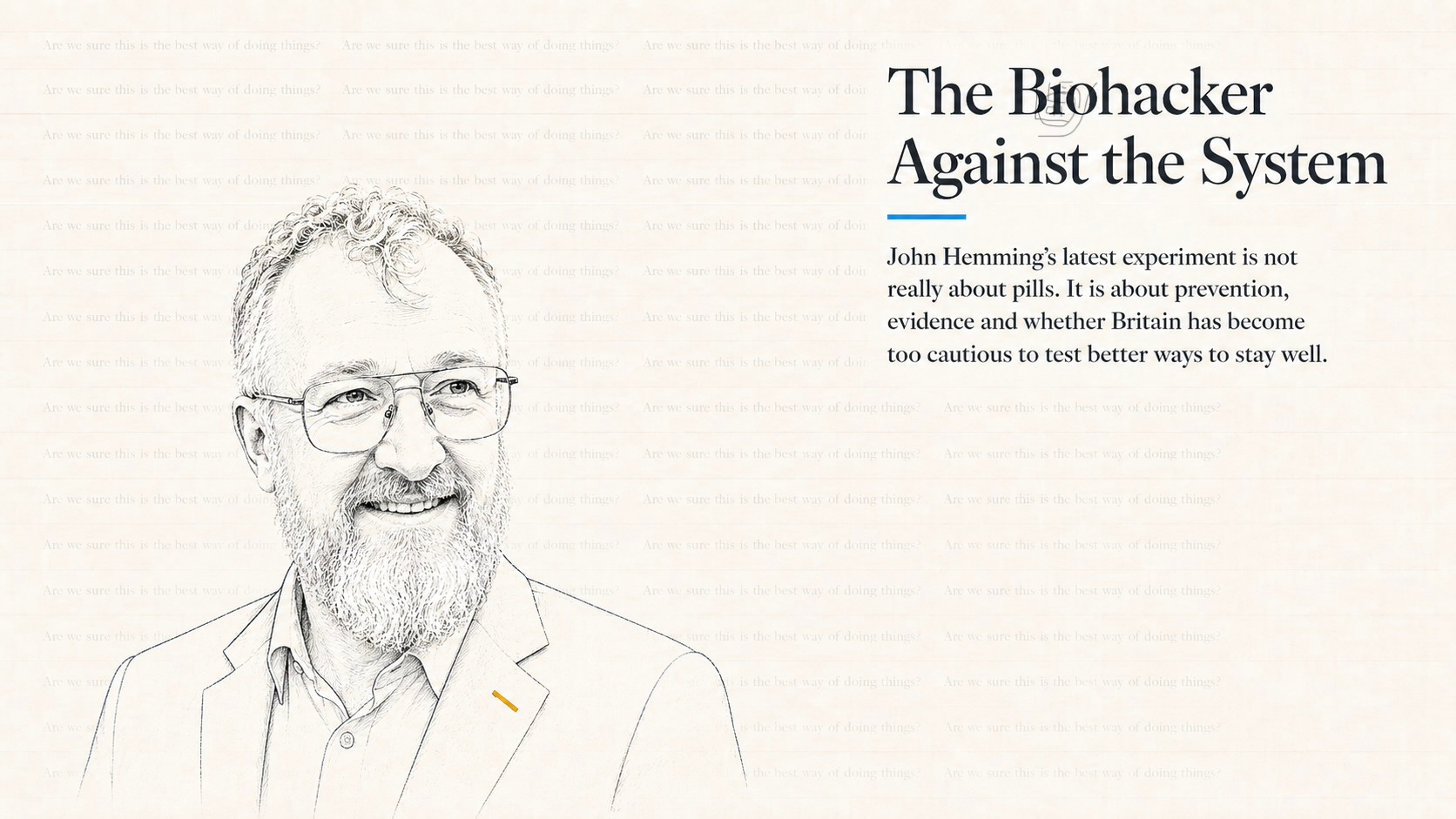
Former MP John Hemming has spent a lifetime challenging accepted wisdom. Today his latest obsession is biohacking, but the real story is not vitamins or longevity. It is curiosity, regulation and whether Britain has become too cautious to explore better ways of staying healthy.
John Hemming has never been especially good at staying in his lane. I first met him more than thirty years ago when we both sat on Birmingham City Council: John a Liberal Democrat, me Labour. Yet politics was never the most interesting thing about him. Even then there was something unusual about the way his mind worked. Most politicians arrived armed with opinions and left with more of them. John arrived carrying questions. He had an irritating habit of examining accepted wisdom as though it were merely a working hypothesis waiting to be tested. Three decades later, very little appears to have changed.
By a disgustingly youthful age, Hemming had achieved serious financial success. Long before Westminster as the MP for Birmingham Yardley beckoned, he had built a software company whose systems processed a significant proportion of Britain’s equity trades. This was not luck followed by a comfortable retirement. It was evidence of an analytical mind drawn towards complicated systems and making them work better. John had already shown he could solve problems other people had not even noticed. Successful entrepreneurs often find the broken pipe before the rest of us realise the carpet is wet. The successful pioneers get the land. The unsuccessful ones, regrettably, tend to get shot. As a Member of Parliament many shot at him of course but none caused any damage.
Birmingham City Council became John’s next laboratory: another complex system full of moving parts, competing interests and occasionally baffling logic. We disagreed often, as Labour and Liberal Democrat councillors generally did, but there was something refreshing about debating someone who wanted to understand why a system behaved as it did before proposing how it might behave differently. John was less interested in performing certainty than in understanding mechanisms. In 2005 he captured Birmingham Yardley, as its Member of Parliament, and held it for a decade, surviving when many thought he would not.
The interesting thing about John is that politics never seemed to define him. It was simply another chapter. Some former MPs retire into consultancy, after-dinner speaking or the gentle art of explaining why history would have been kinder had only people listened to them. John wandered off elsewhere. Along the way there was music. He still performs with John Hemming and the Jazz Lobbyists, proving that retirement appears to happen to other people. Increasingly, however, his attention turned towards perhaps the most ambitious system: the body.
Mention biohacking and many people picture Californian billionaires living inside oxygen chambers while swallowing supplements whose names resemble encrypted passwords. John Hemming would probably smile at that image. His own approach is more scientific and more ordinary. It begins with diet. It means taking exercise seriously. It means maintaining muscle rather than accepting decline as inevitable. It also means a carefully considered programme of nutritional supplements and food additives, chosen because he believes there is a scientific rationale for trying them. His regime is detailed, disciplined and constantly reviewed.
When I first knew John, he was, let us say, rather more generously proportioned than he is today. Now, in his mid-sixties, he looks leaner, fitter and healthier than he did as a councillor. That alone proves nothing scientifically, and John would be the first to insist that anecdotes are not evidence. His evidence, he would argue, lies elsewhere: years of blood tests, health monitoring and the painstaking measurement of biomarkers covering liver function, kidney function, cardiovascular health, metabolic indicators and more. He is not asking people simply to believe his approach works. He is asking them to look at the data. That is the thread running through his life: measure what matters, understand how the system works, then see if it can be improved.
That is where our conversation became interesting, because it stopped being simply about John Hemming and became a discussion about Britain itself. John is not really interested in selling supplements. He is interested in asking why Britain has become so much better at treating illness than preventing it. His argument is not that modern medicine has failed. Medicines, diagnostics, surgery and emergency care have transformed human life. His question is whether our institutions devote enough intellectual energy to understanding how people might remain healthier for longer, rather than concentrating almost exclusively on what happens after health has already begun to fail.
That distinction matters because it explains why John increasingly finds himself talking not only about biology but about regulation. Britain has built a regulatory culture that performs an essential service by protecting people from dangerous products and misleading claims. John does not challenge that objective. His concern is whether systems designed to prevent bad ideas sometimes become reluctant even to examine unconventional ones. By his account, his attempts to engage regulators over nutrition, food supplements and health claims have been met not with a serious scientific argument, but with a process almost designed to avoid one. Forms, thresholds, categories and official responses become the argument before the evidence itself has properly entered the room. His frustration is not simply that officials disagreed with him. Disagreement is part of science. His complaint is that meaningful discussion never really began.
Earlier this year Hemming returned to Westminster, not as the Member of Parliament for Birmingham Yardley, but as an innovator invited to present evidence before the House of Commons Science, Innovation and Technology Committee’s Innovation Showcase. Parliament was not endorsing his conclusions. It was recognising that the questions he was asking deserved examination. Biohacking has moved beyond internet forums and into mainstream discussion about health, ageing and innovation.
One of the more entertaining moments in our conversation came when John mentioned snake oil. Today the phrase is shorthand for fraud and false hope, though the original Chinese snake oil appears to have contained compounds with genuine anti-inflammatory properties. Dismissing every unconventional idea because some are fraudulent is no more scientific than believing every extravagant promise because it sounds exciting. The challenge, as ever, is evidence.
Artificial intelligence also entered the discussion. John sees enormous potential for AI to help absorb scientific literature and identify patterns, while recognising its current habit of sounding extraordinarily confident while being entirely mistaken, which, in fairness, means it already possesses several qualities required for public life.
Looking back over more than thirty years, it struck me that John Hemming has never really changed careers. He has simply kept applying the same curious mind to different systems: financial markets, local government, Parliament, music and now biology. Different puzzles. Same man. Most people collect careers. John Hemming appears to collect problems. He has spent his life asking the same question in different places: are we sure this is the best way of doing things?
Whether he is ultimately proved right about every aspect of biohacking almost misses the point. Every generation needs people prepared to ask awkward questions. Sometimes they are wrong. Occasionally they are gloriously right. More often they simply force the rest of us to think harder than we otherwise would have done. Britain has never suffered from having too many curious minds. It has sometimes suffered from listening to them too late. John Hemming has found a new establishment to challenge. If history is any guide, he will not stop asking awkward questions any time soon. Perhaps, every now and then, that is exactly what progress requires.