

The Mixed Grill Massacre: Whitbread Calls Last Orders Across the Midlands
Beefeater is closing all 106 restaurants. The real loss is not fine dining but the ordinary Midlands places where families met, staff worked and life happened.

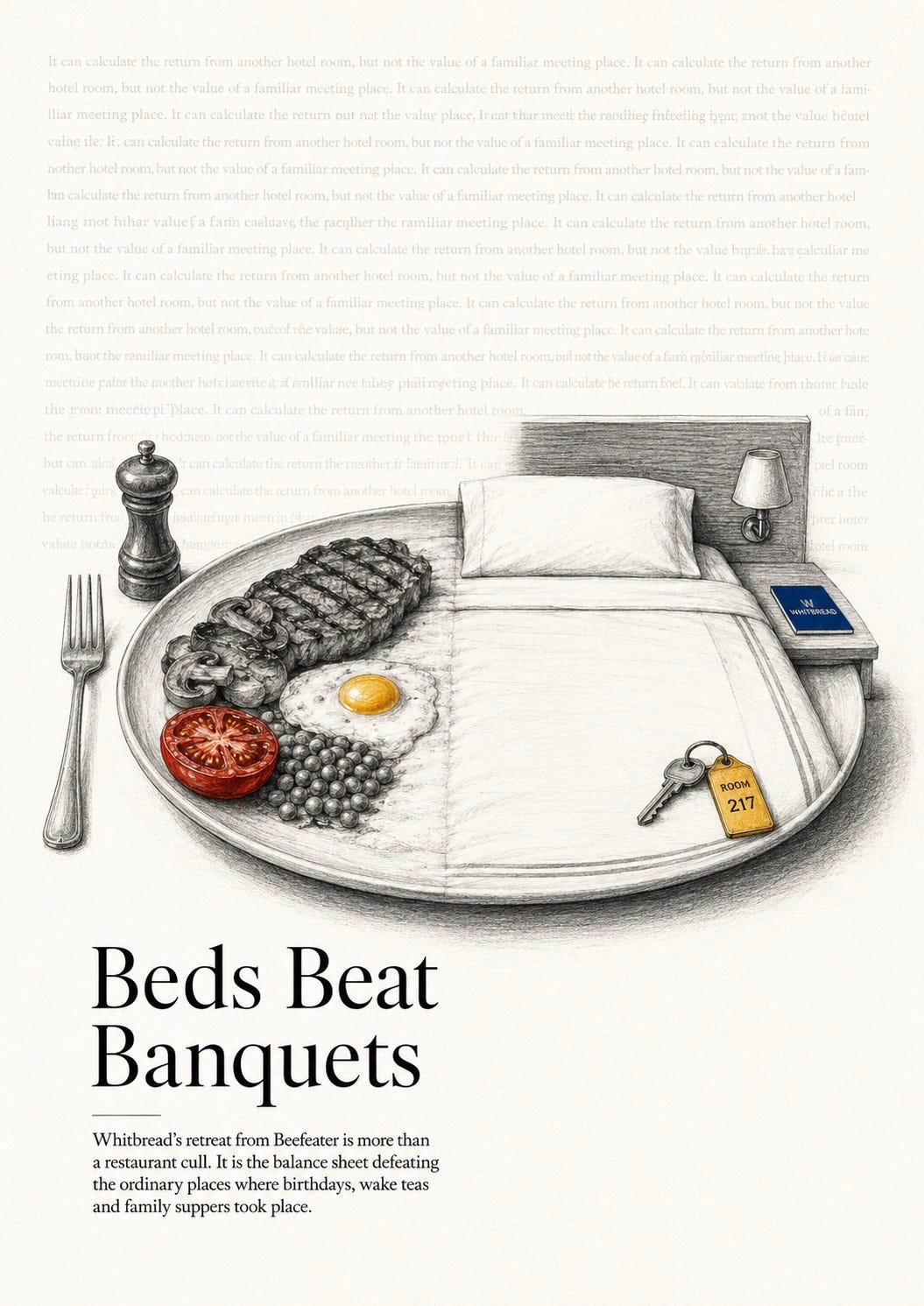
STEAK OUT! The onion rings have exhausted the appeals process, the mixed grill is on death row and even the little grilled tomato, which never did anybody much harm, is going down with the rest. Every remaining Beefeater is due to close by 10 September 2026, while the Rewards Club shuts on 31 August. A customer may reasonably conclude that loyalty is a dish best served quickly.
The Midlands casualties include Birmingham South at Longbridge, Bentley Green in Walsall, George in the Tree at Balsall Common, Redditch and Moseley Park, which despite its name is at Wolverhampton Business Park. They are still serving as I write, but each now carries a corporate expiry date. Staff must continue smiling, cooking and asking whether we would like to see the dessert menu while knowing that the business has already decided there will shortly be no menu, no dessert and, for many of them, no job.
Let us not turn Beefeater into something it was not. This was not the Savoy Grill with a larger car park. Nobody booked Bentley Green six months in advance because the chef had discovered a daring new relationship between the steak and the peas. Some restaurants looked tired, the quality could vary and a few of those now mourning the chain may eventually admit that their last visit was during Theresa May’s premiership. A restaurant cannot live on nostalgia alone. Even the mixed grill requires somebody to turn up and pay for it.
What Beefeater did offer was somewhere almost everybody could use. Grandparents, children, vegetarians, awkward in laws and the person paying the bill could generally sit at the same table without anyone needing to understand a dining concept. The food arrived on plates rather than roof tiles. The potato did not come with a biography. There was parking, space, a children’s menu and no expectation that dinner should become a piece of performance art before being photographed and allowed to go cold.
That dependable ordinariness matters because ordinary places carry an extraordinary amount of life. They host birthdays, retirement meals, family reunions, first dates, charity nights and the tea after funerals. They give teenagers first jobs and older customers somewhere familiar and accessible. A function room may look unimpressive on an investor’s slide, but to the people using it, that room can contain one of the most important days of their lives. Civic life is not made only in council chambers, theatres and grand hotels. Much of it happens around tables beside a large car park.
The geography matters too. Longbridge, Walsall, Balsall Common, Redditch and Wolverhampton Business Park are not all waiting for a television chef to arrive with exposed ductwork and a menu printed on reclaimed wallpaper. These restaurants serve people living between town centres, families travelling from different directions, workers finishing shifts and older customers who do not regard circling Birmingham for an hour in search of parking as part of the dining experience.
Longbridge gives the story a particular edge. The loss of a Beefeater is plainly not comparable with the collapse of the great car works, and nobody should pretend it is. We still make cars here, bloody good ones too. But Longbridge understands what happens when a decision made elsewhere arrives locally wearing the language of transformation. Headquarters produces the strategy. The locality receives the lost jobs, altered routines and another familiar sign being taken down.
Whitbread is not merely pruning a few weak restaurants. It intends to leave all its remaining branded restaurant businesses and concentrate on becoming what it calls a pure hotel company focused on Premier Inn. Some restaurant buildings are expected to be sold as going concerns, while other space will be converted into about 600 additional hotel rooms or smaller food and drink operations serving hotel guests. Whitbread estimates that the changes will reduce its British and Irish workforce by about 3,800 roles.
There is nothing inherently wicked about concentrating on what a business does best. Whitbread is entitled to make money. Labour, food, energy, tax and property costs have risen, and no company can preserve half empty dining rooms as museums of the prawn cocktail and Black Forest gâteau era. Some sites may find decent new hospitality operators. Some conversions may create worthwhile hotel jobs. The case is not that every Beefeater should be listed by Historic England and the unlimited breakfast placed under glass.
Whitbread also says it hopes to redeploy many of those affected. That is welcome, but redeployment is reassuring only when attached to a real job that a real person can actually take. A vacancy elsewhere in a company of this size may be useless to a Walsall cook whose hours, pay or journey no longer work. Until Whitbread explains what is available at each Midlands site, redeployment remains a corporate intention rather than a saved livelihood.
The deeper issue is that a balance sheet measures some forms of value extremely well and others hardly at all. It can calculate the return from another hotel room, but not the value of a familiar meeting place. It can record payroll savings, but not the confidence given by a first job. It can price the building, but not the memories accumulated inside it.
This will not be MidlandsGRIT’s last visit to Whitbread. We will return to The Plough at Monkspath, once associated with the great Berni Inn age and woven through my own family history. We will revisit Ipanema on Broad Street, housed in the former BRMB Radio Bar, where I knew the staff, loved the place and once arranged for a racist and his friends to continue their evening somewhere else.
We will also examine Whitbread’s extraordinary collection of lost, sold or abandoned hospitality brands, its property ambitions, the local councillors who may not regard financial return as the only value worth defending, and the activist investors now demanding that the company itself should be sold. Somewhere along the way we will ask whether Whitbread is becoming hospitality’s answer to Rank. The Rank family name once stretched across Hovis flour on one side and Odeon, Pinewood and the man striking the gong on the other. The surviving quoted Rank business is now principally casinos, bingo and online gambling. A company can become simpler, leaner and still profitable while becoming much less important.
For now, the final mixed grill is approaching. Whitbread calls it transformation. Across the Midlands, staff and customers may call it something rather less polished.
Even the little tomato has something to worry about.