

The Officer Party Is Running Birmingham, And You Can’t Vote It Out
Millions spent, strikes dragging on, and the real decision-makers remain unelected.

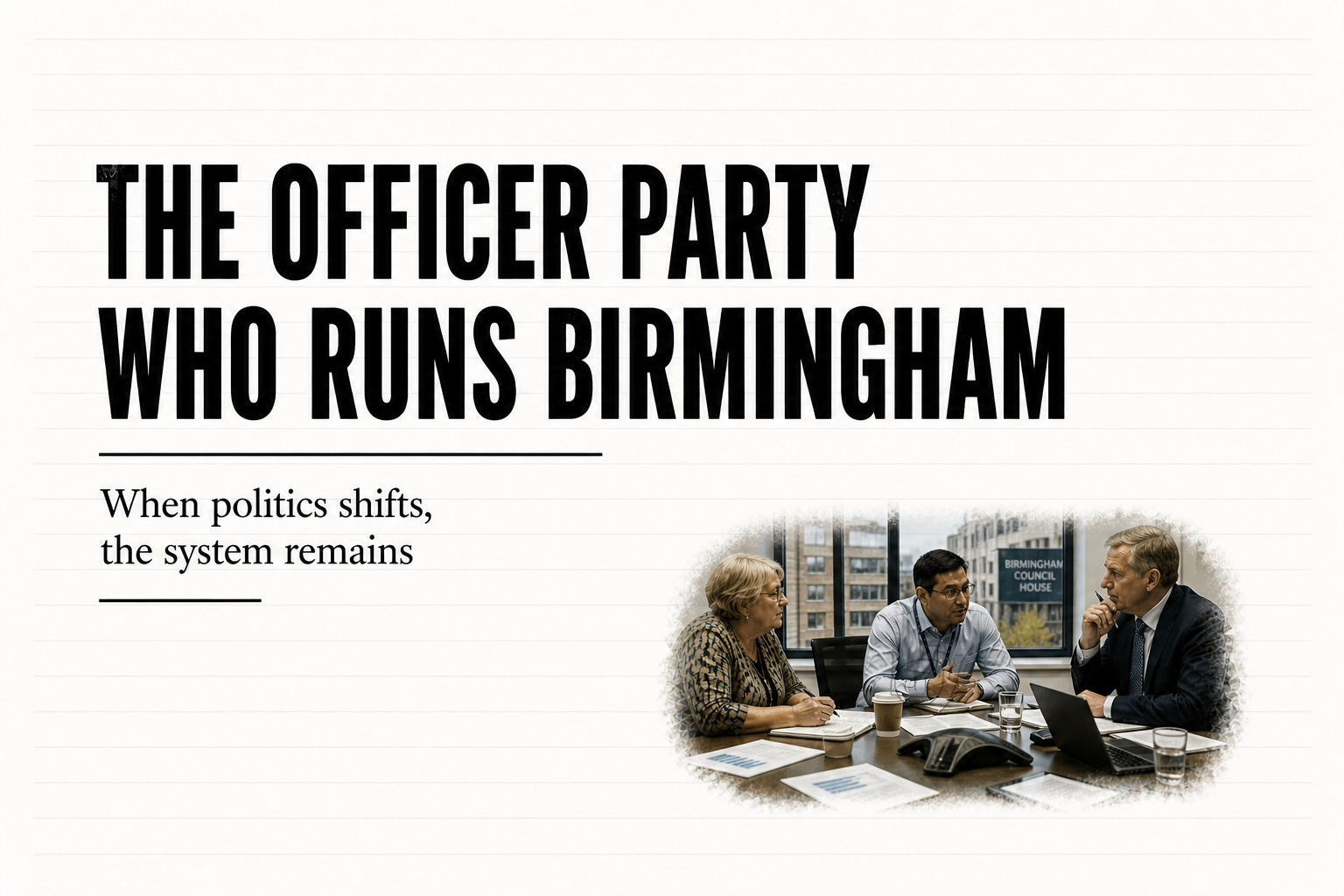
The Party You Can’t Vote For
There is a political party running Birmingham, and it does not appear on any ballot paper this Thursday. It does not campaign, knock on doors, or publish a manifesto, and yet it governs. You can call it what you like, the officer class, the system, the commissioners, but it behaves like a political force, and so it is best understood as one. The officer party.
When Richard Parker speaks, it is worth listening carefully. This is not a councillor chasing attention or positioning for a future role. Parker is an accomplished businessman, a former partner at PricewaterhouseCoopers, and the directly elected Mayor of the West Midlands, carrying arguably the second largest personal democratic mandate in the country outside the Prime Minister. He understands institutions, accountability, and how systems behave when they are working properly and when they are not. So when he says that “very important people” inside Birmingham City Council have not put in enough effort to resolve the bin strike, that eight or nine months passed without meaningful engagement with Unite, and that the process has been undermined by a lack of scrutiny and transparency, that is not casual criticism. It is a deliberate breach of the usual code of silence that protects institutional machinery from public challenge.
To understand why that matters, you have to go back, not to this strike, but to the last one. Around nine years ago, when John Clancy was leading the council, Birmingham faced a similarly bitter dispute with its bin workforce. Clancy’s account, given consistently and in detail, is that a deal had effectively been reached with Unite, a route to settlement that could have brought the dispute to an end. What followed was not implementation, but resistance. The council did not act on the agreement, and Unite took the extraordinary step of going to the High Court, not to create a deal, but to enforce one that had already been struck. The court granted an interim injunction preventing redundancies, forcing the council to pause its course. That sequence matters because it is not conjecture. A deal existed, it was not implemented internally, the union went to court, and the court intervened. Within that sequence sat a deeper dispute about authority itself. Clancy, as the elected leader, believed he had the power to settle. The system behaved as if he did not. That is not simply an industrial disagreement, it is a constitutional one, and Clancy’s conclusion, then and now, is that the approach shifted away from settlement and towards confrontation. Whether one adopts that conclusion in full is less important than recognising what actually happened. He lost that argument, and shortly afterwards, he lost his position.
Fast forward to today, and the names have changed, but the structure looks uncomfortably familiar. Another bin strike, another prolonged dispute, another period in which little appears to happen until political figures intervene, and once again the suggestion, never quite stated openly, that resolution is not the system’s natural resting state. Because if settlement were the priority, it would not take months without engagement, it would not require intervention from outside the machinery to restart talks, and it would not produce the kind of public criticism that Parker has now made. At some point, the question shifts from whether this is failure to whether it is a form of management, a way of controlling outcomes through delay, process, and pressure.
This is where John Cotton becomes central, not as an individual, but as an example of how the system stabilises itself. Parker challenged the machinery directly, raising concerns about effort, scrutiny, and transparency. Cotton responded by thanking the Mayor for his constructive role while simultaneously defending officers as navigating a complex situation. On the surface, that looks like balance. In reality, it functions as alignment. The critique is acknowledged but not pursued, the structure is reassured, and the system continues intact. That is not confrontation, it is containment, and it is precisely how institutional power sustains itself when challenged from within the political sphere.
The deeper issue sits beneath both strikes and both moments. The officer class does not operate in isolation. It increasingly overlaps with a professionalised layer of Labour Party officials, advisers, and career operators whose paths move between party structures, local government, combined authorities, and consultancy roles linked to the public sector. The boundaries have become porous. Careers are built not through a single track, but through movement within an ecosystem, and that ecosystem rewards alignment, stability, and continuity. Disruption is not incentivised. Exposure is not rewarded. The result is not a conspiracy, but a convergence. The party and the administrative system begin to operate in concert, sharing priorities, assumptions, and, crucially, a mutual interest in preserving the structures that sustain them.
The cost of this is not abstract. The bin strike has cost millions, and those are not the system’s millions, they are the city’s millions, public money, taxpayer money, money that reflects disrupted services, reputational damage, operational inefficiencies, and prolonged instability. Yet the structures making and managing these decisions do not face direct electoral consequence. They do not stand for election, they do not face removal at the ballot box, and their exposure to failure is indirect at best. Careers continue, roles evolve, positions shift, and the system absorbs the impact. The cost sits with the public, while the incentives remain elsewhere.
On Thursday, voters will go to the polls and make their choices. They will select councillors, weigh parties, and decide, in good faith, who they believe should represent them. What they will not be voting for is the system that will ultimately shape how those decisions are implemented. They will not be voting for the officer class, the commissioners, or the network that sits between political authority and administrative execution. And yet those forces will remain in place regardless of the result. That is the democratic gap, not the absence of elections, but the dilution of their effect.
So there is a question that should be asked, before the election and after it, and asked repeatedly. Will those who are elected govern, or will they adapt to the system they enter? Will they represent the interests of the electorate, or accommodate the structures already in place? Because that is where the real divide now sits, not between parties, but between authority and deference.
The officer party cannot be removed through the ballot box, but it is not beyond challenge. Its strength lies in opacity, in complexity, and in the quiet assumption that this is simply how things work. That assumption is its shield. The more it is questioned, the more it is exposed, the more it is brought into the light, the harder it becomes to sustain. Systems that operate comfortably in shadow rarely perform as well under scrutiny, and scrutiny remains one of the few tools still available to the public.
What Richard Parker has done, whether intentionally or not, is point directly at that reality. He has identified a lack of effort, a lack of scrutiny, and a lack of urgency within a system that is supposed to serve the public. John Clancy, years earlier, described a similar tension from inside that system. Different moments, different voices, but the same fault line. The question is no longer whether it exists, but whether it will be confronted.
Because the officer party will not appear on any ballot paper this week. But it will still be there the morning after, shaping outcomes, controlling pace, and influencing decisions. And the only way it is ever weakened is not through rhetoric, but through sustained exposure, through elected representatives willing to assert authority, and through a public that refuses to accept that power should operate without visibility.
You know Liz I can see why these things occur yet it's the extremes they can spill over into. Clearly a full time long serving servant will have an in-depth knowledge and should push for what they feel is correct but there comes a point when they simply have to back off. As ever it's the balance...
There used to be an old saying, attributed to amongst others, Spike Milligan and the Bonzo Dog Doo Dah Band:- "No Matter Who You Vote For The Government Always Gets In". By "Government" they mean the "Officials Party" who nobody voted for. Let's see what happens not the BCC election is done .