

The Script, The System, and a City in Motion
A week where elections fragment, systems repeat their failures, and a new politics refuses to wait its turn.

Midlands GRIT Weekly Digest
A week where the ground moved, even if only slightly
There are weeks where politics follows a familiar rhythm. This was not one of them.
Across Birmingham, the West Midlands, and beyond, the stories this week did not sit neatly on their own. They overlapped, echoed each other, and pointed in the same direction, towards a landscape that is becoming harder to predict and easier to question.
Let’s take it from the beginning.
Monday: The ballot paper that tells a bigger story
We began the week with what may prove to be the most important piece, a full, ward-by-ward analysis of the Birmingham City Council elections.
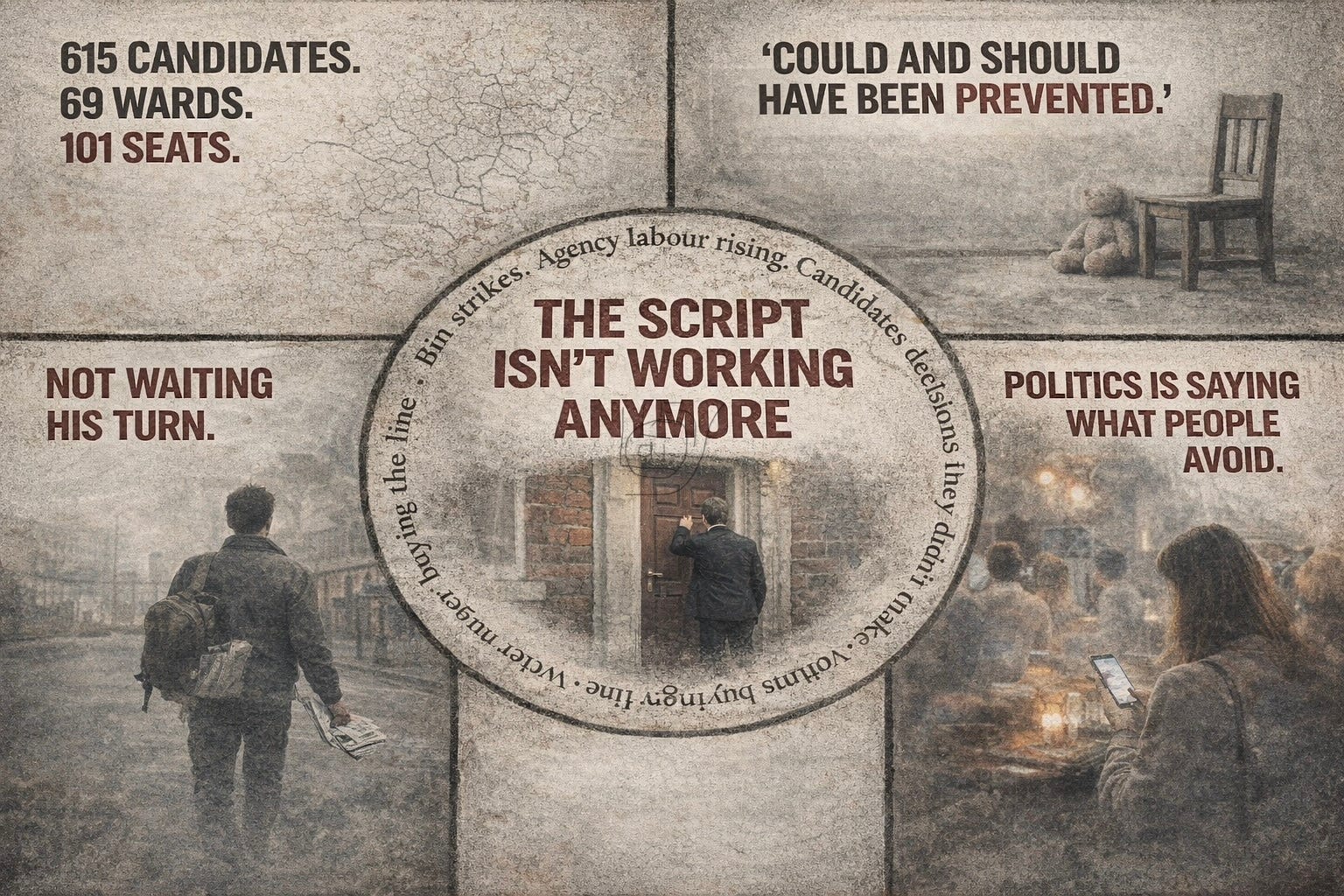
615 candidates. 69 wards. 101 seats.
Those numbers are striking enough. The detail beneath them matters even more.
Across the Labour Party, Conservative Party, Liberal Democrats, Green Party of England and Wales and Reform UK, full slates are colliding with a surge in independents and issue-led campaigns.
Ward by ward, the picture becomes more intricate, not less.
What emerges is not a single contest, but dozens unfolding at once, each with its own tensions and turning points.
Labour is under pressure. Reform UK is converting momentum into credible local challenges. The Greens and independents are finding space where traditional loyalties are loosening.
The outcome is unlikely to be clean. No overall control is now a credible end point.
And once control fragments, the politics changes with it.
Tuesday: When failure becomes familiar
Tuesday brought a much heavier focus.
Three children in Southport. A report concluding their deaths could and should have been prevented.
It is a line that should stop people in their tracks. Yet it is no longer unfamiliar.
Across the West Midlands, the pattern repeats. From the death of Khyra Ishaq to the murder of Arthur Labinjo-Hughes, the sequence is painfully consistent. Risks identified. Concerns raised. Action falls short.
Afterwards, the system responds. Reviews. Reports. Apologies.
And then it continues.
What makes this harder to accept is the imbalance in consequence. When families fail, the response is immediate. When systems fail, it is more diffuse.
Over time, that begins to look less like accountability and more like management.
Wednesday: A candidate who isn’t waiting
Midweek, the focus shifted to a different kind of story.
Hugo Rasenberg, 21, standing in Harborne for the Conservative Party.
His route into politics has been fast, practical, and built through effort rather than patience. Campaign hours, digital reach, constant visibility.
It is not the traditional model. It does not wait for permission.
Win or lose, what matters is what it represents, a generation approaching politics differently, blending ground campaigning with digital instinct, and stepping forward earlier.
Thursday: The script isn’t working anymore
Then came Thursday, and something closer to the ground.
The reality of campaigning itself.
The familiar lines are still there. Stability. Responsibility. Difficult decisions. Shaped within Birmingham City Council and reinforced by the wider Labour Party.
But they are not landing in the same way.
On the doorstep, candidates are being asked to defend decisions they did not shape, explain problems that have not been resolved, and hold together a narrative that is under strain.
The bin strike continues. Agency spending rises alongside it. However it is explained, the pattern is visible.
And it raises an uncomfortable question about Labour’s relationship with its own workforce, and how that is now being perceived.
At the same time, those workers are not standing back. They are campaigning, directly and visibly, targeting Labour candidates.
That changes the contest.
Add to that wider pressures, rising costs, everyday service issues, and the cumulative effect becomes harder to manage.
Then there is selection.
The shift away from locally rooted candidates towards centrally influenced choices is no longer subtle. It is visible. And it is noticed.
All of which leaves a simple question.
Not just what is being said on the doorstep.
But whether those saying it still believe it.
Friday: When politics moves into uncomfortable space
By Friday, the conversation shifted again.
South Derbyshire’s MP, Samantha Niblett, and the call for a “summer of sex”.
It jars. It challenges expectations of tone and place.
But it also reflects something broader.
Attitudes to relationships and expectations are being shaped differently, often influenced more by what is seen online than by lived experience.
In that context, avoiding the subject altogether becomes harder to justify.
That does not remove questions about judgement. But it does suggest some conversations are no longer avoidable.
The thread running through it all
What links these stories is not party or policy.
It is a sense that established ways of doing things are being tested.
Political messaging is meeting resistance. Systems are being questioned. New entrants are approaching politics differently.
And across Birmingham, voters are responding in ways that are less predictable than before.
Nothing has fully broken.
But it is no longer holding in quite the same way.
Final word
And finally, a genuine thank you.
Close to 30,000 of you have read, shared, and engaged with Midlands GRIT this week. That is not just reach, it is attention, and attention matters.
It means these conversations are being followed, considered, and carried forward.
This is the weekly digest.
The full pieces, including Monday’s exclusive ward-by-ward Birmingham election analysis, continue to run on midlandsGRIT, where the words have space to breathe and the seams are left deliberately unpolished.