

The Scrutiny Machine Nobody Voted For
£750,000 on scrutiny, a bankrupt council and politicians arguing over who gets to ask the questions.

Every administration promises transparency. The true test comes when somebody switches the light on. There is an old rule in politics: if you want to know whether scrutiny is working, do not start with the committee chart. Do not start with the agendas, the work programmes or the governance diagrams. Start with the faces around the table. If the people in power look relaxed, comfortable and faintly bored, there is a fair chance you are not watching scrutiny at all. You are watching theatre with minutes.
Birmingham should know this better than most places. For years the city had scrutiny. It had committees, reports, recommendations, reviews, task groups and enough paperwork to keep several forests in gainful employment. Yet somehow all that respectable machinery failed to stop Birmingham driving itself into a financial brick wall. If scrutiny had truly been working as an early warning system, we would remember the warnings. Instead, we remember the effective bankruptcy, Section 114, equal pay chaos, commissioners arriving from Whitehall, governance failures, budget failures and Birmingham becoming a national example of how not to run a major city. Whatever scrutiny was doing, it was not doing enough.
There is another uncomfortable question lurking in the background. During Birmingham’s final years of Labour control, taxpayers spent something approaching three quarters of a million pounds on scrutiny leadership allowances alone. Not officers. Not reports. Not meeting rooms. Not webcasts. Just the additional allowances paid to councillors chairing and leading scrutiny functions. For most of that period, those positions were overwhelmingly occupied by Labour councillors scrutinising a Labour administration.
Now, if that scrutiny had successfully sounded the alarm over the city’s worsening financial position, forced action on equal pay liabilities, exposed governance weaknesses or helped steer Birmingham away from effective bankruptcy, many residents would probably conclude that £750,000 was money well spent. Three quarters of a million pounds is not a great deal if it helps prevent a financial catastrophe. But Birmingham still ended up effectively bankrupt. The city still received a Section 114 notice. The city still ended up under commissioner oversight. The city still became a national cautionary tale. Which leaves a question many residents may reasonably ask: if scrutiny cost taxpayers around £750,000 during those years, and Birmingham still sailed straight into the biggest crisis in its modern history, what exactly did taxpayers receive for their money?
That is not a criticism of every Labour scrutiny chair. Some worked hard. Some asked difficult questions. Some undoubtedly spotted problems long before they became headlines. The question is whether a scrutiny system dominated by Labour councillors during a period of Labour control delivered the level of challenge Birmingham taxpayers had every right to expect. Because scrutiny is not supposed to be a ceremonial function. It is supposed to be an early warning system. And when the ship hits the iceberg anyway, people are entitled to ask what the lookouts were seeing.
Which brings us to the strange position Birmingham now finds itself in. Labour no longer runs the city. Other than, some might mischievously observe, through the all-powerful Labour Government appointed commissioners who still hover over the civic landscape like particularly expensive guardian angels. The elected administration is now a coalition of Liberal Democrats, Greens and independents. Reform has emerged as a significant force. Labour remains a substantial opposition group. The Conservatives, meanwhile, have found themselves in possession of all seven Birmingham City Council scrutiny chair positions.
That has not gone unnoticed. Labour and Reform have both expressed concern that they appear to have been left standing outside the scrutiny shop while the Conservatives have been handed the keys. Whether that criticism is fair or unfair is not really the point. The point is that they are asking the question. They are looking at the machinery of accountability and wondering whether they have been invited to operate it or merely admire it from a safe distance.
Ordinarily that would be the end of the story. Except it isn’t. Because while Labour and Reform have been expressing concerns about scrutiny arrangements in Birmingham, Conservatives have been expressing concerns about scrutiny arrangements at the West Midlands Combined Authority. This is where the story becomes genuinely amusing.
According to a Conservative press release, Labour and Reform councillors at the Combined Authority have voted to abolish the dedicated Transport Delivery Overview and Scrutiny Committee. The outgoing chair of that committee was Cllr Tim Huxtable, Conservative councillor and one of the sharpest people in local government. Tim, or Two Brains Tim as some of us know him, is possibly the most intelligent person in the council chamber, regardless of gender, party or ideology. More importantly, he is a decent bloke, a hard worker and one of those infuriating people who actually reads the paperwork before the meeting rather than discovering the agenda while pretending to turn pages thoughtfully.
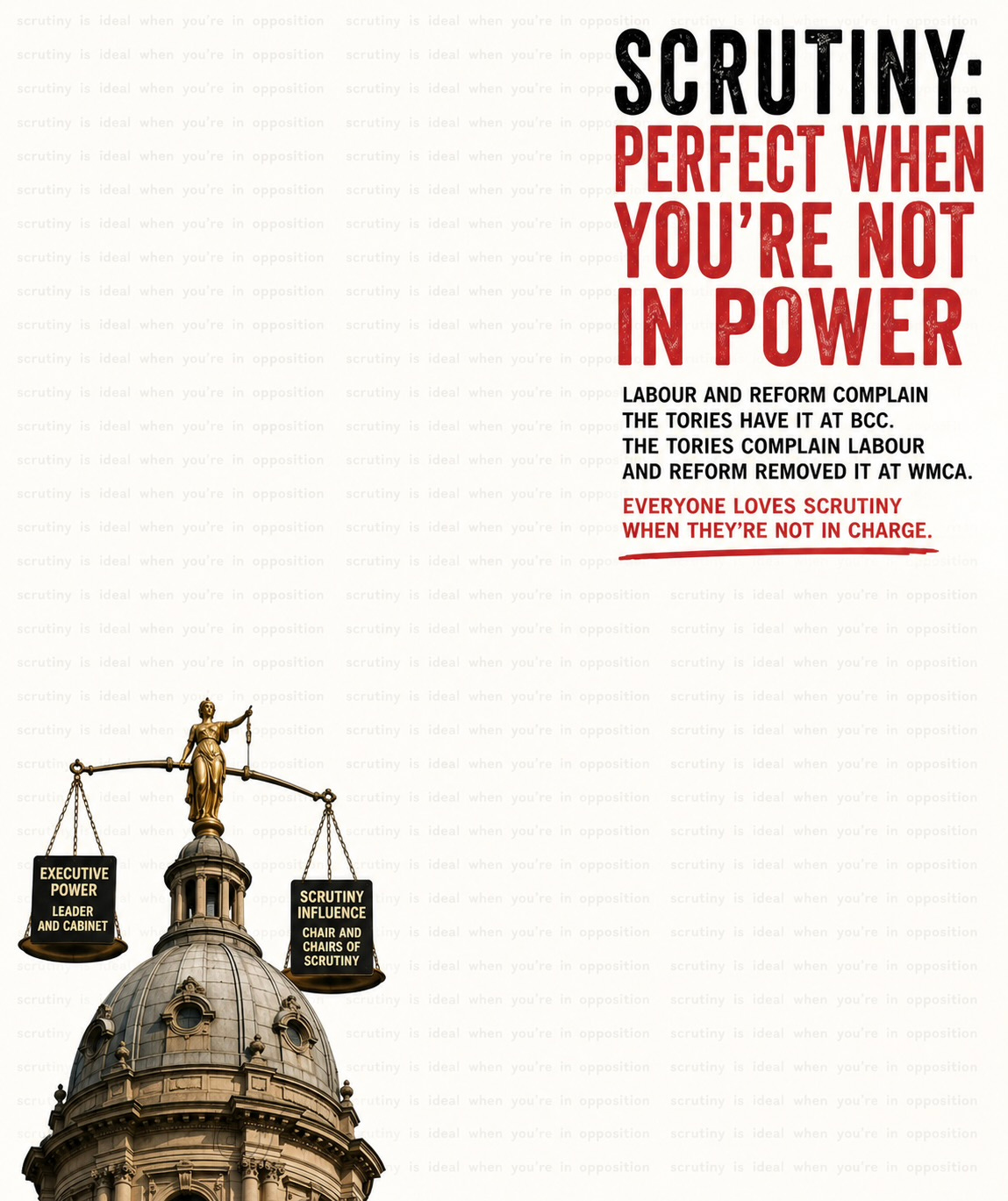
So let us stand back and admire the picture. At Birmingham City Council, Labour and Reform complain that Conservatives have ended up holding the scrutiny levers. At the Combined Authority, Conservatives complain that Labour and Reform have removed one of theirs from the scrutiny levers. You could not make it up. The same political parties who are demanding more influence over scrutiny in one room are accused of reducing scrutiny in another. The same party benefiting from scrutiny arrangements in one building is protesting about scrutiny arrangements in a different building. The players have changed places but the argument remains remarkably familiar.
The truth, of course, is that politicians have a complicated relationship with scrutiny. They all support it. Passionately. Wholeheartedly. Unconditionally. Right up to the moment it starts asking awkward questions about something they would rather not discuss. Politics is a little like football. The referee is always excellent when he awards a penalty to your side and a disgrace to civilisation when he awards one against you. Scrutiny works in much the same way. Every party loves scrutiny when it is holding the microphone. Every party becomes noticeably less enthusiastic when somebody points the microphone back at them.
I know this because I have been there myself. When I chaired scrutiny in Birmingham, every scrutiny chair was Labour. I thought that was wrong. Not unfortunate. Not less than ideal. Wrong. So I appointed opposition councillors. The late John Alden, father of current Conservative leader Bobby Alden, became a scrutiny chair. So did Liberal Democrat councillor Sue Anderson. Some of my Labour colleagues were not entirely delighted. Good. That usually means you have found the right answer.
John Alden was excellent. Sue Anderson was excellent. Both later became effective cabinet members when Labour lost power. Both became memorable Lord Mayors. Scrutiny did not damage them. It improved them. That is because good scrutiny is not punishment. It is preparation. It teaches politicians how to challenge assumptions, test arguments and occasionally identify a problem before it becomes a crisis.
That is why the current argument matters. The Conservative press release complains that transport already accounts for a huge proportion of Combined Authority spending and that scrutiny should be increasing rather than decreasing. It argues that Birmingham taxpayers continue to contribute heavily towards regional transport funding while Birmingham’s representation within scrutiny arrangements has reduced. Labour and Reform, no doubt, have their own rationale for the changes. Fine. Explain it.
Whenever a scrutiny committee is abolished, merged, streamlined, modernised, refreshed, repurposed or subjected to whatever fashionable management phrase happens to be circulating this month, the burden of proof should sit firmly with those making the change. Explain why accountability improves. Explain why transparency increases. Explain why the public should feel reassured rather than concerned. Because history offers a simple lesson. Nobody ever creates a scandal because there was too much scrutiny. Most scandals happen because there was not enough.
That is the real lesson hidden inside this entertaining little row. Today Labour and Reform complain in Birmingham while Conservatives complain at the Combined Authority. Tomorrow the positions may reverse. The day after that somebody else will be demanding fairness, transparency and accountability while another group explains why now is not quite the right time. The principle, however, remains constant. Scrutiny should not belong to a party, a coalition or an administration. It belongs to the public.
Politicians treat scrutiny rather like teenagers treat bedroom inspections. They support the principle in theory. They become noticeably less enthusiastic when somebody starts opening drawers. Yet that is precisely why scrutiny exists. Not to make life easier. To make life harder. To ask questions. To challenge assumptions. To shine light into corners where some people would rather the light did not reach.
Every administration promises transparency. The true test comes when somebody switches the light on. After everything Birmingham has been through, that may be the very least residents should expect.
The continental system of government has come to the UK and to Birmingham without PR… that system works like this: the losers in the election, where no party can ever have a majority, gang up to stop the winner from ever ruling. The electors speak but the politicians have other ideas… let’s apply this to Birmingham… the greater number of seats were won by Reform but they cannot lead the Council. Instead one of the losers the LIBERALS lead the Council despite losing wads of votes and a few seats in the election. This is the Liberal way… lose and win not just here but across Europe. The new leader himself lost vast numbers of votes in his own election… and then the scrutiny committees to be run by another big loser on the night, the TORIES, who lost seats and wads of votes. Both the Liberal and the Tories are virtually non existent in 80% of the wards… so we have an unrepresentative administration… both in terms of seats and votes. So you lose big time but you then become the leadership… this could be Germany or Spain, where two unpopular leaders stay in power to prevent the biggest party taking over… Let me politely tell these parties that they have created a situation which will ensure Reform will win even more seats in 2030, as my analysis will show. So Reform will be thanking these loser winners for denying them a seat at the table.
As to scrutiny committees … well they have done a good job in the past… really! But what really needs scrutiny is the back handers (sorry my mistake gifts) councillors received in the last council and their company interests… but there was no such scrutiny of these… so much so that the officers allowed councillors to put or not put what they liked on their Registers and no one ever checked their reliability. What a shambles!