
The Village Is Never Just One Village
Bloodshed in Kashmir and Birmingham’s new politics expose the arguments hidden beneath easy labels such as Asian, Pakistani and Muslim.

Birmingham has been celebrating South Asian Heritage Month under the theme “Unity in Diversity”. It recognises eight countries, hundreds of languages, several faiths and sharply different histories. Birmingham City Council has joined in with performances, exhibitions and workshops. But diversity becomes hollow if we celebrate only food, fabric and music while refusing to examine the disagreements, inherited loyalties and uncomfortable truths that also travel across generations.
A striking example has arrived from Shakeel Afsar, a prominent Birmingham Kashmiri activist and a leading public voice behind the Independent Candidate Alliance during May’s elections. Seven councillors now sit at the Council House under the Better Birmingham name, contributing to the partnership running the city. The politics he championed now sits close to Birmingham’s new establishment.
In an impassioned recording, Afsar speaks of “dead bodies of our Kashmiri brothers” in Rawalakot. He condemns the Pakistani government, its military and politicians in Pakistan administered Kashmir. He urges people in Britain to contact councillors and MPs, calls for a British delegation and advocates an election boycott. His anger follows deadly clashes involving supporters of the Joint Awami Action Committee, security forces and police. The movement has campaigned over electricity, flour, infrastructure and political representation.
This is not the usual simple story of British Pakistanis condemning India over Kashmir. Afsar is a passionate advocate of Kashmiri freedom, yet here his fire is directed towards Pakistan. He describes Pakistani forces as occupiers and “so called brothers”. That may anger people whose Pakistani national loyalty is as powerful as their Kashmiri ancestry. Others will believe he has finally said aloud what they have long felt. Either way, the recording dismantles the fiction that Birmingham has one Asian community, one Muslim community or even one Pakistani community.
A person can be British by citizenship, Kashmiri by family, Pakistani by cultural association, Muslim by faith and deeply hostile to the Pakistani state. Those identities can coexist, but they can also pull against each other. The argument runs through families, mosques, election campaigns and generations within the same community.
Even the word “Asian” begins to collapse under examination. My own delightful and much loved daughter in law is from Taiwan, is of Han Chinese heritage and is the proud mother of my fourth grandchild. She is plainly Asian, but I would never presume to speak for her or assume that she feels any connection with Birmingham’s Pakistani, Kashmiri or Sikh political arguments. Taiwanese, Chinese, Indian, Pakistani and Bangladeshi people may be placed together on official forms while sharing little language, religion, history or political experience. The label often conceals more than it reveals.
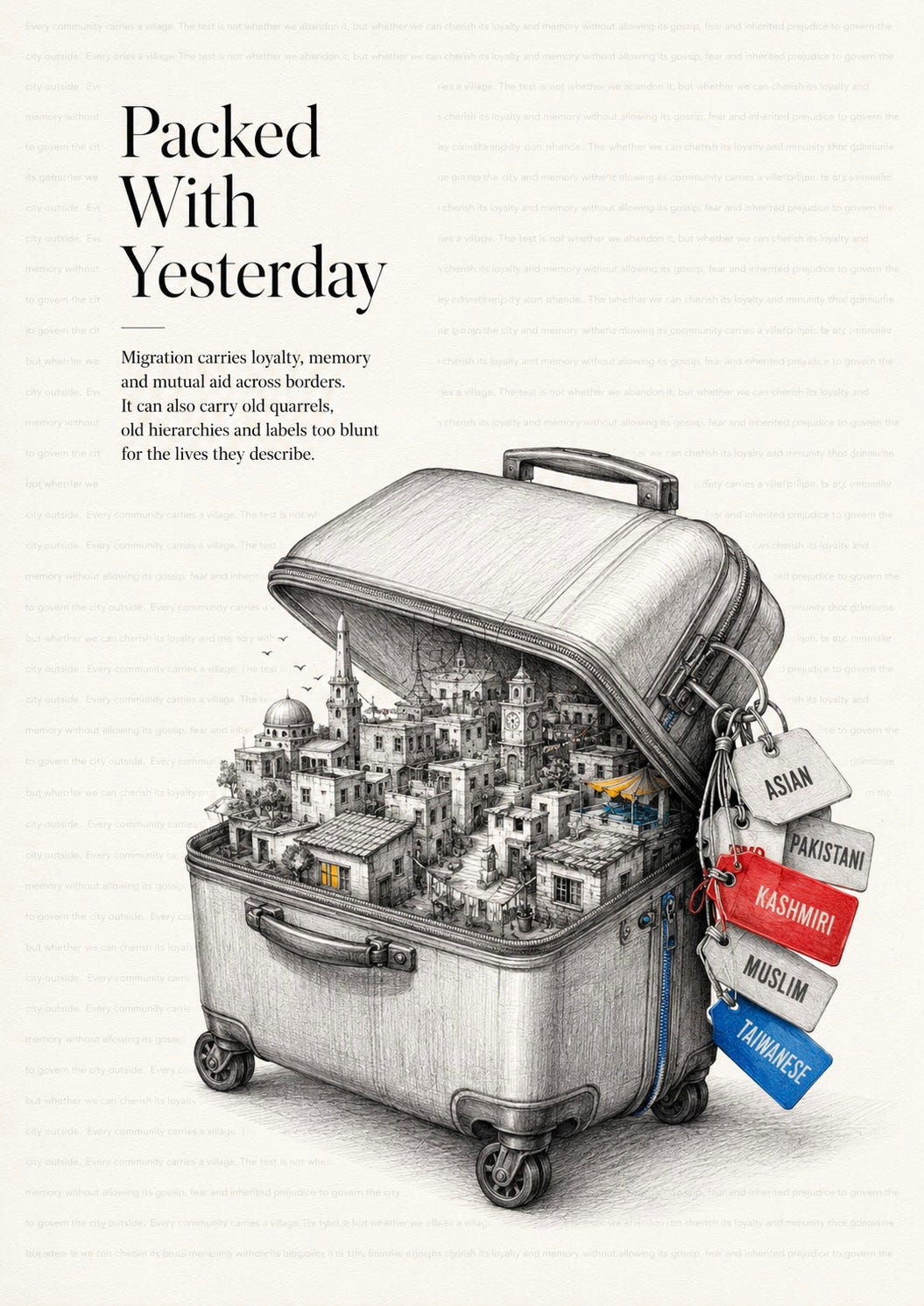
Every community carries a village inside it. Sometimes it is an actual village remembered through family stories, recipes and obligations. Sometimes it is the year in which people left home. Migrants carry enterprise, courage, faith and mutual support, but they can also carry old suspicions, rigid family expectations and ideas about gender, honour and authority. Sometimes the homeland changes while the diaspora preserves a photograph of how it once was.
There are Muslim brothers and sisters in Birmingham who are thoroughly modern in their work, education and use of technology, yet remain governed socially by attitudes that belong to another age. Some Muslims, speaking privately and more bluntly than civic leaders ever would, might describe parts of their own community as still living “in the village”. Others might go further and call certain attitudes Stone Age.
That is severe language and should never be used to condemn Islam or Muslims collectively. But when it describes forced control over marriage, the policing of women, inherited hostility towards other faiths or the belief that family honour matters more than individual freedom, the criticism cannot simply be dismissed as prejudice. Respect for a community should include enough respect to admit that some of its customs require challenge.
The British do it too. Put some of us in Spain, Australia or Dubai and people who never displayed a flag in Birmingham become guardians of tea, roast dinners and British television. A minority forms an expatriate bubble and becomes more theatrically British abroad than it ever was at home. Distance does not always dilute identity. Sometimes it concentrates it.
We use similar shorthand about the Isle of Man, describing it as though it remains in the 1950s. The horse trams and slower rhythms help the image, but the island also supports finance, digital business and technology. Calling a place “the 1950s”, or calling an attitude “Stone Age”, may identify something recognisable, but it becomes unjust when one fragment is treated as a description of an entire population.
Adil Ray’s Citizen Khan made that tension into Birmingham comedy. Ray is not an outsider peering into the city for material. He is a proud Brummie, born and raised here, who still lives in Birmingham and has built a production company based in the city. Mr Khan himself was also unmistakably Brummie, a vain, bossy, tight fisted, self appointed community leader who believed status arrived with a clipboard.
Some British Muslims enjoyed seeing a Pakistani family granted the comic foolishness long enjoyed by white television families. Others believed the programme mocked Islam or recycled stereotypes. The first episode drew nearly 200 complaints. Ray received death threats and an online message threatened a riot. During location filming on Ladypool Road, somebody threw an egg at him. Most interior scenes were made in Salford, but Ray insisted on bringing Mr Khan’s outside world back to Birmingham.
That makes the dispute more revealing, not less. Who may laugh at a community? Does satire betray it by supplying ammunition to racists, or respect it by allowing its members to be vain, hypocritical and ridiculous like everybody else? Citizen Khan was created by a Brummie, about a Brummie, in a city Ray continues proudly to call home. It did not prove Pakistani Birmingham was trapped in the past. It proved there were fierce arguments within the city about how that life should portray itself.
There are also uncomfortable tensions between sections of Birmingham’s Pakistani Muslim and Sikh populations. Claims concerning relationships, conversion, grooming, religion and family honour have circulated for decades. Some concerns are sincerely held, while some allegations have been poorly evidenced or exploited by communal activists and the far right.
Pretending every claim is invented allows rumour to grow. Treating every allegation as proof turns neighbours into enemy tribes. The great majority of Pakistani Muslim and Sikh Brummies work, study, trade and live beside one another without drama. Their shared Punjabi inheritance is often greater than their differences, although religion and history can sharpen the boundary.
South Asian Heritage Month’s “Unity in Diversity” is therefore more demanding than it sounds. Unity does not require silence, and diversity is not a tidy display cabinet. Birmingham’s South Asian life contains national rivalries, religious distinctions, class divisions, generational struggles and political movements capable of changing who runs the city.
Shakeel Afsar may not be everyone’s cup of tea, but he is direct, respectable and seldom afraid to voice an opinion. In my experience, the views he expresses are often shared by a significant section of the public, even when their arrival is deeply uncomfortable for those who would prefer the subject remained safely beneath the carpet. That does not make him right about everything, nor would he expect such a ridiculous concession. It means he is willing to say aloud what others mutter privately and to accept the consequences of having said it.
There is something distinctly British about that. Whatever one thinks of his politics, Shakeel wears rather well the very British mantle of a fully signed up member of the awkward squad. Every healthy city needs a few of them. They disturb comfortable meetings, challenge official versions of events and occasionally force the rest of us to confront an uncomfortable truth we had hoped might miss the bus.
Every community carries a village. The test is not whether we abandon it, but whether we can cherish its loyalty and memory without allowing its gossip, fear and inherited prejudice to govern the city outside. Shakeel’s contribution is to remind us, sometimes loudly and rarely apologetically, that the village itself is never of one mind.