

THE WEEKEND ESSAY Birmingham’s Great Green Monument
Was Birmingham’s Clean Air Zone ever in the right place, is it still needed, and has the money become too useful to switch off?

I have asthma. I mention this at the outset because whenever anyone questions something with the words “clean air” written on the side of it there is a danger of being treated as though you spend your weekends burning tyres in Sutton Park. I rather like clean air. I have developed quite an attachment to breathing over the years and, all things being equal, intend to carry on with it. But I do not particularly want a clean patch of Birmingham surrounded by somebody else’s pollution. I want a cleaner planet, and I want every sensible, practical and properly evidenced measure we can devise to help achieve it. The planet, incidentally, does not actually need saving. It was here long before Birmingham City Council and will probably still be spinning merrily around the sun when the Council House is an interesting archaeological discovery. It is humanity, and the living world upon which humanity depends, that we are trying to preserve. Which is precisely why environmental policy matters too much to be reduced to badges, slogans, gestures and dreary municipal monuments.
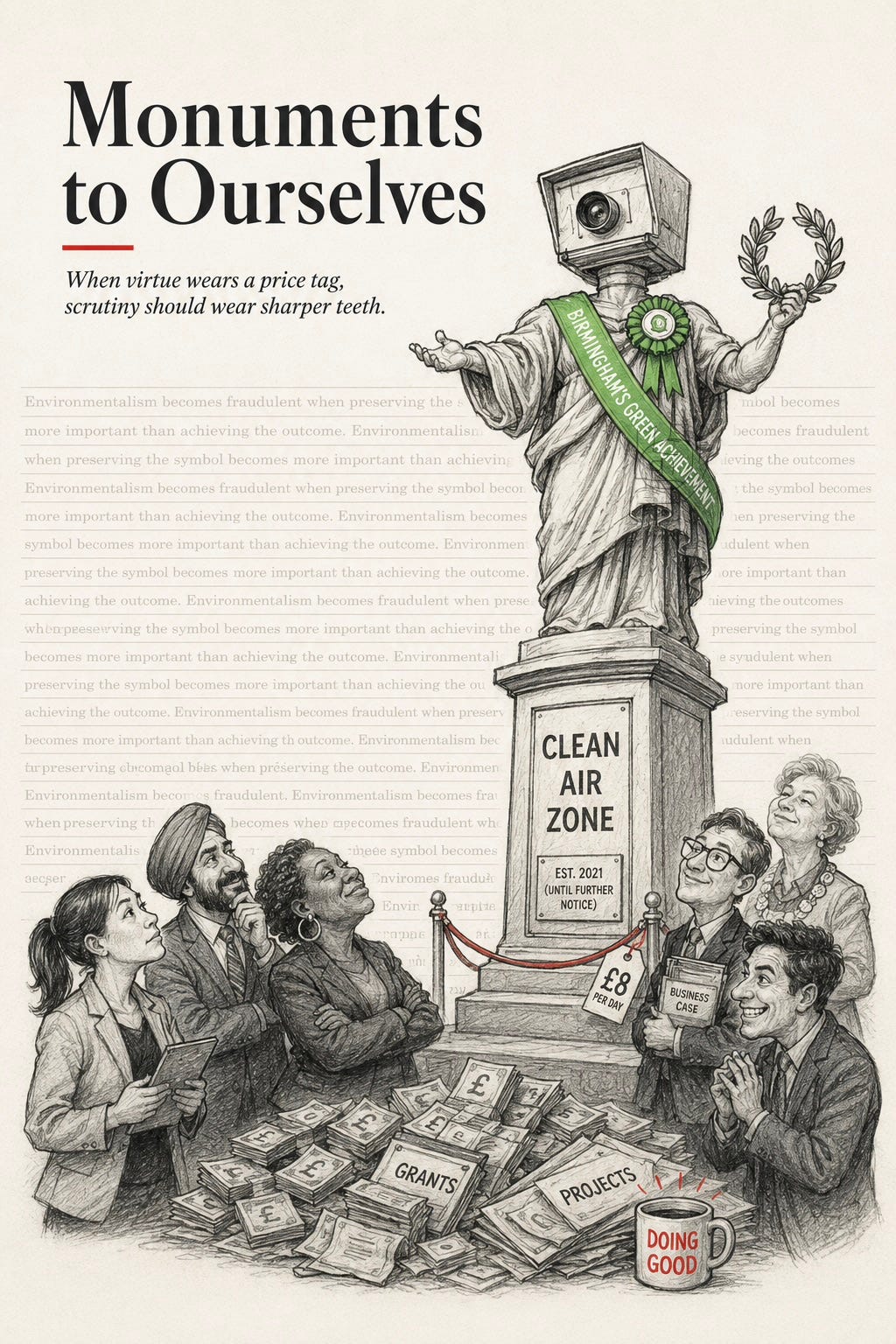
And Birmingham does enjoy a municipal monument. Once upon a time we built reservoirs, parks, libraries, sewers and gasworks because Birmingham actually needed reservoirs, parks, libraries, sewers and gasworks. More recently municipal government has discovered another sort of monument, one which comes with cameras, signs, logos, websites, consultants, dashboards and a suitably uplifting name. The Clean Air Zone has all the characteristics of the modern municipal accessory. It looks progressive. It sounds progressive. It tells visitors that Birmingham is terribly serious about the environment. It also sends out invoices. The uncomfortable question is whether Birmingham began with the evidence and asked what intervention was necessary and where, or whether the fashionable answer had already become a shiny city centre Clean Air Zone and sufficient evidence was subsequently squeezed and shaped around it to make the answer fit.
Because Birmingham certainly had an air quality problem. Let us dispose of the easy argument immediately. This is not a claim that every breath ever taken in Birmingham contained nothing more threatening than the scent of Cadbury chocolate and a distant Balti. There were serious NO₂ exceedances. But look at where some of the strongest official Government evidence actually placed them. The historic Defra national monitoring station in Birmingham city centre repeatedly recorded annual NO₂ averages below the legal 40 micrograms per cubic metre limit. The figures in the Government’s own published table included 34, 34, 33, 35, 33, 34, 34 and 33. Meanwhile the Government’s Birmingham Tyburn Roadside monitor was recording figures including 47, 51, 45, 46 and 46. Defra explicitly identified a measured exceedance at Tyburn. Birmingham Centre was below the limit. Tyburn was above it. Guess which one ended up inside Birmingham’s great charging zone.
I know Tyburn rather well. I represented the ward from 1991 to 2005, after the old Kingsbury ward expanded and became Tyburn, which makes it especially difficult for me to ignore the fact that one of Birmingham’s clearest historic measured exceedances sat there rather than inside the eventual city centre CAZ. That does not prove the city centre intervention was irrational, because Government and the council were also using local monitoring, traffic information and modelling. Birmingham’s eventual business case concluded that a Class D city centre CAZ was the quickest route to compliance. Modelling is legitimate evidence. Diffusion tubes are legitimate indicative monitoring devices when properly operated, corrected and interpreted. But they are not the same thing as the reference grade automatic monitoring network, and Government technical guidance itself recognises their greater uncertainty. So the question has never been whether somebody invented the numbers. The question is whether Birmingham had a desired solution and assembled a collection of measurements, assumptions and modelling sufficient to justify putting that solution where a modern city would rather like its Clean Air Zone to be.
I know this because some of us were being awkward about it before anybody started receiving £8 demands. In November 2019 I gave evidence to Birmingham City Council’s Economy and Skills Overview and Scrutiny Committee, then chaired by Cllr Tahir Ali. I challenged the baseline air quality data, asked what monitoring equipment was being used and asked about its calibration and the manufacturers’ requirements. The official minutes record those questions. Officers said the equipment was calibrated, that consultants had undertaken the work and that the Government had accepted the business case. Fair enough. But the same discussion also recorded that Birmingham had asked Government to fund additional monitoring equipment and Government had not done so, with the intention instead being to use future CAZ income to create a fit for purpose monitoring system. I remember asking about the budget available for calibration and not receiving anything resembling the comforting answer I had hoped for. The minutes do not record that particular exchange in sufficient detail for me to present my memory as holy writ, but they certainly record the concern that prompted it.
More interestingly still, the councillors themselves asked a beautifully straightforward question: why was the CAZ not being considered for areas outside the city centre where pollution exceeded Government safe levels? That question deserves to be read again slowly. This was not Mike Olley sitting at the back muttering into his notebook. Birmingham’s own scrutiny committee was asking, before implementation, why the proposed Clean Air Zone was not going where some of the pollution demonstrably was. Cllr Tahir Ali was then unexpectedly transported from the Council House to Westminster by the 2019 general election and that particular line of inquiry never received the forensic conclusion it deserved. One wonders what might have happened had it done so.
I did not forget about it. By 2024 I was still trying to establish how confidently Birmingham could proclaim the success of the CAZ from the monitoring arrangements being used. In my Birmingham Mail column that February I described some of the equipment I had seen in characteristically technical language as looking “old and knackered and uncared for”. I had photographed one particularly sorry looking specimen on my way to church, which at least proves I occasionally travel somewhere without causing trouble at the destination. I had been asking the council for information and eventually submitted a public question to Full Council, when Cllr John Cotton was Leader of Birmingham City Council and Cllr Liz Clements was Cabinet Member for Transport. We still need to revisit that exchange in detail, because several years after I first asked how Birmingham was measuring this stuff, I was still asking how Birmingham was measuring this stuff. Perhaps I am unusually slow. There is another possibility.
Then there is the question of what happened to the vehicles. Imagine a bus company, delivery company or any large fleet operator with newer compliant vehicles and older non compliant ones. Put a charge around central Birmingham and what would a rational fleet manager do? Send the compliant vehicles into the charging zone and use the older ones where there is no charge. That does not prove that Birmingham’s major operators systematically did precisely that, and I want the fleet evidence before saying they did. But the economic incentive plainly exists and Birmingham itself now considers the danger of traffic interventions causing pollution elsewhere through rerouting. So let us find out. Did Birmingham eliminate dirty vehicles, or did we occasionally teach them to turn left before they reached the cameras? Did we clean Birmingham’s air or rearrange some of it?
Which brings us to money, because municipal monuments become particularly difficult to dismantle once they start producing the stuff. The Clean Air Zone was not sold to Birmingham as a wonderful new municipal cash machine. Its purpose was behavioural and environmental. Make dirty vehicles less attractive, encourage cleaner ones and achieve legal air quality compliance. In a perfectly successful charging scheme the revenue should ultimately eat itself. The behaviour producing the income disappears and eventually so does the income. Yet Birmingham’s CAZ has generated tens of millions of pounds in surplus revenue, money which has subsequently supported transport and environmental schemes including Brum Breathes. Many of those projects may be perfectly worthwhile. That is not the point. The problem is the institutional incentive created when an environmental intervention designed ultimately to make itself unnecessary becomes a very useful source of money.
Nobody needs to be corrupt for that to happen. Nobody needs to sit in the Council House stroking a white cat and plotting another bicycle rack. Institutions acquire habits. Jobs exist around programmes. Monitoring systems require funding. Projects develop. Grants are distributed. Community organisations understandably welcome money for things they want to do. Officers quite properly find worthwhile ways of spending money legally available to them. Politicians get photographed beside the resulting schemes looking commendably green. Gradually an ecosystem develops around the environmental ecosystem, and the mechanism originally designed to solve one particular problem acquires beneficiaries who quite reasonably appreciate its continued existence. That is precisely when scrutiny should become harder, not softer. If the CAZ produced absolutely no surplus revenue whatsoever, would Birmingham still make exactly the same environmental case for retaining exactly the same boundary today?
Rather wonderfully, Birmingham’s own scrutiny system has now opened that door. The Breathless in Birmingham Clean Air Inquiry, presented to full Council in January this year, called for a full and timely options appraisal of the Clean Air Zone and annual scrutiny of its future. It contemplated the point at which compliance might allow the CAZ to be discontinued. Good. That is what environmental policy ought to do. A measure is not a religious artefact. If it works, celebrate it. If circumstances change, change it. If the evidence says intervention is now needed somewhere else, move the intervention. If the job is done, stop doing it.
And this is where Birmingham’s new political administration has a wonderful opportunity. Greens now have real influence in the running of the city. I do not want them to stick another green badge on the existing machinery and tell us how virtuous everybody is. I want them to be greener than that. They did not create this CAZ and have no obligation to defend the political reputations of those who did. Ask where Birmingham’s worst traffic related pollution is today. Ask where exposure produces the greatest health harm. Ask what happened to the older commercial fleets. Put the Government reference monitors beside the local monitoring, modelling and current data. Ask whether we would draw this boundary if we started with a blank map tomorrow morning. And ask the nastiest question of all: would any answer change if there were no CAZ money to spend?
There is also an ideal person to make sure those questions are asked properly. Cllr Timothy Huxtable is unmistakably Conservative, but in my experience he is also one of those increasingly precious political creatures capable of looking at evidence without first checking which colour rosette produced it. I have always found Tim fair minded, independent and straight down the middle. Cllr Tahir Ali’s committee started asking awkward questions about the geography of the CAZ in 2019. The 2026 inquiry has now demanded an options appraisal. Tim’s scrutiny committee has an opportunity to connect those two pieces of unfinished business. I gave evidence then. I would happily bring it back, put it on the table and have somebody try to knock holes in it. That is what scrutiny is for.
There is an analogy which will probably get me into trouble, so naturally I shall use it. Keeping an environmentally unnecessary charging zone because its proceeds can then be spent on worthy environmental projects would be rather like spending the early 1980s eating South African apples and washing them down with South African wine while explaining that you were doing your bit to free Nelson Mandela. I am very obviously not comparing a Birmingham road charging scheme with apartheid. I am comparing the logic. An admirable declared objective does not automatically make every mechanism used in its name sensible. Sometimes the mechanism travels in precisely the opposite direction.
So no, I do not want Birmingham to abolish its Clean Air Zone tomorrow morning because Mike Olley has become irritated by a roadside box. Nor do I want Birmingham to preserve it because we have grown accustomed to the signs, cameras, income and grants. I want something considerably more radical in modern municipal government: evidence. If the evidence says this CAZ remains necessary, in this precise place, keep it and I shall happily accept the conclusion. If the pollution problem has moved, move our intervention with it. If the charging zone has achieved what it was created to achieve and is no longer necessary, switch it off. And if somebody says we cannot afford to do that because we have become accustomed to spending the proceeds, then at least we will finally know what the scheme has become.
I don’t want a Clean Air Zone. I don’t even particularly want a clean Birmingham. I want a cleaner planet and every sensible positive step we can take towards it. But shallow symbolism, evidence squeezed to fit fashionable answers and dreary municipal monuments will slow that journey rather than speed it up. Environmentalism becomes fraudulent when preserving the symbol becomes more important than achieving the outcome. The planet will survive Birmingham City Council, the Clean Air Zone, the councillors, the officers and certainly this columnist. It is humanity we are trying to protect, including occasionally from our own remarkable capacity to confuse looking as though we are doing something with actually doing it.
Follow the evidence. Not the money.