

The Weekly Digest: What an Interesting Week
What a week it has been.

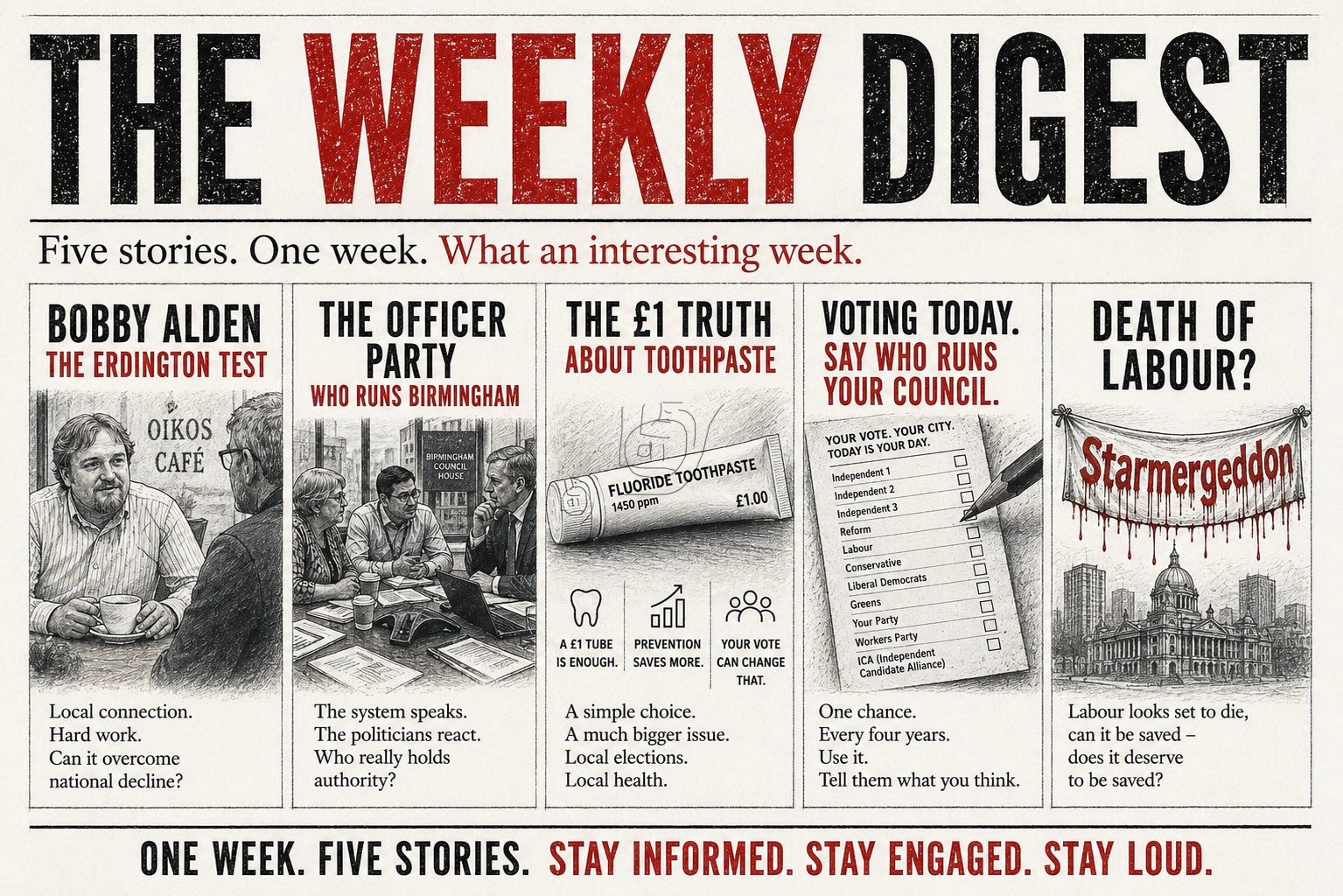
Behind closed doors across Birmingham and the wider West Midlands, senior political figures will already be deep in conversation, carving out positions, testing alliances, weighing possibilities. Some of those discussions will be formal. Others rather less so. Politics has always operated partly in public and partly in the shadows between meetings.
Good luck to all of them.
And knowing most of them as I do, I genuinely believe the city’s interests will feature somewhere in those conversations. No, that is not irony.
Before anything else, though, thank you.
Just under 27,000 of you read MidlandsGRIT this week. That is a remarkable number for an independent platform built largely on instinct, experience, frustration and a stubborn refusal to stop asking awkward questions. The comments, the emails, the private messages and the quiet conversations in cafés and corridors all matter enormously.
So let us look back at what turned into another fascinating week in Birmingham politics and beyond.
Monday began with Bobby Alden.
The reaction to that piece genuinely surprised me. It clearly struck a chord. And for the record, Bobby did indeed hold his seat. Congratulations to him.
I met Bobby at Oikos Café on Erdington High Street, the sort of place that perfectly captures the character of a local community. Not polished for effect, not curated for social media, simply real. And almost immediately the pattern became obvious. People constantly interrupted our conversation, but not in the awkward way politicians sometimes endure. These were natural interruptions. Familiar faces stopping to talk. Residents raising issues. Locals wishing him luck.
You cannot fake that kind of relationship over time.
Whatever one thinks of the Conservative Party nationally, Bobby himself is deeply rooted in Erdington. And that matters because Birmingham politics is entering an era where local identity increasingly outweighs national branding.
That was really the wider point of the piece. Birmingham has become politically fluid in a way it has not been for decades. Labour remains dominant structurally, but emotionally the city feels restless. Reform is rising. Independents are multiplying. The Greens are becoming more organised. The Conservatives, written off not long ago, are finding pockets of resilience.
And hovering over all of it is the question nobody can yet answer properly.
Who actually governs Birmingham now?
That theme carried directly into Tuesday’s article, which admittedly contained a little steam venting. But I make no apology for it.
Because the longer I watch Birmingham politics, the more convinced I become that one of the central tensions in the city is no longer Labour versus Conservative, or left versus right, but elected politicians versus the institutional machinery surrounding them.
The officer class.
The managerial state.
The unelected structures that increasingly shape outcomes regardless of who voters choose.
When Mayor Richard Parker criticised the handling of the bin strike, it mattered precisely because he understands institutions. He knows how systems operate. So when he publicly suggested key figures inside the council had not tried hard enough to resolve matters, it landed heavily.
And it brought back memories.
Around nine years ago, during John Clancy’s leadership, Birmingham experienced a remarkably similar pattern. Agreements apparently existed. Yet implementation drifted or stalled. Unite intervened. The courts became involved. And somewhere inside that process sat a deeply uncomfortable democratic question.
Who actually has the authority?
That question has never fully gone away.
The reality is that modern local government increasingly operates through overlapping networks of senior officers, advisers, consultants and political professionals whose careers move seamlessly between institutions. This is not some grand conspiracy. Most are competent and well intentioned. But systems develop instincts of self-preservation. Stability becomes the overriding value. Disruption becomes unwelcome.
And voters increasingly sense it.
That, more than ideology alone, is partly why Reform has found traction. Not necessarily because voters fully endorse every policy, but because the party projects motion. Energy. Frustration. A sense of wanting to force movement into systems that feel paralysed.
Wednesday took a rather different turn.
Sometimes politics sits inside the smallest things.
This week it was toothpaste.
The £1 Truth About Toothpaste unexpectedly became one of the week’s most widely shared articles, probably because it touched something familiar. We live in a society where marketing increasingly blurs the line between genuine value and manufactured perception. Stand in front of a supermarket shelf and it becomes obvious. Expensive packaging, whitening promises, “advanced protection”, endless branding language.
Yet for most people the essential ingredient remains fluoride.
That is the protection.
The rest is often margin.
But the deeper issue was never really toothpaste. It was public health, prevention and how quietly Britain has drifted backwards in areas that once seemed solved. Years ago, while serving on the board of Birmingham Dental Hospital, I remember professors discussing how difficult it could be for students to find enough routine filling work locally because oral health standards had improved so dramatically.
Now children once again undergo preventable extractions.
That is not merely decline. It is reversal.
And it reflects something broader happening across Britain, where prevention repeatedly loses out to short-term pressure management.
Then came Thursday.
Polling day.
Even after decades around politics, elections still generate a peculiar tension. Part excitement, part dread, part fascination. The polls suggested major change, but polls often flatter to deceive. Birmingham especially has always possessed a habit of surprising commentators.
Yet this time the direction of travel proved very real indeed.
What struck me most was not simply Labour’s losses or Reform’s gains, but the fragmentation underneath everything. Birmingham increasingly resembles a political system where parties are shedding parts of themselves onto the ballot paper.
Former Labour councillors now stand as independents against Labour itself. Local reputations increasingly outweigh party loyalty. Political labels feel weaker than they once did.
And voters know it.
The electorate is no longer choosing neatly between coherent governing visions. Instead, many voters are trying to assemble workable judgments from incomplete options. Labour struggles with credibility after years of decline. Conservatives struggle with trust. Reform struggles with structure. Independents struggle with scale.
Yet underneath the chaos sits something oddly healthy too.
People are re-engaging emotionally with local politics again.
There is anger, yes. Frustration certainly. But also participation. Debate. Movement. Democracy feels messy because democracy is messy.
And then Friday arrived with perhaps the week’s most emotionally resonant piece.
Britain Went To Sleep Before Democracy Had Even Finished Speaking clearly touched a nerve far beyond Birmingham. According to the metrics, it spread heavily across platforms and private forwarding chains.
Perhaps because people instinctively recognised the truth behind it.
Election night used to feel alive.
Ballot boxes arriving under escort. Crowded count halls. Candidates pacing nervously. Volunteers living on tea and exhaustion. Local radio broadcasting results into homes deep into the night. Democracy possessing atmosphere and urgency.
When I served as a councillor, polls closed at nine o’clock and counting began almost immediately afterwards. Often by quarter past ten the result would already be known and I would be speaking live to Ed Doolan on BBC WM while Birmingham still buzzed with political energy.
Now increasingly we lock ballot boxes away overnight because process management says it is more convenient.
Perhaps that sounds nostalgic. Perhaps it is. But symbols matter in politics.
When democracy itself begins feeling administratively inconvenient, something important is lost.
And that, ultimately, may be the thread connecting almost everything written this week.
Britain does not simply face a crisis of policy. It faces a crisis of energy.
People increasingly feel governed by systems that manage rather than inspire, administer rather than lead. Politics becomes procedural rather than emotional. Managerial rather than ambitious.
Into that vacuum step movements willing to sound decisive, whether one agrees with them or not.
Which brings us back to Birmingham.
The city still possesses extraordinary potential. It always has. This was once one of the wealthiest and most productive urban economies anywhere in Europe. A place of invention, confidence and municipal ambition.
That spirit has not disappeared entirely.
But it does need rediscovering.
And perhaps, just perhaps, this election marked the beginning of that argument properly reopening.
We shall see.
Either way, what an interesting week.
Yes I have a screen shot of that - you would have thought that they may have detected that people might be interactive with their elections web site on election day and built in capacity. But no - let hope the new party political
Leadership will take up this challenge as well as several other concerns around the conduct of the elections officers - it's standard for candidates to thank them, I think they have become complacent... and I don't mean the infantry I'm on about the generals
The results are in for the over 5,000 seats in this year’s election… well not quite… 2 are yet to declare and they are in Birmingham. Why it will take four days to count a few thousand votes is hard to say. Why did counting not start on Thursday night and why was it suspended on Saturday? The two seats are important. If Reform adds them to its tally of 22 Reform would be sufficiently ahead of the other parties to form a minority administration. It would not last though as the left wing parties would no doubt defeat it. But I suspect that would be to Reform’s advantage. Let the left wing parties mess things up, as the Tories allowed the first Labour (minority) government to mess up the economy in 1924. Perhaps though the Tories will support Reform but perhaps not since that would not create a majority. The other solution of a left of centre coalition is equally likely to be unstable. Would what is left of Labour support a coalition including the Green Party? Surely Labour will wish to go into Opposition having been so comprehensively defeated in the Election? So is chaos inevitable? What is clear is that what I wrote before the Election has come to pass. Birmingham is not just geographically but also politically divided into three distinct areas, which need three separate boroughs. The North is overwhelmingly Tory or Reform. The centre is overwhelmingly left wing, Liberal, Labour, Green and the Muslim independents. The south is Reform or Tory. To create 3 boroughs out of one County Borough would be a good solution to the chaos, which is only likely to get worse. These three, perhaps four boroughs, would all be population wise as big as most London boroughs. There is also the issue of how connected people on the two extremities are with the central area. Take for example people in Queslett. Most Brummies have never heard of Queslett and many people in Queslett have never been to Birmingham City Centre yet much of it is part of Perry Barr constituency with an Independent Muslim MP yet two Reform councillors. It has more in common with Aldridge and Pheasey in Walsall Borough. Indeed most families have links with Walsall or Sutton Coldfield than with central Birmingham. When the size of the Commons was going to be reduced this part of Birmingham was put into a new Walsall South constituency, which made sense. When the reduction of seats was rejected it became a tail of Perry Barr, where literally a mile long and 1/2 mile thin sliver of 80 houses was added to Perry Barr, curling around the neighbouring Erdington and Sutton constituencies. Similar issues arise in Frankley in the south, which has more in common with Bromsgrove and Redditch than with central Birmingham. Time therefore is ripe to break up Birmingham. As with Manchester the heart should be the City, the South called King’s Norton Metropolitan Borough, the North the Royal Borough of Sutton Coldfield including in it Queslett, Oscott, Perry Common, and Erdington… thus creating two parliamentary constituencies Sutton Coldfield North and South. A fourth borough could be formed in the east based on Yardley, including Moseley etc. Time to change or perpetual chaos?