

THE WEEKLY GRIT
Who’s in charge of common sense?

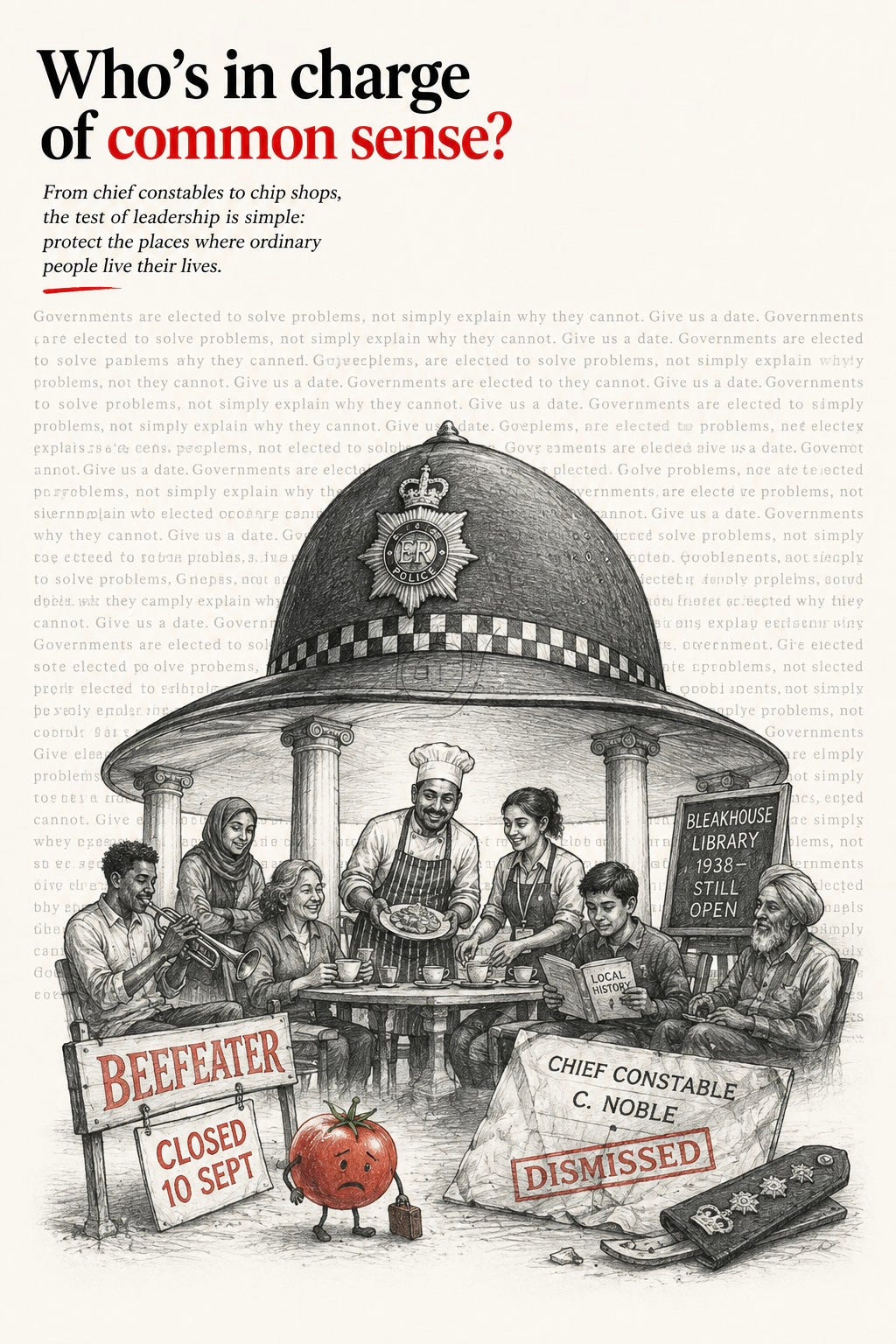
Another week at MidlandsGRIT Towers draws to a close and, as usual, Britain appears to have survived largely through habit. We have had one Chief Constable leaving in disgrace, another Chief Constable putting his neck on the line, 106 Beefeater restaurants being marched towards the commercial gallows, an unexpectedly packed jazz concert in a Sandwell library and a reminder that Birmingham’s wonderfully diverse communities are rather more complicated than the neat labels we sometimes stick on them. In other words, a quiet week. And, looking back, there was a theme running through all of it: leadership, institutions and the ordinary places where civic life actually happens.
We began with the extraordinary downfall of Staffordshire Chief Constable Chris Noble, who resigned immediately before an accelerated gross misconduct hearing. Two days later the panel concluded that gross misconduct was proved and that, had he still been in office, he would have been dismissed without notice. There is something deeply troubling about a Chief Constable ending his career in circumstances like these, but there is something else troubling too: the public still does not properly know what he did. Restrictions on reporting the substance of the hearing may have had perfectly legitimate reasons, particularly while other matters remain under investigation, but secrecy cannot simply become the permanent conclusion. Once the reasons for withholding information have passed, Staffordshire must be told what was proved. The wider figures are equally uncomfortable. The IOPC says Noble was one of eight serving or former Chief Constables under misconduct investigation or awaiting linked proceedings. With 43 territorial forces in England and Wales, that is a startling proportion of policing’s most senior leadership. The important distinction, however, is between leaders and the overwhelming majority of officers. Tonight ordinary constables will still walk into violent homes, deal with frightened victims and make decisions in seconds that the rest of us can debate for weeks afterwards. They deserve leadership worthy of them.
Then Mrs Olley provided the week’s corrective. I had confidently predicted that her appearance with John Hemming and the Jazz Lobbyists at Bleakhouse Library would attract two men and a dog. Somewhere between 80 and 100 people turned up. This was particularly inconvenient because Mrs Olley has accumulated enough evidence over the years that my predictions should probably now carry a government health warning. Bleakhouse was packed. Two advertised 45-minute sets ran over, the audience stayed and Basil Gabbidon, founding member of Steel Pulse, was there with his wife Cathy. Jazz met reggae, volunteers served refreshments and a library opened in 1938 demonstrated exactly why public buildings matter. There was even physical jeopardy when Andy the trumpet player caught his foot in a cable and went down heavily. Thankfully he was shaken rather than seriously hurt. He stood up to enormous applause and observed, “What I have to do to get a round of applause.” That is professionalism. Either that or a dangerously ambitious approach to audience participation.
But beneath the fun was a serious point. Bleakhouse was an example of working-class culture happening naturally. No strategy document was required. Nobody needed a lanyard. People simply gathered in a public building, listened to music, drank tea, talked to one another and enjoyed themselves. Sandwell is now controlled by Reform UK and my challenge to its administration was simple: if you claim to represent working people, protect the places where working people actually live their lives. Civic culture is not only opera houses, galleries and grand theatres. It is also a library garden, volunteers putting out cups and saucers, a jazz band playing longer than advertised and a room full of ordinary people having a thoroughly good evening. As for the dog, it was just as well it stayed at home. It would not have found a seat.
South Asian Heritage Month gave us Wednesday’s subject and perhaps the most difficult argument of the week. Birmingham has been celebrating under the theme “Unity in Diversity”. Quite right too. But diversity cannot simply mean celebrating food, clothes, music and dance while politely ignoring the profound disagreements that exist within communities. Kashmiri activist Shakeel Afsar’s furious intervention over deaths in Rawalakot illustrated the point perfectly. His anger was directed not towards India but towards the Pakistani government, military and politicians in Pakistan-administered Kashmir. The convenient idea of a single “Asian community” therefore collapses almost immediately. Asian can mean Pakistani, Indian, Bangladeshi, Chinese and much more besides. Muslim communities themselves contain differences of nationality, ethnicity, class, generation, theology and politics. Every community carries a village inside it.
The village can bring loyalty, family, faith, memory and mutual support. It can also carry gossip, inherited hostility, controlling attitudes and prejudices that deserve challenge. That is why Adil Ray’s Citizen Khan was more interesting than merely being a sitcom. Some Muslims enjoyed seeing a Pakistani family portrayed with the same vanity, foolishness and hypocrisy television has long bestowed upon white families. Others believed it reinforced stereotypes. That argument itself is diversity. Unity should mean living together despite differences, not pretending the differences do not exist. Birmingham is at its best when it is confident enough to celebrate difference and mature enough to discuss the awkward bits too.
Then came the terrible news. The mixed grill is on death row. Whitbread is closing all 106 remaining Beefeater restaurants by 10 September and around 3,800 roles are affected as the company concentrates increasingly upon Premier Inn. Nobody should rewrite history. Beefeater was not Le Gavroche with unlimited onion rings. Some branches had become tired and some people mourning their disappearance probably last entered one when Theresa May was still Prime Minister. But Beefeater occupied an important part of British life. It was somewhere nearly everybody could go. Children, grandparents, awkward relatives, vegetarians and whoever had unfortunately volunteered to pay could occupy one table without needing a lecture explaining the restaurant’s “concept”. The potato arrived without a biography.
Those restaurants hosted birthdays, first dates, retirement parties, family reunions and the gathering after funerals. They employed generations of young people and offered older customers somewhere familiar and accessible. A balance sheet can measure the value of converting restaurant space into additional hotel bedrooms. What it cannot easily calculate is the civic value of somewhere ordinary people have met for decades. That does not mean Whitbread should operate loss-making restaurants forever as museums of the prawn cocktail era, but it does mean we should recognise what disappears when these places close. Whitbread calls it transformation. The little grilled tomato may use stronger language.
And then, having spent the week criticising senior police leadership, I ended it by praising one. Thames Valley Chief Constable Jason Hogg has reportedly sought legal advice concerning the proposed early release of two men convicted over the killing of PC Andrew Harper. Whether a legal challenge is possible, desirable or successful is ultimately for lawyers and courts. The important point today is that a serving Chief Constable appears prepared to make his own Government uncomfortable because he believes something fundamental is at stake. That takes courage. It reminded me of former West Midlands Chief Constable Chris Sims. I met Chris several times. He could be gruff, but I always thought he was extremely well suited to the job and officers regularly spoke highly of him. When government cuts affected policing, Sims was prepared to say so rather than dressing the consequences up in management jargon.
There is a world of difference between discovering your courage after retirement, when the pension is safely arriving every month, and challenging those in power while they can still affect your professional future. That is why Hogg deserves praise. Governments also need to answer the underlying question. If prison capacity is being used to justify releasing offenders earlier than the public reasonably expects, when will Britain possess sufficient prison capacity for that excuse no longer to be necessary? Give us a date. Not another review, consultation or aspiration. A date. Governments are elected to solve problems, not simply become increasingly sophisticated at explaining why the problems remain.
And perhaps that is the thread connecting this peculiar week. Institutions matter. Leadership matters. Public confidence matters. But so do libraries, restaurants, communities, music and the ordinary places in which people encounter one another. A disgraced Chief Constable damages an institution. A courageous one can strengthen it. A packed library reminds us that civic culture does not have to cost a fortune. Birmingham’s communities remind us that diversity is complicated and should remain so. The death of Beefeater reminds us that sometimes we only recognise the social value of ordinary places when somebody arrives with a calculator and closes them.
So ends another week. Mrs Olley was right, I was wrong, the dog stayed at home, Andy survived his encounter with a cable and Jason Hogg has reminded us that occasionally somebody still reaches the top of public life without losing the ability to tell those above them something they would rather not hear. As for the Beefeater tomato, its lawyers have asked me to confirm that it continues vigorously to deny being a vegetable. See you next week.