

The Woman Who Walked Away
A Labour grafter walks away, and Birmingham’s political machine starts to look rather exposed.

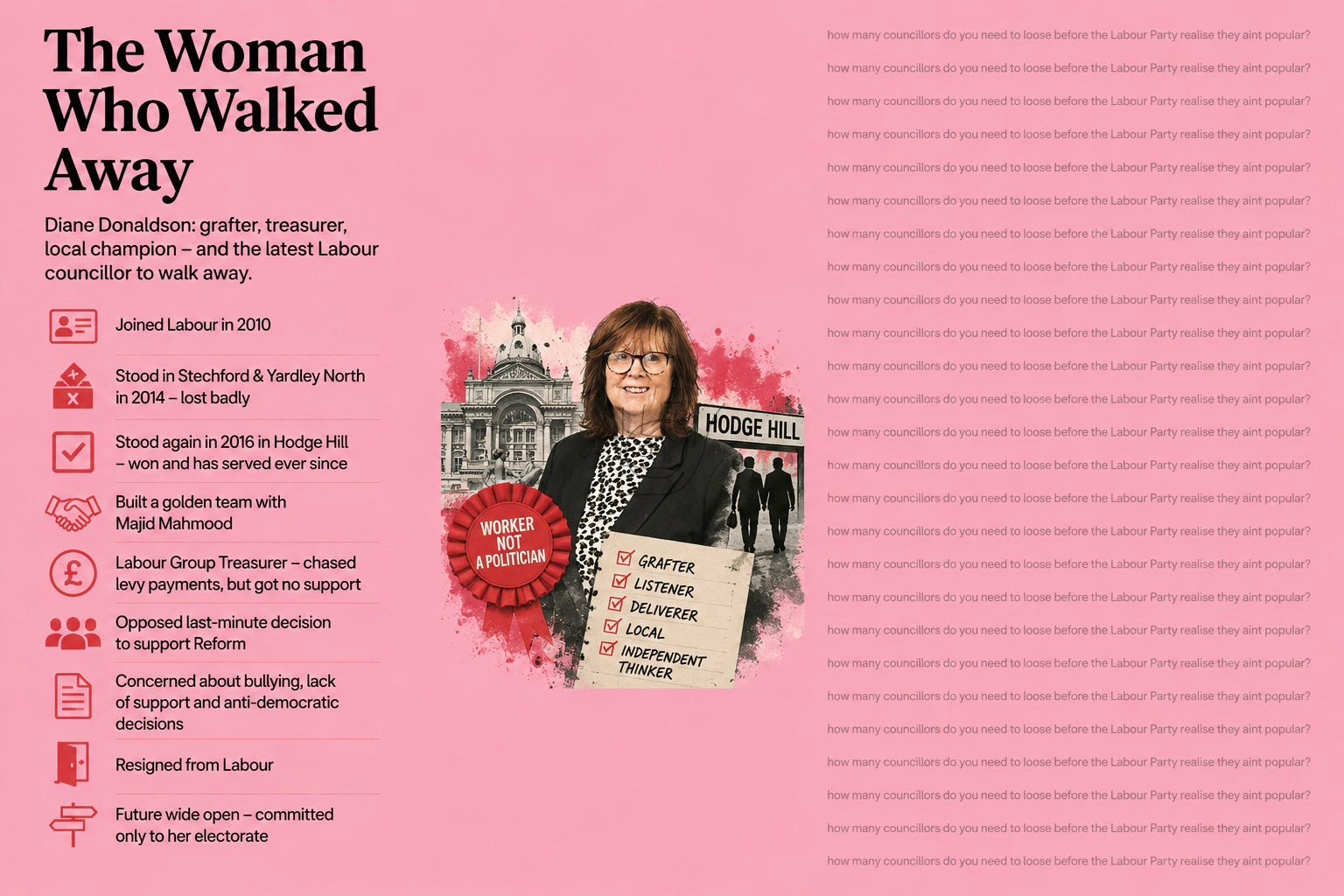
There are resignations in politics, dramatic resignations in politics, and then there are the departures that leave people staring into their tea wondering whether they have just witnessed the first crack in a much larger wall.
Cllr Diane Donaldson’s departure from Labour belongs firmly in that last category.
The reason is simple. Political parties can survive losing loudmouths. They can survive losing rebels. They can survive losing ambitious careerists who spend half their lives plotting and the other half briefing against one another. What they struggle to explain is losing the grafters.
The people who quietly turn up, do the work, answer the emails, attend the meetings, sit through endless committees, and generally keep the show on the road while others compete for the best photograph, the best slogan and the most dramatic social media post. And that is precisely why Diane Donaldson’s resignation matters.
Donaldson joined Labour in 2010. Like many members of her generation, she was motivated by a desire to stop the Conservatives rather than by any burning ambition to become a political celebrity. Four years later she was selected to fight Stechford and Yardley North against the Liberal Democrats. She lost. Badly. Most sensible people would have regarded that as a sign from the political gods that there were easier ways to spend their evenings. Gardening perhaps. Amateur dramatics. Collecting stamps. Learning the bass guitar. Anything, in fact, other than knocking on strangers’ doors asking them for votes.
Not Diane.
Like every proper political addict, she dusted herself down and came back for more. In 2016 she stood in Hodge Hill, won comfortably and has remained there ever since. Over the years she developed a reputation for something deeply unfashionable in modern politics: hard work.
Together with fellow councillor Majid Mahmood she became part of what many inside Labour privately regarded as a golden team. While Birmingham Labour was enduring defeats, internal rows and periodic nervous breakdowns, Donaldson and Mahmood simply got on with representing their ward. Residents knew them. Council officers knew them. Problems generally knew them too. If something needed chasing, they chased it. If something needed fixing, they tried fixing it. If somebody needed an answer, they generally got one.
It is not glamorous work. Nobody gets invited onto national television because they successfully resolved a fly-tipping complaint or sorted out a planning issue. Yet local government depends entirely upon people willing to do precisely those things. Donaldson was also Labour Group Treasurer, which sounds rather grand until one discovers the job largely involves pursuing fellow councillors for money they would rather keep in their own bank accounts.
Think less Chancellor of the Exchequer and more dinner lady chasing dinner money from reluctant teenagers.
Councillors are expected to pay a levy into the Labour Group, reportedly around £700 a year, with indications that the figure may rise further. Donaldson discovered that some now former councillors had not paid. Being the sort of person who believes rules should apply equally, she sought support from Labour Group officers to enforce the rules. The support never arrived.
Which left the Treasurer in the curious position of being expected to collect money while simultaneously being denied the authority to ensure everybody paid it. One might describe that as awkward. One might also describe it as absurd.
Eventually Donaldson resigned as Treasurer.
Then she resigned from Labour altogether.
At that point Birmingham’s political rumour mill sprang into action.
The city’s rumour mill is a magnificent institution. It operates twenty-four hours a day, requires no electricity, and can travel from Victoria Square to Sutton Coldfield faster than broadband. One theory suggested her departure was primarily linked to Labour’s support for Reform during last week’s dramatic council manoeuvrings.
That certainly appears to have been a factor, but it was not, according to Donaldson, the whole story.
Far from it.
She says the Labour Group had previously agreed not to support Reform, only for members to be told the following evening, in short order and under pressure, to vote the other way. Donaldson did so reluctantly, but the decision clearly lodged somewhere deep. The vote happened. The meeting moved on. The political machine clanked forward. Diane went home, did not sleep properly, and by lunchtime the next day had sent her resignation letter.
That is not a tantrum.
That is a conscience finally refusing to be whipped.
Nor was this an isolated irritation. Donaldson describes broader concerns involving bullying, lack of support, internal culture and what she regards as increasingly anti-democratic behaviour both nationally and locally.
She is also concerned about Labour’s refusal to publish a report into Birmingham Labour affairs which, in her view, would shed light on how leaders, leadership teams and councillors have been selected without meaningful consultation with ordinary members.
That point matters because Donaldson is not some ideological revolutionary. She is not plotting to seize control of anything. She is not demanding ministerial office or seeking a grand title. Her instinct has always been rooted in local democracy: the idea that members should have a meaningful voice in decisions affecting their party, that rules should apply equally, and that voters matter.
Radical stuff, apparently.
Then there is Sir Keir Starmer.
Donaldson is not exactly a card-carrying member of his fan club. More importantly, many of her voters are not either. And that worries her.
For a grassroots politician, electoral reality tends to matter more than conference speeches, focus groups or expensive presentations from London consultants earning more money in a month than some families see in a year. If voters are unhappy, local councillors eventually hear about it. Repeatedly. Usually on doorsteps. And often in language unsuitable for family newspapers.
Perhaps the most revealing aspect of the saga came after her resignation.
Having left Labour, she was apparently encouraged by party officials to consider standing down as a councillor too. This is the normal tired little chant political parties make when one of their elected members leaves. Labour does it. The Conservatives do it. The Liberal Democrats do it. If Reform gets big enough, they will probably do it too, possibly with a flag and a foghorn.
The argument arrives dressed as principle, but usually looks more like a political sulk.
If Labour really believes councillors should automatically lose their seats when they leave a party, it is now in government and could try changing the law. It will not, because everyone knows the electorate elects the individual as well as the rosette.
Whether Labour genuinely believes it could retain Hodge Hill in a by-election is another question. Yet some officials may be deluded enough to think so. Otherwise why encourage Donaldson to stand down?
Donaldson is not a decorative badge pinned to a red rosette. She has spent years building relationships and delivering casework. If Labour believes voters will automatically choose the machine over the woman who has done the work, someone needs to open a window and inhale some actual Birmingham air.
Meanwhile Majid Mahmood, her long-time colleague and political ally, faces his own difficulties within Labour. Whether he remains in the party remains to be seen. Politics is a strange business. Yesterday’s loyalist becomes today’s dissident. Today’s rebel becomes tomorrow’s elder statesman.
As for Diane Donaldson, the world appears very much her oyster.
She could remain independent. She could join another grouping. She could align with former Labour councillors such as Sam Forsyth and Martin Brookes, good people both, who left Labour on grounds of principle and continue serving their communities after being elected as independents. She could even decide that party labels matter less than representing local residents.
Whatever she chooses, one fact remains.
Labour has not simply lost a councillor.
It has lost one of its workers.
And when an organisation starts losing the people who quietly keep the wheels turning, sensible observers do not ask what is wrong with the individual.
They start asking what is wrong with the machine.
That, more than any resignation letter, may be the question Birmingham Labour now has to answer.
For the avoidance of doubt: Cllr Donaldson remains a councillor for Hodge Hill an independent councillor.