

This Began With a Letter. It Ends With an Invoice
This was not inevitable. Had Labour councillors acted with transparency and restraint, £3.17 million per seat could have been saved for Birmingham rather than squandered in silence.

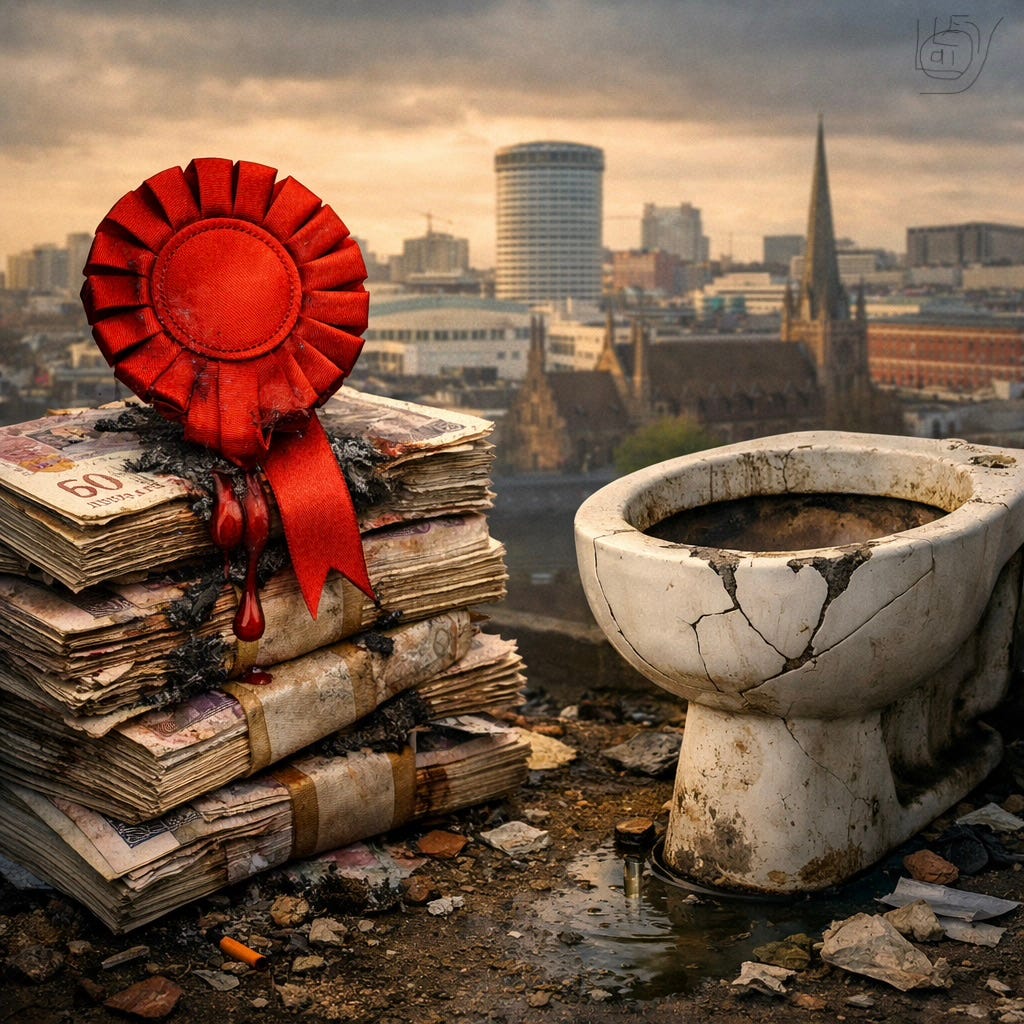
This did not begin with bloggers, commentators, or political opponents. It began with a letter.
A calm, forensic letter from Unite the Union to Birmingham’s councillors, setting out in plain language how tens of millions of pounds of public money are being burned to avoid settling a dispute that could be resolved for a fraction of the cost. That letter is not rhetoric. It is evidence. And it is aimed squarely at those in charge.
The Labour councillors who run Birmingham City Council hold the majority, control the budget, shape the negotiating stance, and yet have chosen near-total silence. So let us do what they will not. Let us put numbers on this, carefully, conservatively, and in a way every voter can understand.
Unite’s letter is devastating precisely because it is restrained. Its organisers have been out across Birmingham, knocking on doors, visiting high streets, mosques, churches and community centres. They are doing this week after week in the run up to the May elections. And the message coming back is remarkably consistent. Residents are angry that millions in council tax are being wasted trying to break a strike rather than sitting down and negotiating a fair settlement.
Hundreds of residents have already written to their councillors and MPs. Unite is now focusing on the battleground wards that will decide the election. This is not abstract trade union pressure or performative outrage. It is targeted, grounded, and rooted in lived public anger.
Then come the figures, and they matter.
According to the council’s own Cabinet Revenue Report, if the strike continues to the end of March the cost is at least £33.4 million. That is the council’s number, not Unite’s. Lost income from bulky waste, commercial waste and paper. Lost green waste income. Delayed street scene savings. And a large, disturbingly vague block of so called “direct costs”.
But Unite did not stop at the headline. Council contract data shows an additional £12.6 million spent in 2025 alone on agency and contract staff compared with the previous year. If that sum is not already buried inside those elastic “direct costs”, the real bill rises to £56 million.
The council refuses to clarify. It will not publish its legal advice. It will not explain precisely what those direct costs include. Unite, by contrast, has shared its legal advice in detail and has comprehensively rebutted the claim that a negotiated deal would create new equal pay liabilities.
One side is publishing. The other is hiding.
This matters because responsibility is not evenly shared. Labour controls the council. Labour councillors vote through the budgets. Labour councillors determine negotiating strategy. Labour councillors are the ones Unite is addressing and the ones it is now pressuring in public.
So when we talk about accountability, we are not talking about “the council” as an abstraction. We are talking about a political majority making political choices and then declining to explain them.
Nor is the bin strike an isolated failure. It sits within a clear four-year pattern. First came the catastrophic collapse of the council’s financial and HR systems under Oracle, a project meant to stabilise the books that instead left bills unpaid, accounts unreliable and basic controls broken. Then came pensions, downgrades, deferred liabilities, and a long habit of treating future obligations as someone else’s problem. Now we have tens of millions spent not to resolve a dispute, but to prolong it.
Different episodes. Same behaviour. Spend freely. Explain little. Hope time dulls the consequences.
So let us stop circling this politely and put the dagger where it belongs.
Using conservative figures only, and counting just three headline failures, the numbers are stark. Around £100 million lost to the Oracle fallout. Around £50 million in pensions and employment liabilities pushed down the road. And £56 million burned on a strike breaking strategy that has failed financially and politically. That is £206 million wasted over a single council term.
Labour holds around 65 council seats. Divide £206 million by 65 and you arrive at £3.17 million per Labour councillor over four years. That is nearly £800,000 a year, around £66,000 a month, more than £2,000 a day, every day, for four years.
Had Labour councillors taken a different, more sensible path, negotiation rather than entrenchment, transparency rather than silence, that money could have stayed in the city. It could have stabilised frontline services, reduced pressure on council tax, protected pensions rather than inflaming future liabilities, and fixed problems instead of compounding them.
Instead it was flushed away. And not one of them uttered a word of protest.
This is where an important point must be made, because it goes to democratic responsibility. Every Labour councillor in Birmingham has had the absolute right to raise concerns within the Labour Group, the body that shapes policy and determines how Labour councillors act on the council. No one was gagged. No one was procedurally silenced. No one was prevented from objecting.
If councillors believed the Oracle programme was spiralling, they could have raised it. If they believed pensions liabilities were being mishandled, they could have raised it. If they believed spending £56 million to avoid a negotiated settlement was reckless, they could have raised it.
As best I understand, they did not.
If I am wrong, then send me the evidence. Show me the motions, the objections, the recorded dissent. I will correct the record immediately, with a heartfelt and public apology. But silence, repeated and collective, is itself evidence.
I do not write this as a political opponent. I write it as a former Labour councillor, and as someone who still considers himself a Labour man. Which is precisely why this is so dispiriting. Labour is supposed to be the party that argues internally, that challenges power, that does not confuse loyalty with obedience.
What we have seen instead is a group that closed ranks while hundreds of millions were wasted, and then retreated into quiet when questions were asked. That is not discipline. It is abdication.
Now translate this into votes. At the last full council elections, turnout across Birmingham was roughly 30 percent. Out of an electorate of around 750,000, about 225,000 people voted. Labour secured roughly 70 percent of those votes, around 157,500 voters, which delivered control of the council.
£206 million divided by those votes equals £1,308 per Labour voter over four years. About £327 per year. Quietly extracted. Quietly squandered. Not invested in residents. Not explained to them. Just gone.
This is the contrast that now defines Birmingham politics. Unite the Union is knocking on doors every week, armed with figures, pledges, and a clear demand to return to negotiations based on the Advisory, Conciliation and Arbitration Service ballpark proposal. Labour councillors, meanwhile, are conspicuous by their absence.
No one has knocked on my door to explain why £3.17 million per councillor was a price worth paying.
Have they knocked on yours?
The council hoped this would stay buried in reports, footnotes and jargon. It has not. Unite has dragged the numbers into daylight. The arithmetic is now unavoidable. And on the first Thursday in May, every Labour councillor will be asking voters for another endorsement.
At that point, the letter stops being a warning and becomes an invoice.
Pound by pound. Vote by vote. Accountability, finally, due.