

Three Million Steps, One Very Simple Idea
At 70, Graham Whittaker is walking three million steps for charity and proving that looking after yourself can be as simple as getting your shoes on.

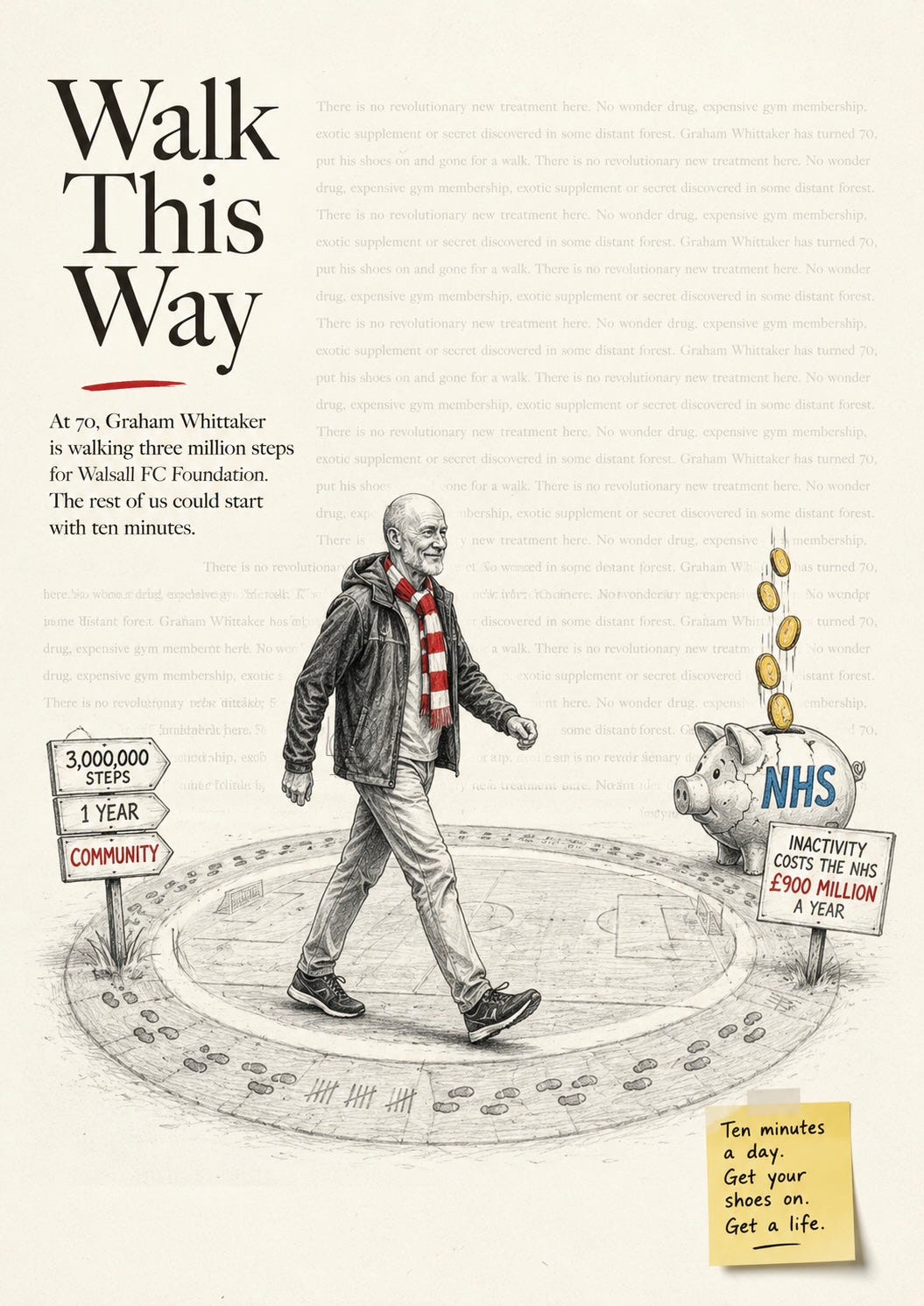
There are, apparently, all manner of things you can buy to make yourself live longer. Powders. Potions. Pills. Gym memberships. Personal trainers. Watches that know you are awake before you do. Apps that count your calories, examine your sleep and presumably send a small electronic reprimand if you have a biscuit after nine o’clock. Somewhere, no doubt, there is a very expensive berry growing in a forest that promises to make a 70-year-old feel 35 again. Graham Whittaker has gone for shoes. He turned 70 this month and has decided to mark it by walking three million steps over the next year, raising money for Walsall FC Foundation as he goes. Three million is a wonderfully ridiculous number. It is about 8,200 steps every day for a year and, depending on the length of Graham’s stride, somewhere around 1,400 miles. Put it into the unofficial British measurement system and it is roughly 6,500 laps of a decent-sized football pitch. Do not try this at home. Well, do. Just perhaps not all three million of them. Get a proper life. Graham’s target is deliberately enormous because he is raising money. The useful lesson for the rest of us is considerably smaller. Put your shoes on. Go outside. Walk somewhere. Then, preferably, walk back.
There is nothing particularly remarkable about Graham physically, which is rather the point. He isn’t a 70-year-old bodybuilder with muscles in places most of us don’t have places. Nor is this one of those heroic before-and-after stories involving the loss of six stone and trousers big enough to accommodate a family of four. He is a reasonably fit bloke of 70 who would quite like to remain reasonably fit at 71, 72 and, with luck, for a good while after that. There is a photograph of Graham I particularly like. It was taken in 1973 at Walsall’s old Fellows Park ground. He is 16, up a ladder helping to build the new illuminated scoreboard and, most surprisingly of all to anyone who knows him today, possesses an impressive quantity of hair. Fifty-three years later there is another photograph. Graham is standing at Bristol City preparing for another walk in Walsall colours. The hair has largely gone, but Walsall FC hasn’t. In truth it never stood much chance of escaping him. Graham was born virtually next door to Fellows Park. He has shown me an old aerial photograph and there is the ground with his childhood home immediately alongside it. Fellows Park disappeared years ago and the site is now Morrisons. I have not yet established what occupies the precise footprint of Graham’s old house. I rather hope it is the bacon counter.
Now an Associate Director and Supporter Liaison Officer at Walsall, as well as chairman of trustees of the club’s Foundation, Graham travels to away matches and hopes to walk around as many of those grounds as possible. That gives us another pleasing absurdity because journalists routinely describe enormous areas in football pitches despite football pitches not actually being a standard size. A new housing development is 20 football pitches. A forest fire destroys 5,000 football pitches. A warehouse covers 30 football pitches. Which football pitch? Nobody ever says. Graham could inadvertently spend his seventies conducting the definitive survey. We will therefore keep an eye on him, although there may already be an unexpected sporting dimension to the experiment. Graham walked at Bristol City. Walsall won. He went to Gillingham. Walsall won there too. The Saddlers currently sit top of League Two. Pure coincidence, obviously. If this continues much longer, however, Graham may discover that Walsall supporters are less interested in his cardiovascular wellbeing than ensuring he completes several circuits before kick-off. Should the Saddlers reach Wembley, I imagine somebody will carry him around the pitch if necessary.
But underneath all this silliness sits something rather serious. Physical inactivity is associated with about one in six deaths in the UK and has been estimated to cost the country £7.4 billion a year, including around £900 million falling directly upon the NHS. Regular physical activity is associated with lower risks of heart disease, stroke, type 2 diabetes, some cancers and premature death. We spend an extraordinary amount of time discussing how to save the NHS. There are reorganisations, strategies, integrated systems, new structures, revised structures and, inevitably, committees to examine whether the previous structure should have been structured differently. Some of us could also go for a walk. Not three million steps. Nobody is suggesting the population should spend the rest of its life marching around housing estates like a badly organised infantry regiment. The NHS says even a brisk ten-minute daily walk has health benefits. For older adults the broad advice is to do some physical activity every day, with those able to do so working towards 150 minutes of moderate activity each week. Ten minutes. You can spend longer than that looking for your glasses while they are on your head.
And there is a slightly uncomfortable aspect to all this for those of us who have reached the age when candles represent a genuine fire risk. Living longer is only half the bargain. Being capable of doing something with the extra years is the useful bit. There is little triumph in acquiring another decade if you spend most of it unable to get out of the chair. Besides, living longer presents another danger rarely mentioned by public-health officials. The grandchildren. Medical science has become so successful that we may now have to put up with them for decades. More school concerts. More photographs. More explanations of things we already understand. More requests for money. If that isn’t sufficient motivation to maintain enough mobility to make a quick getaway, I don’t know what is. Graham isn’t offering a cure for ageing. He isn’t even offering advice particularly. He’s simply doing something. He walks. Along the way he raises money for Walsall FC Foundation, whose work reaches into education, employability, health, youth engagement and football development across the town. Supporters can join him on some of the walks and, perhaps more importantly, somebody watching a 70-year-old clocking up the miles might decide they could manage ten minutes themselves.
That is where Graham’s three million steps become rather more interesting than the number. We don’t all need three million. We don’t need a football club, an away fixture or a charity challenge either. We don’t even need to be particularly good at it. Shoes. Front door. Left foot. Right foot. Repeat occasionally. It will never make anybody rich enough to advertise it during prime-time television, which may explain why such a revolutionary piece of healthcare has been hiding in plain sight for several thousand years. Graham has merely decided to remind us. And if Walsall keep winning every time he walks around the opposition’s ground, he may accidentally get them promoted as well.