

Three Votes Then. One Seat Now. Birmingham’s First Political Test Since May
It’s only one Town Council seat… or is it? Vesey may become the first real measure of where Birmingham’s increasingly unpredictable voters are heading.

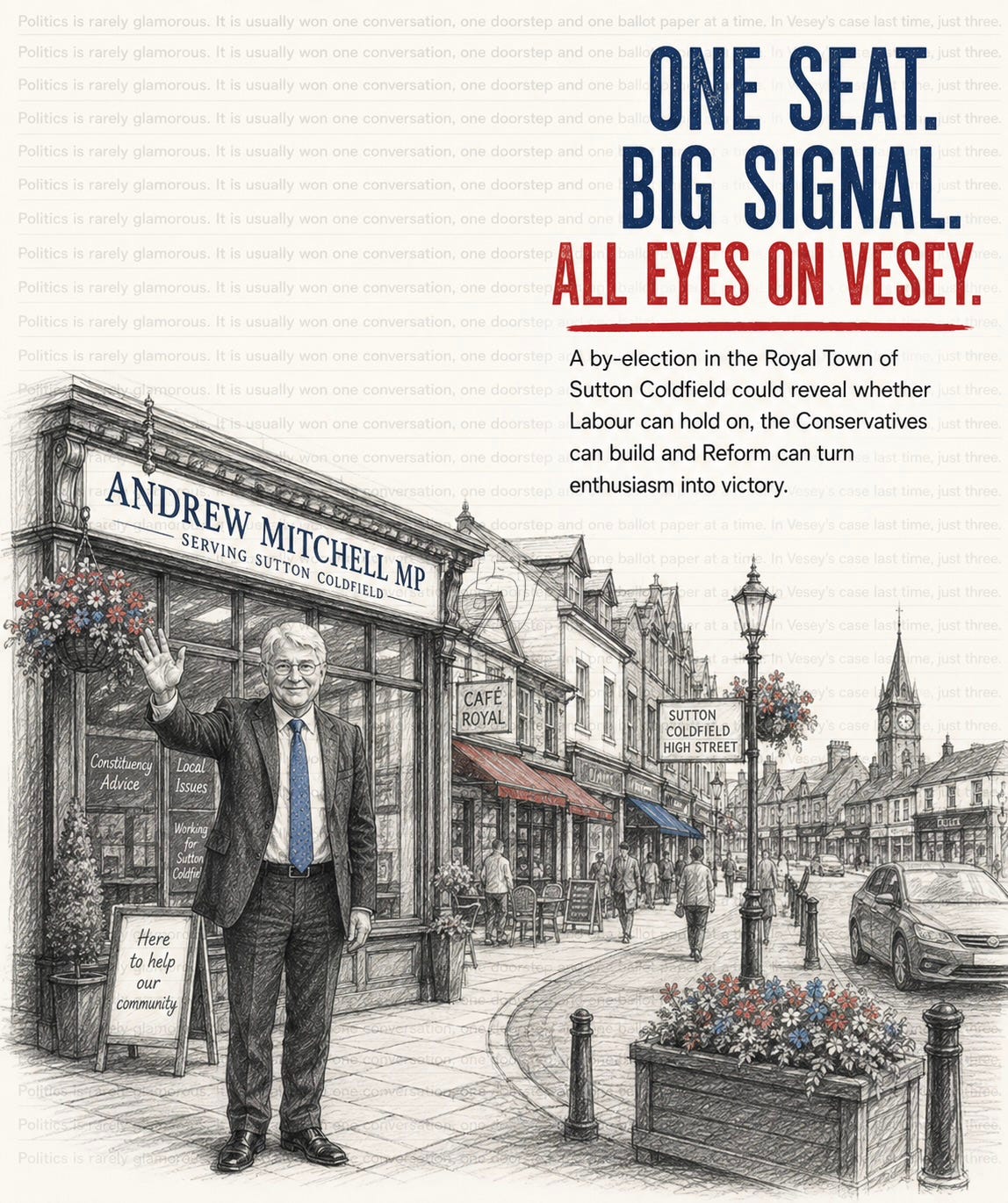
Politics is a funny old business. Sometimes billions of pounds, international crises and national opinion polls dominate the headlines. Then along comes a vacancy on a Town Council and suddenly Westminster, Birmingham and every political activist with a clipboard begins paying attention. That is exactly what may happen in Royal Sutton Coldfield. Following the resignation of Labour Town Councillor Alex Cowley, Birmingham City Council has confirmed that sufficient requests have now been received from electors to trigger a by-election. The date is yet to be announced, but one thing is already certain. This little election has suddenly become rather important.
Not because Royal Sutton Coldfield Town Council controls vast budgets or determines the future of civilisation as we know it. It does not. But because elections, particularly by-elections, often tell us something about the public mood that opinion polls simply cannot. Think of it as Birmingham’s first political MOT since the extraordinary elections of May. The Conservatives recovered ground. Reform UK became Birmingham’s largest party. Labour suffered heavy losses. The Greens continued their remarkable rise. Independents demonstrated that local campaigning still counts for something. The electorate looked less like a loyal family and more like speed dating. Now comes the first opportunity to discover whether that was a one-off political earthquake or the beginning of a new landscape.
Vesey is fascinating because the numbers tell a story. At Birmingham City Council level the Conservatives captured both Sutton Vesey seats. Yet in the Town Council election, held on exactly the same day, Labour won three of the five available seats, the Conservatives secured two and Reform UK missed taking the final Labour place by just three votes. Three. In electoral terms that is not so much a defeat as a rounding error. That alone makes this by-election worth watching.
Reform’s performance across Birmingham in May was remarkable by any sensible measure. To move from political outsider to becoming the council’s largest party in such a short period is something most parties can only dream about. But remarkable does not necessarily mean perfect. Looking through the ward results there is a pattern emerging. Reform attracted substantial support in many parts of the city but did not always convert that enthusiasm into seats. Castle Vale is perhaps the clearest example, where victory slipped away by just 44 votes. In Vesey, at Town Council level, the margin was only three votes. Elsewhere Reform established itself as a serious challenger without quite getting over the finishing line. The point is not that every second place was a hidden victory. It was not. The point is that there were places where a sharper, more concentrated and more personal campaign might have produced more councillors.
There is a world of difference between building momentum and building an election-winning machine. The first is exciting. The second wins council seats. Politics is littered with parties that packed public meetings, filled Facebook with enthusiastic supporters and generated impressive headlines, only to discover that elections are actually won by knocking on doors in the rain on a Tuesday evening. Successful local politics is gloriously unglamorous. It means selecting candidates people know and trust. It means building a reputation before polling day arrives. It means keeping records, following up residents’ concerns, identifying supporters and, perhaps most importantly of all, encouraging postal votes. It means real personal contact rather than assuming a national wave will carry every candidate over the line.
Labour has understood that lesson for decades. The Conservatives understand it too. Neither party simply turns up six weeks before polling day and hopes for the best. They identify likely supporters, return to them, speak to them again, organise postal votes and make sure people actually cast their ballot. Reform has already proved it can generate enthusiasm. The next test is whether it can turn that enthusiasm into disciplined electioneering. That means high-profile candidates with local credibility, strong ward campaigns, careful organisation, repeated doorstep contact and postal votes treated as a primary consideration rather than an afterthought.
This is where Vesey becomes such a useful test. Reform came within three votes of winning a Town Council seat only weeks ago. It does not need to invent a support base because one already exists. But a by-election is a different animal from a city-wide election. Turnout may be lower. The electorate will receive more concentrated attention. The established parties will know exactly what is at stake. Reform will not be able to rely simply on national momentum or anger with the old parties. It will have to show that it can identify its voters, persuade the undecided and make sure supporters return their postal ballots or get to the polling station.
Labour also has a serious problem to solve. It has lost both City Council seats in Sutton Vesey and now faces an unexpected vacancy after one of its Town Councillors resigned only weeks after being elected. Retaining the seat would show that its local vote remains resilient despite the wider collapse. Losing it would deepen the impression that Labour’s old grip on parts of Birmingham is continuing to loosen. The Conservatives, meanwhile, will see an opportunity to add to their May gains and demonstrate that their Sutton recovery was not merely a temporary reaction against Labour.
That is why nobody should dismiss this as only a Town Council election. The seat itself may be modest, but the political test is real. If Reform wins, it will suggest the party is beginning to turn enthusiasm into organisation. If Labour holds on, it will show that local campaigning and established networks still count. If the Conservatives take it, they will claim their resurgence in Sutton is becoming firmly rooted. Each party has something to prove, and each has something to lose.
Somewhere in campaign headquarters across Birmingham there will already be volunteers hunting for canvassing sheets, candidates checking their diaries, printers warming up for the first leaflets and activists discussing postal votes over cups of tea that went cold half an hour ago. Politics, after all, is rarely glamorous. It is usually won one conversation, one doorstep and one ballot paper at a time. Or, in Vesey’s case last time, just three.
Love him, loathe him… or never really had him on your radar?
If you enjoy political memoirs, Andrew Mitchell MP’s Beyond a Fringe is well worth your time. Refreshingly honest, self-deprecating and often very funny, it offers a rare insider’s view of Westminster without descending into score-settling. Whatever your politics, this is an engaging and worthwhile read from Sutton Coldfield’s long-serving MP.
“I loved it ..” - Mike Olley
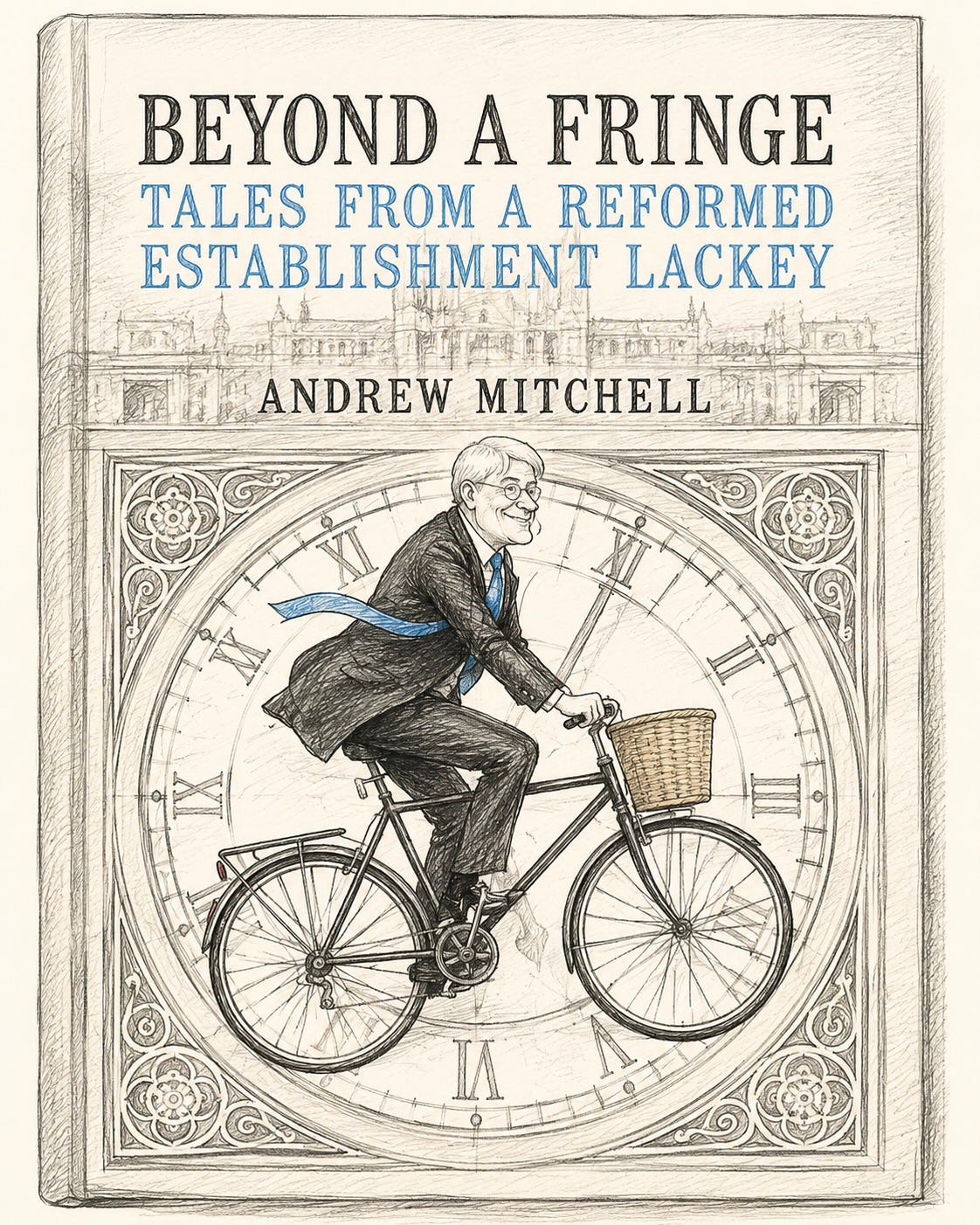
From decent booksellers including Amazon …