

TIES, TRANSPARENCY… AND THE GREAT DECLARATION OF INTEREST
A good first Cabinet meeting raised one awkward question: if Cllrs declare interests in public, why don’t senior officers?

It was one of those glorious Birmingham afternoons when common sense suggested leaving the jacket at home. Cllr Roger Harmer clearly agreed. Birmingham’s new Leader took the chair for his first Cabinet meeting looking smart, relaxed and sensibly dressed in an open-necked white shirt. Sitting alongside him was his deputy, Cllr Julian Pritchard, who had taken an altogether different approach to the weather. Jacket. Shirt. Tie. Immaculately turned out, looking as though he could chair Cabinet, nip off to a board meeting and still have time to present the evening news. Two politicians. Two wardrobes. One heatwave. It was a reassuringly human way to begin a new political chapter for Birmingham.
More importantly, the meeting itself was a decent first outing. New administrations can sometimes look nervous, hesitant or unsure of themselves. This one did not. It was orderly, businesslike and refreshingly free of unnecessary political theatre. There were no spectacular own goals, no dramatic rows and certainly nothing that made you think Birmingham had accidentally handed the keys to the city to the cast of a sitcom. Credit where it is due. They looked prepared, they looked professional and, as opening performances go, they deserved a generous round of applause. Of course, now comes the difficult bit. The city’s finances still need repairing, confidence still needs rebuilding and, yes, those bins still need collecting. But first impressions matter, and this was a respectable beginning.
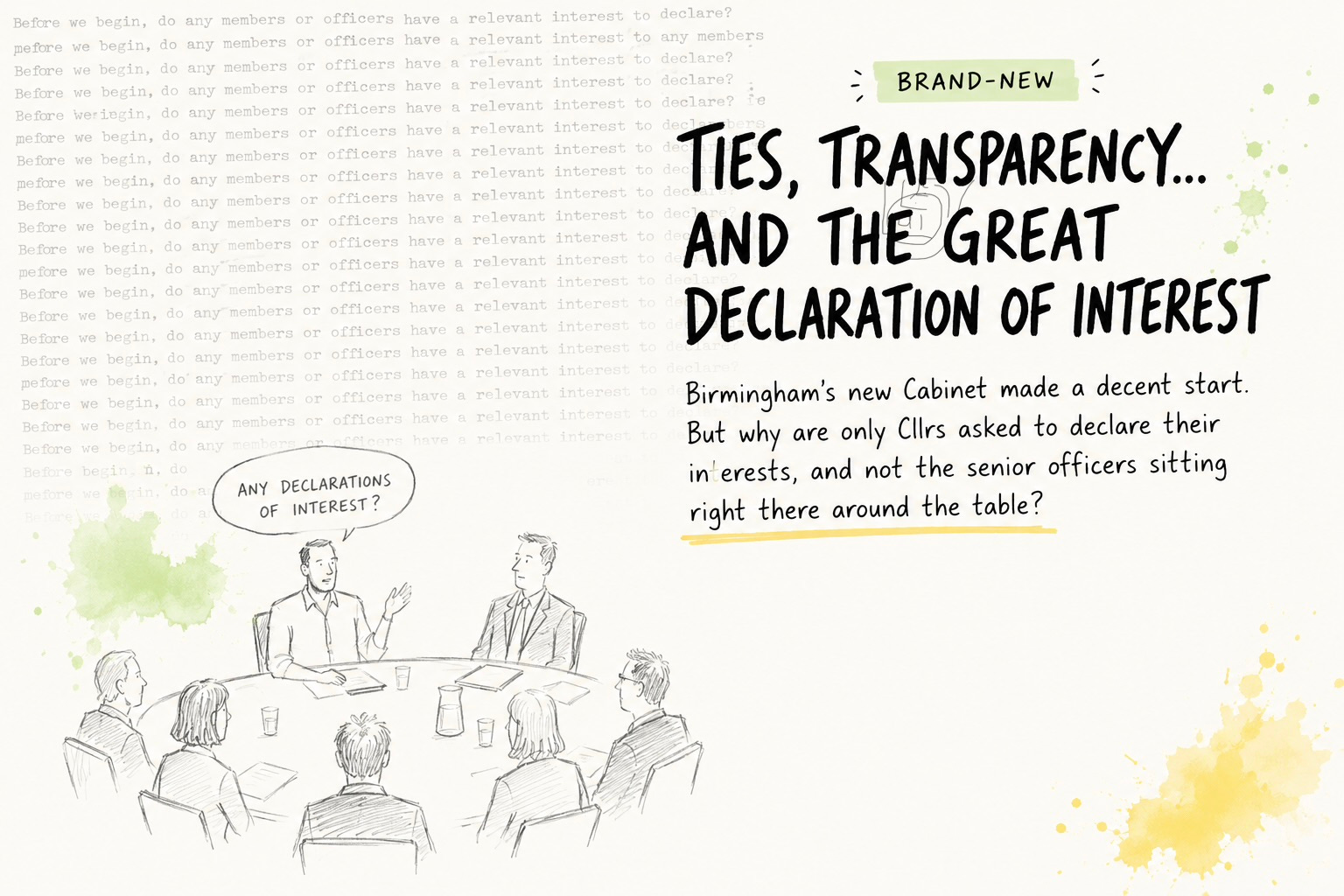
Then Cllr Harmer reached the point in the agenda that appears in virtually every council meeting in the country. Were there any declarations of interest? It is one of local government’s oldest traditions and, frankly, one of its most important. If an elected member has a financial interest, a family connection or another relevant involvement in the business before them, the public deserves to know before decisions are taken. Nobody could sensibly argue with that principle.
But as Cllr Harmer asked the question, my attention wandered towards the senior officers sitting around the Cabinet table alongside the elected members. They had written the reports. They had prepared the recommendations. They had advised Cabinet members, assembled the evidence and, in many cases, knew more about the subjects under discussion than anyone else in the room. Yet nobody asked them whether they had anything to declare.
Before anyone rushes to the complaints procedure, let me make something crystal clear. I am not suggesting that any officer present had an undeclared interest. Nor am I criticising Cllr Harmer personally. He simply followed the convention observed in council chambers across the country. My question is whether that convention still makes sense.
Council officers wield enormous influence. They oversee procurement, negotiate contracts, manage major projects, investigate complaints, draft policies and advise elected members before decisions are taken. They are governed by professional codes, internal declaration procedures and employment rules, exactly as they should be. But if transparency is the objective, why not make it visible? Why not simply ask everyone sitting around the Cabinet table the same question? “Before we begin, do any members or officers have a relevant interest to declare?” It would add perhaps ten seconds to the meeting and send a powerful message that openness applies equally to everyone involved in public decision-making.
Nationally, we know officers are every bit as capable as elected members of finding themselves in difficulty over conflicts of interest. Internal audits have uncovered undisclosed business interests, procurement conflicts and relationships with suppliers which should have been declared. The consequences can be severe, ranging from disciplinary action to dismissal and, in the most serious cases, criminal investigation. They are not superhuman. They are simply human, just like the politicians sitting alongside them.
Cllrs who are found to have breached their Code of Conduct face the Standards process, and Birmingham quite properly publishes annual Standards information and the outcomes of formal findings. My only observation is that if you have ever tried finding some of those reports, you will know they are not exactly displayed in the shop window. They are there, but locating them can sometimes feel like taking part in the Great Birmingham Municipal Treasure Hunt. One click takes you to committee papers. Another to an agenda. Then an appendix. Then a report hidden inside another report. Eventually, after enough digital archaeology, you find the document you were looking for. By then you’ve forgotten what you were looking for in the first place.
Interestingly, Birmingham’s own governance review has already highlighted the importance of transparency around officers’ declarations of interests, gifts and hospitality. The government-appointed commissioners recommended improvements in this area, recognising that public confidence depends upon clear and robust governance. So this is not some daft question dreamt up over a cup of coffee. It is a perfectly respectable question about whether local government should demonstrate openness in the same way for everyone who influences a decision.
So here is my modest proposal. Keep asking Cllrs to declare their interests. That is absolutely right. But extend the invitation to the senior officers sitting around the Cabinet table as well. Nobody loses face. Nobody is accused of anything. Everybody is treated equally. If transparency really is the aim, then transparency should apply to everyone involved in making public decisions, not simply those who happen to have fought an election.
As for Cllr Harmer and Cllr Pritchard, congratulations on getting through your first Cabinet meeting without any obvious calamities. One of you may wish to invest in a tie before winter. The other may wish to leave his at home until October. More importantly, you made a decent start. There was nothing in that first performance which made me think, “Good grief, this lot will never sort Birmingham out.” On the contrary, it was a respectable job, competently done. Well done, chaps. Now get on and sort the bin strike.