


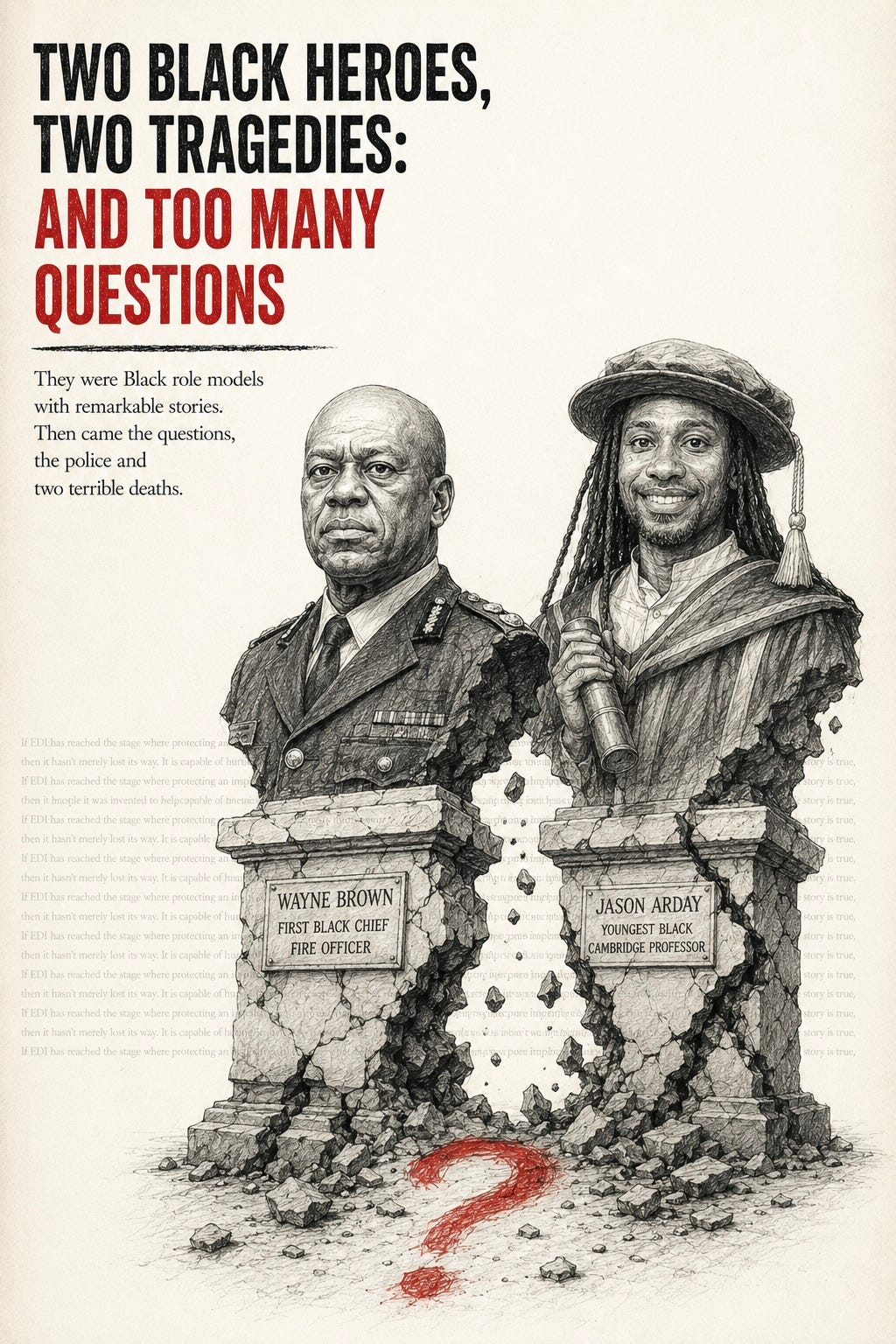
Wayne Brown was Britain’s first Black Chief Fire Officer, the man appointed to run West Midlands Fire Service, and Jason Arday was the academic with the quite extraordinary life story who became Cambridge University’s youngest Black professor. Two men who made history, two Black men whose success was held up as proof that some of the old barriers were finally coming down, and now, terribly, two men who are dead. I wanted both stories to be true. I really did. I have Black children and I want them to have people like Brown and Arday to look up to, although the ultimate victory will come when there are so many Black Chief Fire Officers and Cambridge professors that nobody thinks to put “Black” in the headline at all. There is something particularly haunting for me about Brown because I discovered after his death that we had actually been next-door neighbours on Wake Green Road in Moseley, albeit separated by forty-odd years. I lived there, then much later he lived there, and it was there that he took his own life. Add another coincidence from thirty-odd years in time: when I was a Birmingham councillor I sat on what was then the West Midlands Fire and Civil Defence Authority. I didn’t know Brown, so I am not going to pretend some friendship into existence, but every so often a story comes along and bumps into bits of your own life. This one seems determined to do it.
The difficulty is that Wayne Brown’s wonderful story had a hole in it. The MBA associated with his professional credentials had never been completed. Brown eventually acknowledged that and Grant Thornton subsequently criticised West Midlands Fire Service for failing properly to check his educational qualifications; who was that then? Somebody, somewhere, had managed to appoint a Chief Fire Officer without getting that rather basic bit of homework right. And sitting inconveniently in the background was Ben Walker, who had been asking awkward questions long before the rest of us knew there were awkward questions to ask. Walker says he went through the proper channels in October 2021, raising concerns about Brown among wider issues, and returned to the subject in January 2023 as Brown approached the top job, asking whether proper due diligence had actually been carried out. That is worth remembering because Walker subsequently acquired the appearance of the troublesome man pursuing Brown. It is rather harder to dismiss him that way when you realise he had been knocking on the proper doors asking people to look before Brown was appointed, and that one of the things he was worried about subsequently turned out to have considerable substance.
Walker is an interesting bloke in his own right. He identifies as a Water Gypsy, from the old canal-boat community, which introduces one of those deliciously inconvenient wrinkles that real life tends to insert into nice tidy EDI stories. The troublesome fellow asking questions about Britain’s first Black Chief Fire Officer was himself from a minority travelling tradition. He is no mug either. He had worked internationally as a fire specialist and, nowadays, is in the closing stages of training to become a barrister. None of that makes him right about everything and it isn’t supposed to. It merely makes the cardboard-cutout version of this story rather difficult to sustain. Then, on 2 April 2023, Walker flew back into Birmingham Airport from the Far East, where he had been working as an international fire consultant, and waiting for him was West Midlands Police. Quite a lot of West Midlands Police, according to Walker, including armed officers. He was arrested over allegations arising from Brown’s complaint of harassment and interviewed the following day. I am deliberately not decorating that scene because it doesn’t need decorating. When arresting someone for allegedly harassing another person through social media and electronic communications, is the presence of armed police at an international airport utterly routine or decidedly unusual? I don’t know, so tonight I asked West Midlands Police. If they tell me this was entirely normal, that is useful and I shall report it. If they tell me it wasn’t, an even better question arrives all by itself: what was different about Ben Walker?
And that question has acquired rather more bite with age. Who decided how that arrest would be conducted? Why there? Why that level of policing? What risk was thought to exist? Who authorised it? Had anybody at West Midlands Fire Service spoken to anybody at West Midlands Police about Walker beforehand? I am not filling in the blanks because I don’t know what belongs in them, but somebody does. Walker’s case was eventually dropped on 10 February 2025. He didn’t want it simply disappearing and, at his request, it was reinstated so that there could be a proper conclusion. On 2 April 2025, exactly two years after the airport arrest, the CPS offered no evidence and Walker was acquitted. By then Wayne Brown was dead and the qualification issue Walker had been worrying away at had emerged into daylight. There is nothing remotely celebratory in writing that. Brown taking his own life on Wake Green Road was a dreadful human ending and the subsequent inquest examined the enormous pressures he had been experiencing. Being wrong about your qualifications does not mean you deserve humiliation, destruction or death. Of course it doesn’t. But equally, dying cannot retrospectively make the questions Walker was asking improper questions.
And then came Jason Arday, and I began getting that peculiar feeling you get when a new story reminds you of one you haven’t quite finished with yet. Arday’s story was magnificent. Autism, profound difficulties as a child, unable according to his account to speak until 11 and unable to read or write until 18, then academia and eventually Cambridge, where in 2023 he became its youngest Black professor. He raised money for charity, undertook extraordinary physical challenges and became an inspirational speaker. Then people began checking bits of this extraordinary life and finding things they wanted explained. His academic work was questioned, as were affiliations, fundraising and elements of the biography which had helped make him famous. Former schoolmates have subsequently given conflicting accounts of his childhood. There were serious allegations of plagiarism, although Arday denied dishonesty and Liverpool John Moores University had previously cleared him; Cambridge eventually opened its own investigation after receiving what it called new information, but Arday resigned before that process reached a conclusion. Days later he was found dead. Police say his death was unexpected but is not being treated as suspicious. His family says he was subjected to misinformation and harassment, and there is now a huge and deeply emotional argument over whether the scrutiny of him was legitimate journalism or a racially charged public destruction of a Black man.
I don’t find that argument nearly as easy as some people apparently do. Arday undoubtedly received racist abuse and there is nothing remotely defensible about it. His family is grieving and I cannot begin to imagine what these days are like for them. There was also a huge volume of coverage and it is perfectly legitimate to ask whether a human being, particularly a vulnerable one, became engulfed by it. But legitimate journalism doesn’t cease being legitimate because racists are simultaneously behaving disgracefully. A professor’s published academic work can be checked. A claimed university affiliation can be checked. Fundraising claims can be checked. An extraordinary life story sold to newspapers, publishers and universities can be checked. Indeed one of the strangest parts of the Arday affair concerns journalist Jack Grove, who investigated questions about Arday’s academic record and became the subject of a police harassment investigation after contacting him with journalistic enquiries. Metropolitan Police Commissioner Sir Mark Rowley has since said his force “dropped the ball” and that the matter should have been screened out as requiring no police action. And there I was, back thinking about Ben Walker again.
Perhaps this is the bit of EDI we haven’t thought about enough. I spent part of my own professional life working around equality and diversity and I believe in the basic idea for the rather uncomplicated reason that it is right. If a brilliant Black youngster was once kept away from a job because the bloke doing the appointing couldn’t imagine a Black face doing it, get rid of the barrier. If somebody with a disability can do the job, make the adjustment and let them do it. Equality ought not to be terribly complicated. Somewhere along the road, though, institutions discovered something else: diversity was good publicity. Suddenly we had first Black this, youngest Black that, barriers being broken, photographs, awards, inspirational biographies and organisations congratulating themselves on the achievement of the person they had appointed. I understand it. Wayne Brown becoming Britain’s first Black Chief Fire Officer really was something worth celebrating. Jason Arday reaching Cambridge really was an extraordinary achievement. But the moment an institution becomes emotionally invested in somebody as evidence of its own virtue, an awkward possibility arises. What happens when somebody asks whether the bloke on the pedestal actually has the qualification written on the CV?
That is where I think good EDI can become rotten EDI. Not because Black people have been given jobs they shouldn’t have. That lazy conclusion would be as stupid as it is offensive. It becomes rotten when ordinary scrutiny starts looking like hostility to diversity itself. Brown’s MBA should have been checked for exactly the same reason mine should have been checked. Arday’s academic work should have faced exactly the scrutiny any Cambridge professor’s work should face. If Ben Walker raised concerns through the proper channels, somebody should have investigated whether those concerns were true before becoming terribly interested in whether Walker was a nuisance. If Jack Grove sent legitimate journalistic questions to a Cambridge professor, the answer wasn’t a four-month police investigation, and the Metropolitan Police Commissioner now effectively says so. Equality doesn’t mean lowering a bar. It doesn’t mean raising it either. It means leaving the damned thing exactly where it is and measuring everybody against it.
I keep coming back to Brown because of Wake Green Road. Perhaps that’s sentimental, but there it is. I can picture the road because I lived on it. I can think back to sitting on the old Fire Authority and never imagining that decades later I would be writing about a Chief Fire Officer who would live next door to where I had lived and die there, while a man who had questioned him would find himself arriving home from the Far East to an arrest at Birmingham Airport involving armed police. There are people inside West Midlands Police and West Midlands Fire Service who know considerably more about how that happened than I presently do. They may have perfectly good answers. I have now started asking for them. If the presence of armed officers was utterly routine, fine. If it wasn’t, somebody made a decision and there will presumably be a reason for it. Given everything that subsequently unravelled, I suspect anybody involved in anything less than an entirely proper decision will not particularly relish somebody rummaging around in the paperwork now. Duvets are available in most sensible sizes.
None of this makes Wayne Brown a monster. It doesn’t make Jason Arday one either. Actually that is part of what bothers me about the whole business. These were human beings whom institutions and newspapers helped turn into symbols. When you turn somebody into a symbol, people eventually stop allowing him the ordinary luxury of being flawed. Either he remains an inspirational hero or, when things unravel, he becomes a fraud. Real people are generally messier than either description. I feel terribly sorry for Brown. I feel terribly sorry for Arday. I wish Brown had been sitting in that house on Wake Green Road answering difficult questions rather than dying there. I wish Arday were still here answering his. Neither man deserved the ending he got, whatever eventually proves true about either of them.
But I also feel sorry for the people who asked questions and discovered that asking them could become remarkably expensive. Ben Walker spent two years going from that extraordinary airport arrest to the CPS offering no evidence. Jack Grove discovered that emailing questions to an academic could help generate a four-month Metropolitan Police investigation which the Commissioner now says should never have happened. If EDI has reached the stage where protecting an inspirational story becomes more important than finding out whether the story is true, then it hasn’t merely lost its way. It is capable of hurting the very people it was invented to help.
And I really did want both of these stories to be true.