

Two Men, a Dog and a Flying Trumpet Player at Bleakhouse Library
I predicted an audience of two men and a dog. Sandwell supplied a packed library, extra jazz, tea, history and a trumpet player entering the second half almost horizontally.

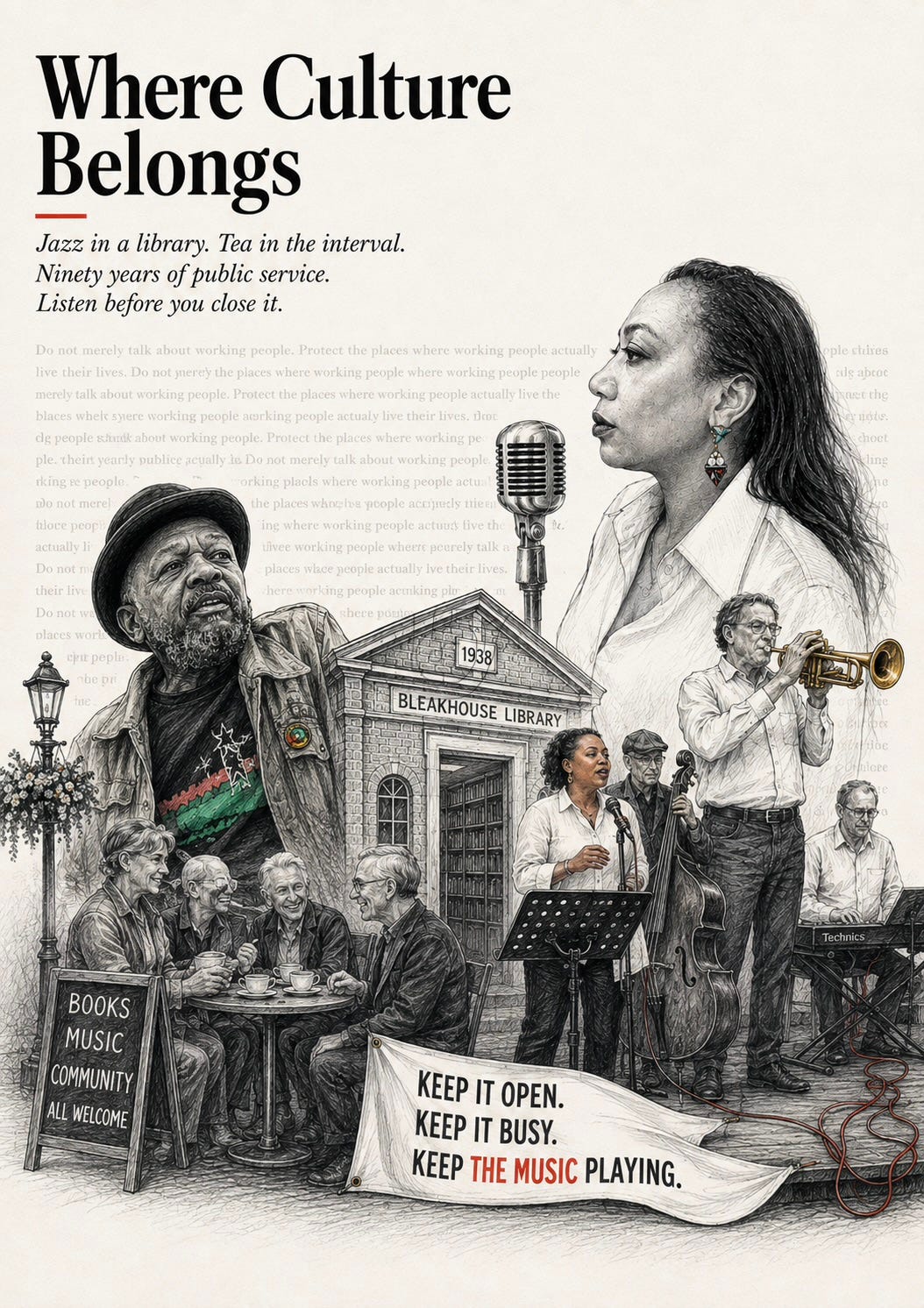
I told Mrs Olley she would be lucky to get two men and a dog at Bleakhouse Library. This was not intended as husbandly discouragement. It was what I considered a sensible forecast for an evening of jazz in a public library in Sandwell. Mrs Olley, who has built a successful marriage around ignoring most of my sensible forecasts, went off to sing with John Hemming and the Jazz Lobbyists and helped fill the place with somewhere between 80 and 100 people.
There are moments when a man must admit he was wrong. I try to ration mine, otherwise Mrs Olley might become overconfident, but there was no escape from this one. Bleakhouse was packed. Not politely occupied or enjoying what organisers describe as an encouraging turnout when 14 people arrive and five of those are related to the band. It was properly full, with an audience ready to listen, laugh and applaud.
The advertised programme was two 45-minute sets, although both ran over. The audience therefore received considerably more jazz than promised and appeared delighted with every minute of the extra time. Nobody was shuffling towards the door or looking anxiously at a watch. They stayed because they were enjoying themselves, which remains a rather better test of a successful event than any audience development report.
Naturally, as Mrs Olley is the vocalist, I am duty-bound to support her. I also support the Birmingham Jazz and Blues Festival, even when it crosses the border into Sandwell and requires a Birmingham man to carry his passport. Family loyalty only gets a band so far, however, and the truth is that I have now heard much of this set a fair few times and still genuinely get drawn into it.
John Hemming is known to many people as a former MP and a successful business entrepreneur. Politics being politics, some people will decide what they think of him before he reaches the piano stool. That is their loss. He is an accomplished musician and, perhaps just as importantly, he knows how to gather excellent musicians around him and allow them to be excellent. There is no vanity orchestra here, with everybody instructed to remain half a note quieter than the proprietor. The band works because the musicians are allowed to play.
The most dramatic contribution came at the beginning of the second half when Andy, the trumpet player, made an impressive entrance in a way nobody would recommend repeating. He caught a cable around his foot and crashed down hard, almost leaving the stage by the quickest available route. For a moment the entire room tightened. The audience fell silent and the band froze. This had stopped being funny.
Thankfully Andy was all right, shaken but not seriously hurt. He got back to his feet and received a huge, relieved round of applause. “What I have to do to get a round of applause,” he observed, which produced another one. Andy then played on, a little shaken but not stirred. Only live music gives you a trumpet player nearly arriving in the audience without using the steps, making a joke about it and then completing the set.
Basil Gabbidon was there with his equally talented wife Cathy. Basil is one of Birmingham’s great reggae musicians and a founding member of Steel Pulse. This was his second appearance at this year’s Jazz Festival, not on the stage but in the audience, supporting other musicians. During the interval he went over and spoke to all the band. He appeared to know most of them, and those he might not have known he plainly respected.
I liked that. Birmingham music can sometimes behave like a collection of neighbouring religious denominations, each convinced that the people playing three streets away are involved in an entirely different faith. Here was reggae coming out for jazz, musician appreciating musician, without anybody producing a strategy document headed “cross-genre stakeholder engagement”. Perhaps next year Basil might fuse some reggae into the jazz. I offer the suggestion free, although should it become an international musical movement, I reserve the right to remember inventing it over a cup of tea at Bleakhouse Library.
The building was the other star of the evening. Bleakhouse Library opened as Warley Library on 20 January 1938. The plaque records Councillor H. A. Lacon JP, chairman of the Public Libraries Committee, and Councillor R. M. Hadley JP, Mayor of Oldbury. You can tell that opening a library was considered a major civic occasion because it was. Councillors put on their chains, people gathered, speeches were made and nobody described the provision of books as an outdated delivery model.
On that same day, King Farouk of Egypt married the woman who became Queen Farida before enormous crowds in Cairo. Oldbury could not offer a king, a queen, a palace or half a million cheering Egyptians, but it opened a public library. Farouk lost his throne in 1952. Bleakhouse is still lending books. Oldbury may have made the sounder long-term investment.
The Friends of Bleakhouse Library provided half-time refreshments, including a very welcome cup of tea, and opened the library garden. For a book place, they certainly know how to keep a garden looking well. The evening demonstrated what a public library can be when it is treated not merely as a room containing shelves but as shared civic space. There was music, history, volunteering, conversation, tea, a lovely garden and, in an extravagant nod to tradition, even books.
This is one of the reasons the Birmingham Jazz and Blues Festival matters. It does not merely showcase musicians. It reveals venues and brings music into places where people already live their lives. One day Mrs Olley is singing among sofas, televisions and electrical goods at Harvey Norman in Sutton Coldfield; another day she is performing inside a library steeped in Oldbury history. Eclectic does not begin to cover it. What a festival, what a library and, as previously reported, what a furniture and electrical shop.
Now then, before we go any further, can I let you into a little secret? This article was never supposed to become political. Honestly, it was not. I sat down intending to write about Mrs Olley proving her husband wrong yet again, a packed library, a trumpet player who briefly tried to reach the audience without bothering with the steps, Basil Gabbidon encouraging fellow musicians and a wonderful evening of jazz that overran because nobody wanted it to end.
Then I looked back over my notes and realised that, whether I liked it or not, I was not simply writing about music. I was writing about working-class culture and what happens when politicians forget where it actually lives.
Look around that room. Ordinary local people spending a summer evening together. Volunteers making tea. Friends of the Library tending the garden. Jazz being played in a public building that has served its community since 1938. One of Birmingham’s great reggae musicians turning up simply because he respected the people on the stage. Nobody was asking whether this counted as high culture. Nobody cared whether the audience had read the programme notes. They were laughing, applauding, talking to neighbours and enjoying themselves.
And that made me uncomfortable because I am a Labour man. Always have been. Yet somewhere along the way Labour, particularly in Birmingham, appears to have stopped noticing too many of the places and activities working people actually value. It talks enthusiastically about culture but has too often seemed more comfortable championing the expensive, fashionable and officially approved end of it than fighting for libraries, speedway, local music festivals, working men’s clubs, community choirs, reggae, jazz and the everyday places where people gather.
There is nothing wrong with opera, ballet, theatre or fine art. I enjoy plenty of it myself. But working-class culture is not an inferior version of culture waiting to be improved by somebody with a grant application, a lanyard and a degree in audience development. It is culture. Full stop.
Birmingham Labour lost sight of too much of that and got booted out. Sandwell Labour was bottled out too, and the electorate handed control to Reform UK.
Which brings me to Councillor Ray Nock and his new administration. Reform talks a great deal about ordinary people, neglected communities, aspiration and giving a voice to those who feel ignored. Fine words. Now comes the interesting bit.
Walk into Bleakhouse Library and listen.
Listen to the applause. Listen to the laughter after Andy, thankfully more shaken than hurt, discovered the most painful way of earning a second round of applause. Listen to the conversations over cups of tea. Look at the volunteers, the garden, the musicians and a building that has been serving its community for nearly 90 years.
If Reform genuinely wants to represent working people, it should recognise that libraries such as Bleakhouse are not simply ageing buildings with maintenance bills attached. They are places where communities meet, children grow up, music is discovered, neighbours become friends and culture belongs to everybody.
Bleakhouse can lend books, stage live music, host community events, open its garden, bring generations together and still provide a decent cup of tea. It has survived since Oldbury had its own borough and King Farouk still possessed both a throne and a bride.
Reform should listen to the sound of jazz in the library and understand what it means. Do not merely talk about working people. Protect the places where working people actually live their lives.
Keep Bleakhouse open, keep it busy and keep the music playing.
And I was completely wrong about the two men and a dog.
There was no dog. It would not have found a seat.