

I have spent the last couple of days trying to understand what Mayor Richard Parker has actually done with our buses and I make no apology for that because, judging by some of the language being thrown around, I am not entirely sure everybody else understood it straight away either. Nationalisation? Public control? Franchising? A bailout? The buses coming home? National Express going home? All of those descriptions have been wandering about and at one point I found myself wondering whether the Mayor had actually bought a bus company at all or merely bought the right to tell somebody else’s bus company where to send its buses. Well, he has bought a bus company. Or, more precisely, the West Midlands Combined Authority is acquiring National Express’s West Midlands operation after its parent company Mobico decided it wanted out. This is the operation responsible for something approaching 94 per cent of bus journeys in the West Midlands, with around 4,800 employees and 1,300 buses, so Richard Parker could hardly wave goodbye and hope another bus company happened to turn up on Monday morning. He stepped in. Good for him.
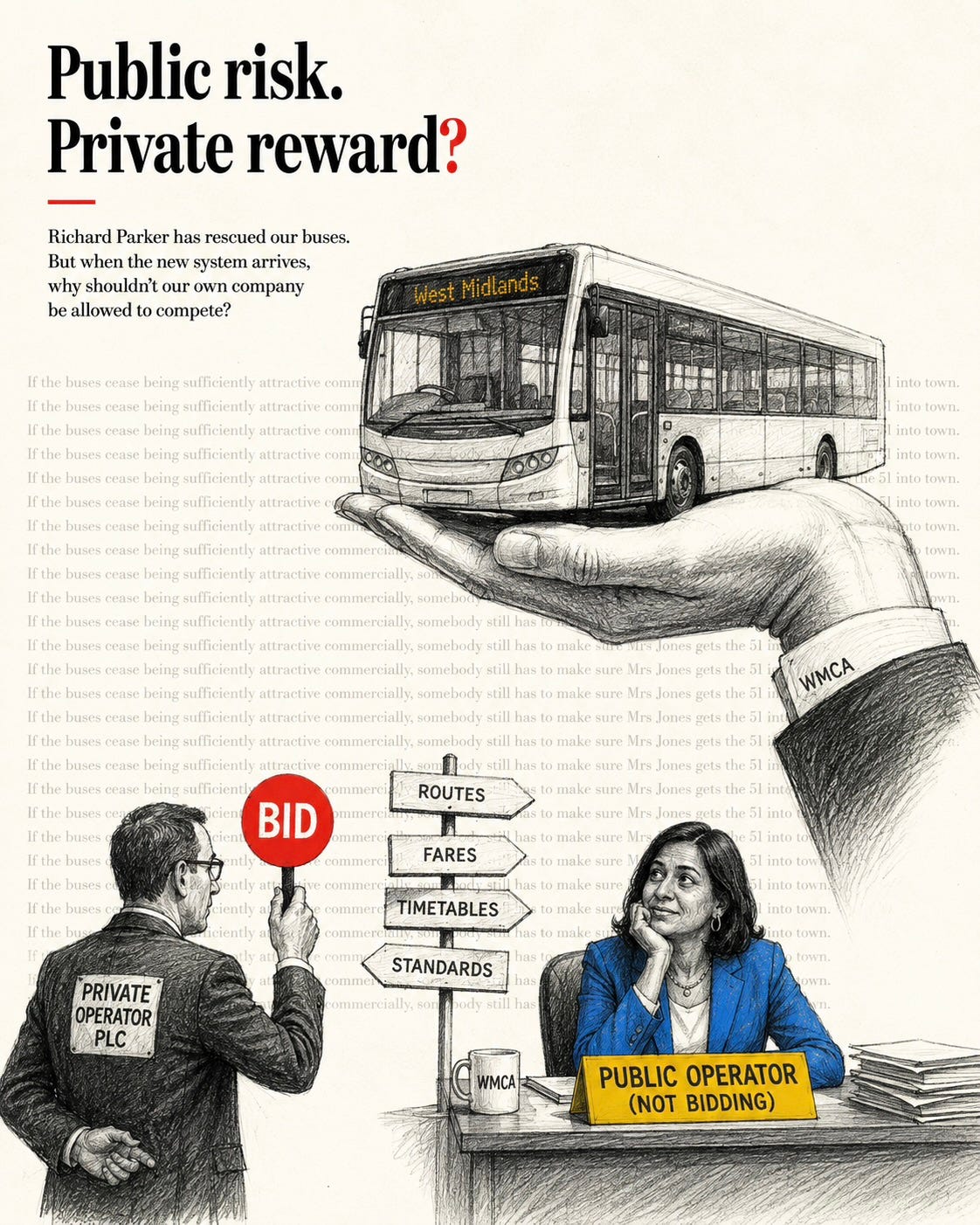
It took me a little longer to get my head around what happens next. The new publicly owned operation will be called West Midlands Bus Ltd and it will keep the buses running while Parker moves the region towards franchising. Franchising means the Combined Authority decides the routes, fares, timetables and standards and bus companies bid for contracts to actually run them. Fair enough. Greater public control was Parker’s promise and this delivers it. Then I discovered the bit which made me scratch my head. West Midlands Bus Ltd, the bus company we are buying, isn’t going to bid for those franchises. National Express, having got out of the existing operation, potentially can. I went around that particular roundabout several times before deciding I hadn’t misunderstood it. We are buying a functioning bus company because we cannot afford for it to disappear, but when the new system arrives our own bus company is not intended to compete to run our buses.
Now there may be a perfectly good reason for that and I have asked WMCA what it is. I have also asked what eventually happens to the buses, employees and infrastructure we are acquiring, whether allowing West Midlands Bus to compete was modelled and what the eventual cost to the public purse will be. At the time of writing I haven’t had the answers, although I haven’t been waiting long enough to start rattling the press office windows either. Birmingham’s Conservatives certainly think they know the answer. Cllr Robert Alden and Cllr Timothy Huxtable describe the deal as Labour having “nationalised the risk” while leaving private companies able to compete for the reward. It is a cracking political line, but a cracking political line isn’t necessarily the same thing as the truth and I want to hear Parker’s explanation before deciding that one.
Because there is another side to this which shouldn’t get lost. National Express’s owner isn’t a charity and isn’t supposed to be one. Mobico has shareholders and directors whose job is to look after the business. The West Midlands operation has reportedly been around break even over the longer term and Mobico has plenty of financial pressures of its own. Add franchising, which is about to completely change the market in which National Express operates, and I can understand somebody around a boardroom table asking why they should continue owning 1,300 buses, employing thousands of people and carrying all the commercial risk while waiting for the rules to change. If they can dispose of the existing operation and later compete for contracts in a franchised market, somebody at Mobico may regard that as rather sensible business. I don’t blame them for that. What interests me is whether it is equally sensible business for us.
There is some lovely history here too. West Midlands Travel was once ours. It left public ownership in 1991 in a management and employee buyout for £72 million. Just a few years later, in 1995, National Express acquired it in a deal worth £244 million. And now, 35 years after the original sale, the great West Midlands bus operation is coming back into public ownership, although apparently not in order to remain the permanent public operator of the network. History has a funny habit in Birmingham of coming back round, and in this case it appears to have done so on the Number 11.
I should declare an ideological weakness at this point. Had I been Richard Parker I would probably have been on the steps of the Council House with a brass band, banging a drum and announcing another small victory over the capitalist war machine. Richard Parker instead talks about “maintaining continuity”, “devolution”, “accountability” and the “transition towards franchising”. Perhaps that helps explain why Richard Parker, after a formidable career in international finance, became Mayor of the West Midlands while I have enjoyed a distinguished career sitting on the sidelines writing columns telling people like Richard Parker what I would have done. He may even have the better technique.
And actually I think Parker deserves rather more credit than some of the immediate criticism allows. When the private operator responsible for nearly all your bus journeys decides the existing business no longer suits it, the Mayor doesn’t have the luxury of making the same commercial calculation. The buses still have to turn up. People still have to get to work, school, hospital and the shops. Drivers still need jobs. A commercial company can eventually decide that the return no longer justifies the risk. Government cannot decide that Birmingham, Wolverhampton, Walsall, Dudley, Sandwell, Solihull and Coventry can manage without buses until somebody finds a more profitable way of providing them. Parker faced that reality and intervened.
Which is where my mind wandered off to water, because it usually does wander somewhere. We were told that privatisation would bring investment, efficiency and commercial discipline. More than three decades later we are embarking upon another enormous investment programme, paid for through eye watering increases in customers’ bills, while something approaching 2.9 billion litres of water is still being lost through leakage every day. Yes, leakage has fallen substantially from the estimated five billion litres a day around privatisation, but after more than 30 years I am not sure we should be handing out medals. Meanwhile we have become horribly familiar with sewage spills into rivers and seas. There comes a point when asking whether an essential monopoly service is best treated principally as an investment opportunity isn’t revolutionary politics. It is a reasonable question.
Buses aren’t water and I am not pretending they are. But National Express has inadvertently illustrated something about essential public services which those of us inclined towards public ownership have been banging on about for years. Private enterprise is perfectly entitled to be enthusiastic while the commercial proposition works and equally entitled to leave when it doesn’t. The public cannot leave. If the buses cease being sufficiently attractive commercially, somebody still has to make sure Mrs Jones gets the 51 into town.
And that, oddly enough, leaves me feeling rather positive about Richard Parker. He hasn’t nationalised the West Midlands bus network in the old fashioned sense and he hasn’t claimed that he has. He had a potentially enormous problem land on his desk and instead of giving us a speech about the invisible hand of the market he put the public hand in and grabbed hold of the service before it fell over. That’s government doing what government is there to do.
I just remain intrigued by what he does with the bus company now he has grabbed it.
Because if the public sector is good enough to own the buses, employ the people and carry the risk when National Express wants to leave, I would quite like Richard Parker to explain why our bus company shouldn’t at least have the chance to compete to run some of them when the franchises arrive.
I have asked him.
Part Two, therefore, belongs to Richard Parker.