

Weekly Digest: Birmingham’s Week of Votes, Questions and Heavyweights
A by-election beckons, Cabinet finds its feet, a Chief Constable faces judgment, councillors discover supplementary questions and Rachel Reeves receives her scorecard.

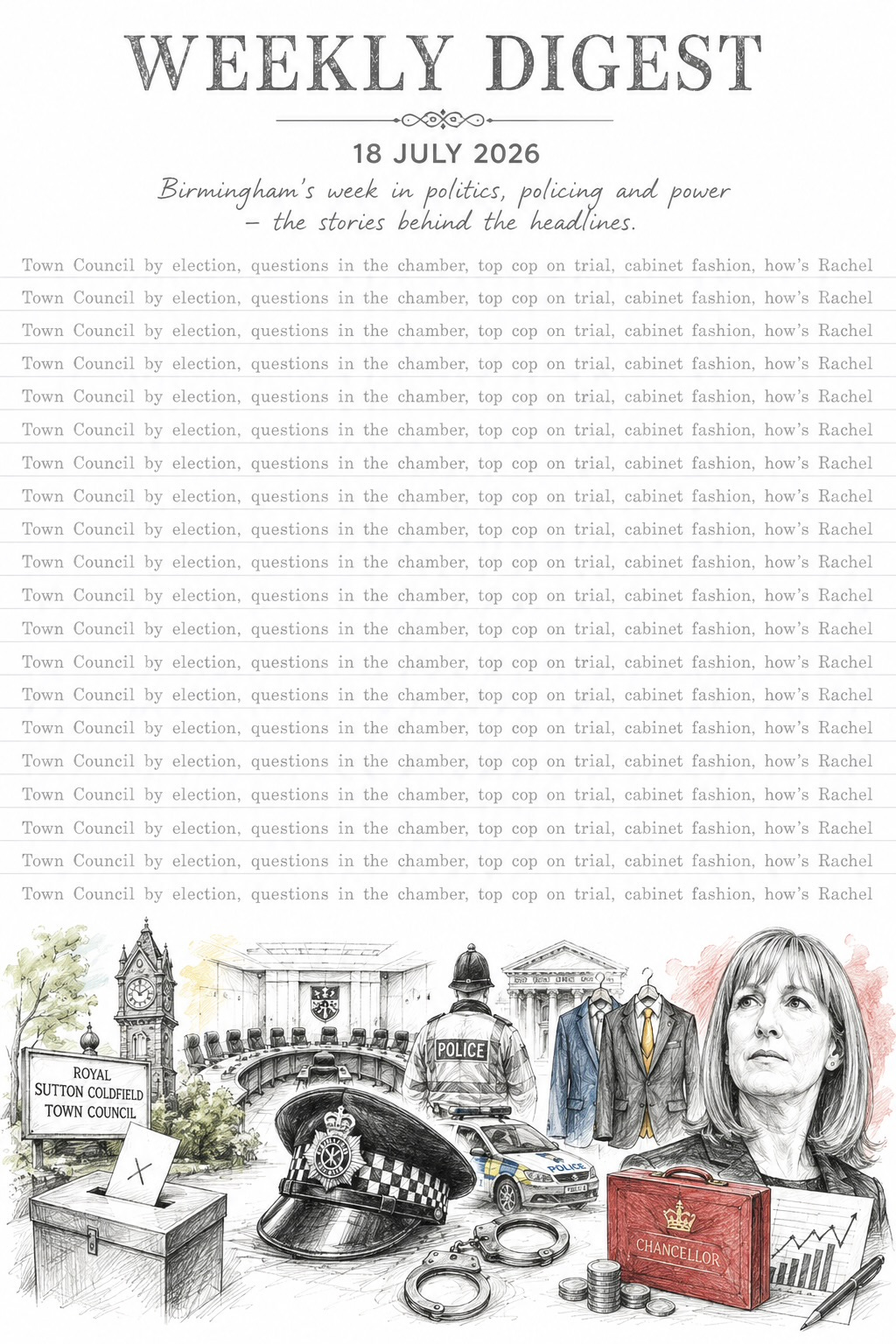
What a roller coaster of a week this has been. A warm welcome first to all our new subscribers. You are genuinely very welcome. Reads across our platforms are already approaching 30,000 this month, which is superb, and I remain enormously grateful to everyone who reads, shares, comments, argues and occasionally tells me that I am talking complete rubbish. Independent publishing only works when readers become part of the conversation, and the GRIT conversation is growing louder, broader and considerably more interesting. This week carried us from a three-vote election margin in Sutton Coldfield to the future reputation of a Chancellor of the Exchequer, with Birmingham’s first Cabinet meeting, a Chief Constable’s forthcoming misconduct hearing and a lively afternoon in the council chamber squeezed in between. Quiet weeks are clearly no longer available.
We began in Sutton Coldfield, where the resignation of newly elected Labour councillor Alex Cowley has created a Royal Sutton Coldfield Town Council by-election in Vesey ward. Nobody should dismiss it as “only” a Town Council contest. In May, Reform UK missed the final Vesey seat by three votes. Not 300. Not 30. Three. That result alone gives the coming contest significance, but the wider political setting makes it more important still. Birmingham’s electorate delivered an extraordinary verdict in May. Reform became the largest party on Birmingham City Council, the Conservatives recovered ground, Labour endured heavy losses, the Greens advanced and independents demonstrated that determined local campaigning can still overcome national party machines. Vesey will provide the first proper indication of whether that upheaval was a one-day explosion of anger or the beginning of a more lasting political realignment.
Reform has already proved that it can attract support. Its next challenge is to organise that support. Elections are not won simply because a party is fashionable on social media or because thousands of people tell an opinion pollster they are fed up. They are won by selecting credible candidates, knocking on doors, recruiting volunteers, identifying supporters, encouraging postal votes and returning to homes where nobody answered the first three times. That may sound old-fashioned, but democracy remains stubbornly analogue. The Conservatives will want to build upon their May successes in Sutton, while Labour must defend a seat vacated almost immediately after it was won. Sometimes the smallest elections tell us the largest stories. Vesey will not decide who governs Birmingham, but it may tell us which party is learning fastest from May.
Tuesday brought Birmingham’s new political administration and its first Cabinet meeting. To the surprise, perhaps, of those expecting chaos, revolution or somebody accidentally selling the Council House before lunch, the opening performance was calm, competent and businesslike. Cllr Roger Harmer chaired proceedings in an open-necked white shirt, wisely concluding that a tie and a heatwave need not occupy the same neck. Beside him sat Cllr Julian Pritchard, immaculate in jacket and tie, appearing ready for a Cabinet meeting, a board meeting and a wedding reception without requiring a costume change. Different wardrobes, one administration and, importantly, no immediate calamity. First impressions matter, and Birmingham’s new leadership made a respectable one.
The meeting nevertheless prompted a serious question. At the beginning, councillors were invited to declare any relevant interests. That is proper and necessary. Yet around the same table sat senior officers who had prepared reports, shaped recommendations, advised members, managed contracts and possessed considerable influence over the decisions being taken. Nobody asked them the same question. To be absolutely clear, I am not suggesting that any officer present had an undeclared interest. I am questioning the convention. Why not begin future meetings by asking whether any members or officers have a relevant interest to declare? Ten additional seconds would create consistency and strengthen public confidence without accusing anybody of anything. Transparency should not depend upon whether somebody reached the council chamber through an election or an appointment process. Birmingham’s Cabinet got off to a respectable start. Well done, chaps. Now, as readers repeatedly reminded me, sort the bins.
Wednesday moved from local government to policing and the forthcoming public gross misconduct hearing involving Staffordshire Chief Constable Christopher Noble. Allegations are not findings, and that distinction must be defended even when the person facing them occupies one of the most powerful positions in public life. Public misconduct hearings are healthier than the old system in which too much happened behind closed doors. Senior police officers exercise enormous authority and should be subject to proper scrutiny. Rank must never become body armour. If wrongdoing is established, the public deserves to know and the consequences should be real.
But openness must also protect the innocent. I watched a close friend, himself a Chief Constable, endure suspension over allegations which ultimately proved unfair. I saw the damage inflicted not only upon him but upon his family, his career and his ability to plan his own life. Vindication eventually arrived, but far too late to restore the closing years of a distinguished career. That experience taught me that accountability and fairness are not competing ideas. They are two halves of justice. If Christopher Noble is found to have committed gross misconduct, his office must not save him. If he is cleared, his reputation deserves restoring with the same energy that accompanied the accusations. An innocent person should not be expected to disappear quietly with a belated apology and perhaps one of those mythical £1,000-a-day commissions former Chief Constables always appear to discover. I am joking, although only slightly.
By Thursday, attention had returned to the Council House, where Birmingham’s first proper Full Council meeting since May demonstrated that governing is a very different skill from campaigning. Watching Full Council can resemble watching an open-book examination. Cabinet members arrive with thick folders containing anticipated questions, background information and carefully prepared answers. There is nothing improper about that. The danger begins when a supplementary question arrives which has not been lovingly placed inside the folder by an officer.
Labour’s Marcus Bernasconi had noticed that Reform councillor Danny Carter’s website appeared to claim he had completed 340 ward surgeries in only 64 days, more than five every day. Carter laughed, explained that the figures were dummy content on a website under construction and promised to correct them. It was an honest answer, and the chamber appreciated it. Reform’s Alan Feeney then asked Conservative scrutiny chairman Richard Frederick Jex Parkin what measurable improvement his committee would deliver. Parkin preferred to criticise Reform rather than provide a direct measurement, leaving readers and councillors to decide whether the question had been answered. Labour’s Ray Goodwin challenged Liberal Democrat Cabinet Member Baber Baz on housing standards, while Conservative Matt Bennett produced the afternoon’s biggest laugh by christening Better Birmingham’s Harris Khaliq “Councillor Bin Face” before moving to the rather more serious questions of the continuing refuse dispute, government-appointed commissioners and whether their requests had been met. “It’s a bit rubbish, isn’t it?” he observed. Occasionally a line writes itself.
What mattered was not who won each exchange. Birmingham politics is beginning to resemble politics again. Labour challenged the administration. Conservatives challenged the administration. Reform challenged the administration. Cabinet members were required to move beyond prepared answers and think on their feet. That is precisely what democratic scrutiny should involve. The election posters are down, the celebrations are over and the honeymoon has ended. Birmingham’s councillors are now beginning the less glamorous business of earning their keep.
Friday took us to Westminster and Rachel Reeves. As a younger Labour Party member, I remember hearing Reeves discussed with enormous reverence. She was the coming woman, the intellectual heavyweight and the future Chancellor whose Bank of England experience was repeated so frequently that it almost became a qualification in itself. Perhaps it merely proved that she had worked there. Prestigious institutions, after all, employ people of varying abilities just like engineering works, newspapers and councils.
My judgment is coloured by experience. I once owned and operated an engineering business in the West Midlands. Payroll did not arrive as a theoretical Treasury entry. It arrived on Thursday and had to be met. Once you have watched an order book weaken, worried about wages and considered whether the business can afford another machine or apprentice, economic policy sounds very different. In Whitehall, an increase in employer National Insurance is a fiscal measure. In Birmingham, it is a hotel leaving a vacancy unfilled, a restaurant stretching existing staff, an engineering firm delaying an apprentice and a small company postponing expansion.
That is why Professor David Bailey’s assessment interested me. Dave, Professor of Business Economics at Birmingham Business School and one of our region’s brightest academic gems, gives Reeves five out of ten. He credits her with placing planning reform at the centre of economic policy, supporting investment reform, creating the National Wealth Fund and attempting to restore fiscal credibility. He is especially interested in the longer-term potential of infrastructure and pension reforms. His criticism is that Reeves trapped herself before entering office by ruling out increases in income tax, employee National Insurance and VAT, leaving employer National Insurance, welfare changes and Winter Fuel Payment restrictions as politically damaging alternatives.
Dave is balanced. I am the old engineering businessman muttering from ringside that the favourite has still failed to cut the mustard. Labour promised an economic heavyweight. In my view, it delivered a carefully trained light-middleweight who never quite possessed the authority or political punch we were promised. History may judge her more kindly if planning reform, pension investment and infrastructure spending eventually produce factories, homes, jobs, apprenticeships and cranes across Birmingham and the West Midlands. That is the proper scorecard. Not speeches, spreadsheets or fiscal headroom, but whether businesses recruit, families feel more secure and our skyline contains more cranes than artists’ impressions.
And so the week ends where most political arguments eventually end: with a verdict still pending. Vesey’s voters will decide whether Reform can turn enthusiasm into organisation. Birmingham’s new Cabinet must turn a respectable opening meeting into competent government. Christopher Noble’s hearing must distinguish evidence from allegation. Councillors must prove that lively exchanges produce better decisions. Rachel Reeves must demonstrate that long-term reform can create visible prosperity before public patience expires.
Thank you again for reading and for helping GRIT approach 30,000 reads across our platforms this month. Enjoy the weekend. Birmingham will undoubtedly provide another full menu of politics, power, personalities and occasional nonsense next week. I will be watching, notebook ready, while Mrs Olley prepares the only verdict against which there remains absolutely no right of appeal.