

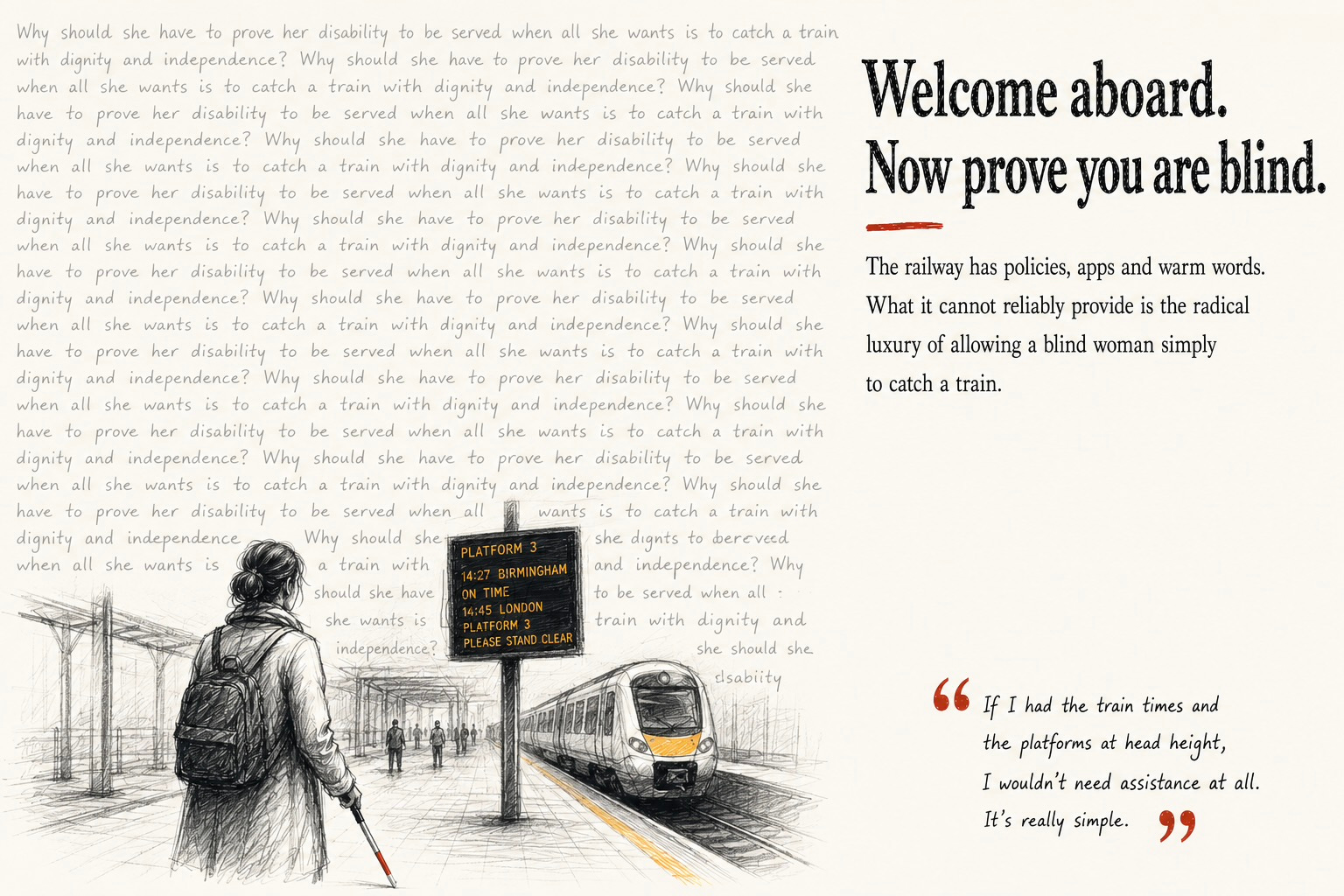
Welcome aboard. Now prove you are blind
The railway has policies, apps and warm words. What it cannot reliably provide is the radical luxury of allowing a blind woman simply to catch a train.

I am not blind. I wear glasses, one eye is useless and the other has carried the firm, like the only competent person in a run office. That makes me no authority on blindness, merely a man with an unreliable spare part. Years ago, while guiding a friend with sight loss, I announced: “There is a step immediately in front of you.” He replied: “Is that up or down?” I have never forgotten it. I had delivered information useful to me and useless to him. In one sentence, he exposed the British approach to disability: kind voice, good intentions, wrong information, carry on regardless.
That memory returned when I met a reader who is blind. I am not naming her because I forgot to ask permission. She does not “look blind”, whatever that means. No dark glasses, no official from the Ministry of Visible Disability stamping her forehead. She looks well, so people assume she is. At a coffee shop she asked a barista to read a poster he had pointed towards. He did, but with that air of wondering whether he was being conned by a woman who had failed to perform blindness convincingly enough.
She could wave her white stick like an airport marshaller bringing in a Boeing. But why should she? We do not demand everyone announce private difficulties to qualify for service. A man booking a doctor’s appointment need not shout across reception that his groin resembles a leaking lasagne. Yet a blind woman is repeatedly expected to declare herself, explain herself and prove herself before information appears. Apparently dignity is accessible, provided you book it two hours ahead, arrive early and find staff who have not vanished behind a door marked “customer assistance”.
Her railway story is where corporate trousers begin heading towards the ankles. She says she was left on a train after everyone else had gone and remained there until she contacted a cleaner. Otherwise, she believes she would have remained stranded. Then came the refund. Britain can propel hundreds of tonnes of metal at 125 miles an hour, but returning one ticket price to a blind passenger required six months, an ombudsman and the energy of a peace treaty. Somewhere, a senior manager’s email signature promised inclusion. On the train, inclusion had gone home.
The railway industry is magnificent at language. It offers Passenger Assist, Welcome Points, accessible travel policies and the chance to “travel with confidence”. There will be strategies, dashboards and a steering group chaired by somebody parked near the door. The arrangement is simple: the passenger must ask. Ask where the platform is. Ask whether it changed. Ask someone to read the board. Ask to be guided. Ask to be met. Ask again when nobody arrives. Then, after being forgotten, ask for money back. This is ceremonial dependence dressed in a lanyard.
Sight Village, organised by Birmingham’s Queen Alexandra College, is a national exhibition across Britain, bringing together technology, equipment, activities and support for blind and partially sighted people. There, my reader challenged Rail Delivery Group representatives about station information. Her suggestion was so sensible that the industry may need several committees to survive it. Put departure information at head height, where people with residual vision can read it. Make it high contrast. Add audio. Update it when platforms change. Suddenly, some blind and partially sighted passengers would not need assistance. They could arrive, check the train and board it, behaving like customers rather than emergencies. Perhaps independence has been overlooked because it produces fewer glossy leaflets explaining how much assistance exists.
The forgotten people, she says, are those with residual vision. They may see enough to navigate or read close up, but using that sight is exhausting. Imagine every journey as a permanent eye test while listening for announcements, watching for obstacles, locating staff and wondering whether the platform changed. Then imagine being sent to a touchscreen designed in an office with lighting and both eyes firing like floodlights. Technology is not accessible merely because somebody bolts it to the floor and adds a wheelchair symbol to the brochure.
The regulator’s figures puncture corporate bunting. Millions of assistance requests are made, yet passengers report receiving none of the help they booked. RNIB research found blind and partially sighted people unable to make journeys they wanted or needed, lacking confidence in staff training and uncertain they would be met at destinations. These are not minor wrinkles. They show the railway has confused having a policy with delivering a service. A fire extinguisher painted on a wall is useless when the building burns; an accessibility promise is decoration if the passenger remains alone on an empty train.
My reader is not asking for a personal footman, a sedan chair or a brass band at New Street. She wants information positioned where it can be used, audio that works, staff who appear when promised and a system that does not demand self-disclosure as the entrance fee to ordinary life. Newly sight-impaired people face fear, grief and collapsing routines. Every avoidable barrier tells them the world has become smaller. Every sensible adjustment gives a little of it back.
So spare the railway another consultation. Lower the screens. Add audio. Test everything with blind passengers during disruption, not a Tuesday demonstration attended by six executives and a photographer. Measure success by how rarely people need to ask, not how many assistance bookings are processed. When somebody is left on a train, do not make her fight six months for her fare. The railway says it wants blind passengers to travel with confidence. Splendid. It can begin by pulling up its corporate trousers, putting down the PowerPoint and noticing the woman it left behind.
We able bodied people have no idea. We are so self serving at times. This piece has made me think about being more aware at stations 🚉 to help and assist, with permission.