

We’re On Air: Olley’s Live Comes to Birmingham TV
No studio gloss, no scripted noise, just live conversation from the places where decisions and ideas actually happen.

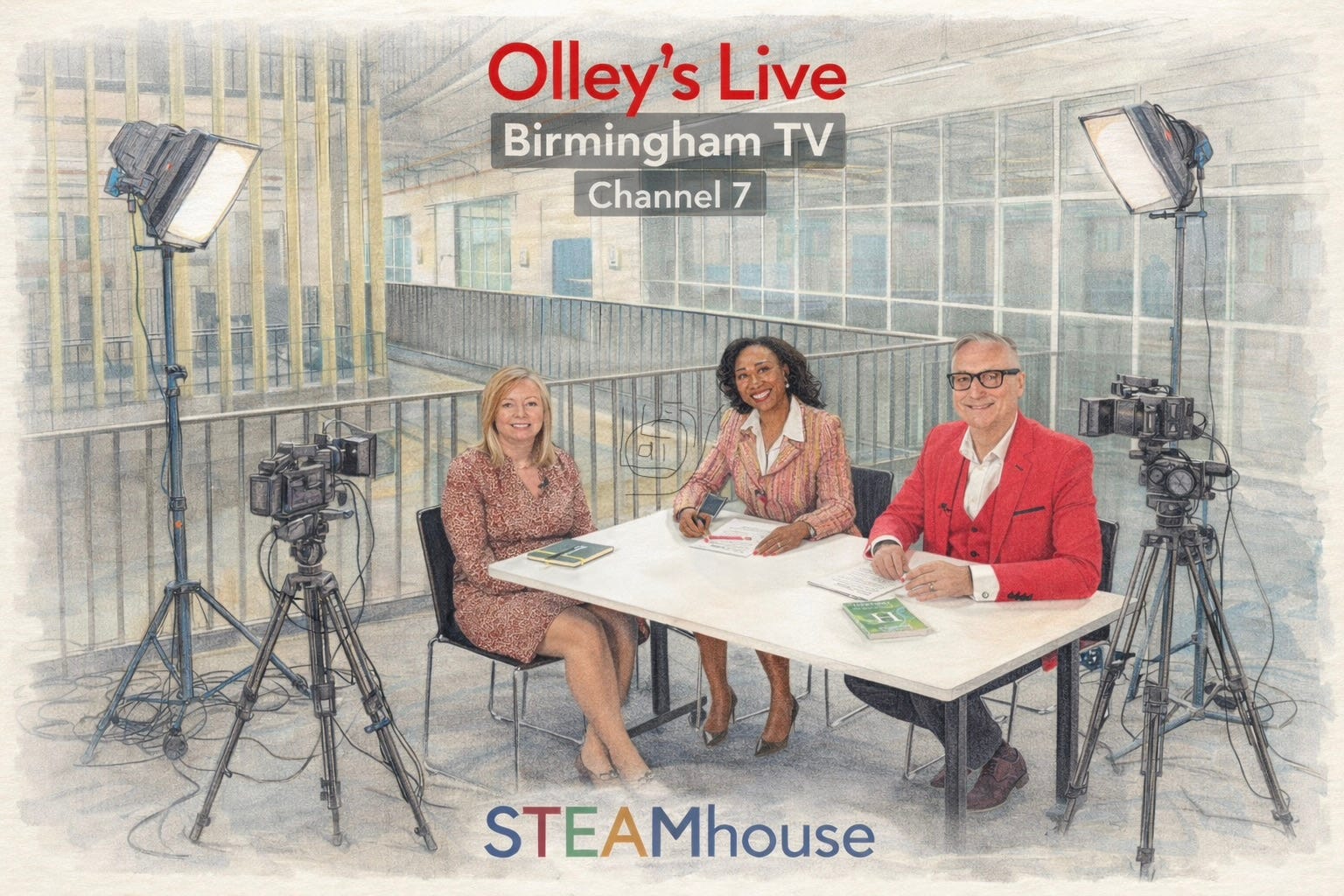
Olley’s Live, Birmingham thinking, national reach
There is a particular honesty to live television. No edits, no safety net, no second take to smooth the edges. What you see is what is said, and what is said has to stand on its own merit.
That is precisely why we do it.
Olley’s Live is presented by myself and Lorraine Olley, and it is built around that principle. A table, a guest, and a conversation that is allowed to unfold without interference. It is filmed as live, which matters. The pace, the rhythm, the pressure of getting it right in the moment, all of that stays intact. What the viewer sees is not manufactured television, it is conversation under light.
Episode 5 of Series 3 was filmed recently at Birmingham City University’s STEAMhouse, and it captures something that sits at the heart of what this programme is trying to do. Not noise, not theatre for its own sake, but a proper conversation. Grounded, informed, and rooted in the Midlands, yet reaching well beyond it.
The format is simple. Sit down with people who know their subject. Ask the questions that matter. Let the answers breathe.
This episode does exactly that.
Across the table sits Dr Michaela Kendall. Not a commentator, not a career panel guest, but a builder. A manufacturer. A scientist who has spent decades in the field of hydrogen fuel cell technology, and who has taken that work from theory into industry. Her company, established over 30 years ago, is part of a conversation Britain urgently needs to have with itself.
Energy.
Not as a slogan, but as a cost. Not as a policy headline, but as a constraint on whether this country can still make things at scale.
The discussion is split into two parts, and rightly so. The first deals with the mechanics and potential of hydrogen energy cells. What they are, how they work, and where they might realistically sit within the UK’s energy mix. There is no indulgence here in fantasy timelines or miracle solutions. It is a measured, technical conversation, translated into plain English.
The second part moves to something more uncomfortable, and more immediate. The cost of energy for British manufacturing, and what that cost is doing to the country’s industrial base. If Britain is serious about remaining a credible producer of goods, not just a consumer of them, then energy pricing is not a side issue. It is the issue.
Dr Kendall does not deal in slogans. She talks about systems, constraints, and the gap between political ambition and industrial reality. It is the sort of contribution that rarely survives the compression of mainstream broadcast formats, which is precisely why long form, live-style discussion still has a place.
The building matters
The setting for this episode was not incidental.
STEAMhouse is a £70 million investment by Birmingham City University, built on the restored shell of a Victorian industrial site that once housed the Eccles Rubber and Cycle Company. It is a building that quite literally sits on Birmingham’s manufacturing past while trying to engineer its future.
At around 100,000 square feet, it is not a passive academic space. It is a working environment, part lab, part workshop, part business incubator. Inside are fabrication zones, prototyping facilities, design studios and collaborative workspaces, all deliberately designed to bring together students, engineers, entrepreneurs and established businesses under one roof.
It is, in effect, a modern engine room.
And that matters, because the conversation taking place inside it, about hydrogen energy, industrial cost pressures and the future of British manufacturing, is exactly the kind of problem the building exists to address.
Birmingham does not always shout about its successes. It should shout about this one.
STEAMhouse is not a vanity project. It is a serious piece of infrastructure, rooted in heritage, built for purpose, and aimed squarely at the question of whether this country still intends to make things. It is a credit to the university, and a statement of intent from the city.
No studio, no fixed stage
There is also a deliberate choice behind how Olley’s Live is made.
We do not have a fixed studio. No permanent set, no controlled backdrop that flattens every conversation into the same visual frame.
We go to our guests.
That is not just a production decision, it is editorial. Place shapes conversation. Context sharpens answers. When you sit down with someone in their environment, or in a space that reflects their work, you get closer to the truth of what they actually do.
STEAMhouse is one example, but it is not the only one. Over the course of the series, we have filmed in a range of locations across the Midlands, each chosen because it adds something to the conversation rather than simply housing it.
It allows us to capture more than just words. It captures atmosphere, intent, and the reality behind the role.
A Midlands lens with national reach
As for the programme itself, Olley’s Live is not trying to compete with national broadcasters on scale. That would miss the point entirely. It is built instead on access and authenticity. Local television, sitting on channel 7 across the network, reaching more than 250,000 viewers, offers something different. A platform where regional voices are not filtered out, and where national issues can be examined through a Midlands lens.
That reach is also evolving. One in four programmes now goes out nationally, on a weekly basis, taking what begins as a Midlands conversation and placing it into a wider UK context. That matters, because the issues discussed here do not stop at the M6.
Energy costs, manufacturing decisions, investment choices, workforce realities. These are not abstract debates. They land in places like Birmingham, the Black Country, Coventry. They shape whether businesses expand, relocate, or quietly disappear.
The programme will be broadcast in the coming weeks, and it will also extend across social media channels, where the conversation tends to take on a second life. Clips travel. Arguments are tested. Viewers respond.
That is where the real value sits. Not just in the broadcast itself, but in what follows.
The open door
There is also a broader intention here. To keep building a roster of guests who have something substantive to say. People with experience, with evidence, with a perspective that goes beyond the immediate news cycle. The Midlands has no shortage of such voices. What it has often lacked is a platform willing to give them time.
We are addressing that, one episode at a time.
Dr Kendall will, one suspects, not be a one off. The issues she raises are not going away. If anything, they are moving closer to the centre of the national conversation. Britain’s ability to produce, to compete, to sustain industrial relevance in a changing energy landscape is not settled. It is still being written.
And that is precisely the sort of story that deserves to be told properly.
If you have something to say, and more importantly something to back it up, then there is an open door here. Not for performance, but for contribution. The bar is not fame, it is substance.
That is the deal.
Olley’s Live. Live for a reason.
Debate over the Wayne Brown Scandal. Chief Constable Scott Green with Chief Fire Officer Simon Tuhill v Ben Walker.
It could be the Don Revie v Brian Clough famous Yorkshire TV interview of the modern era