


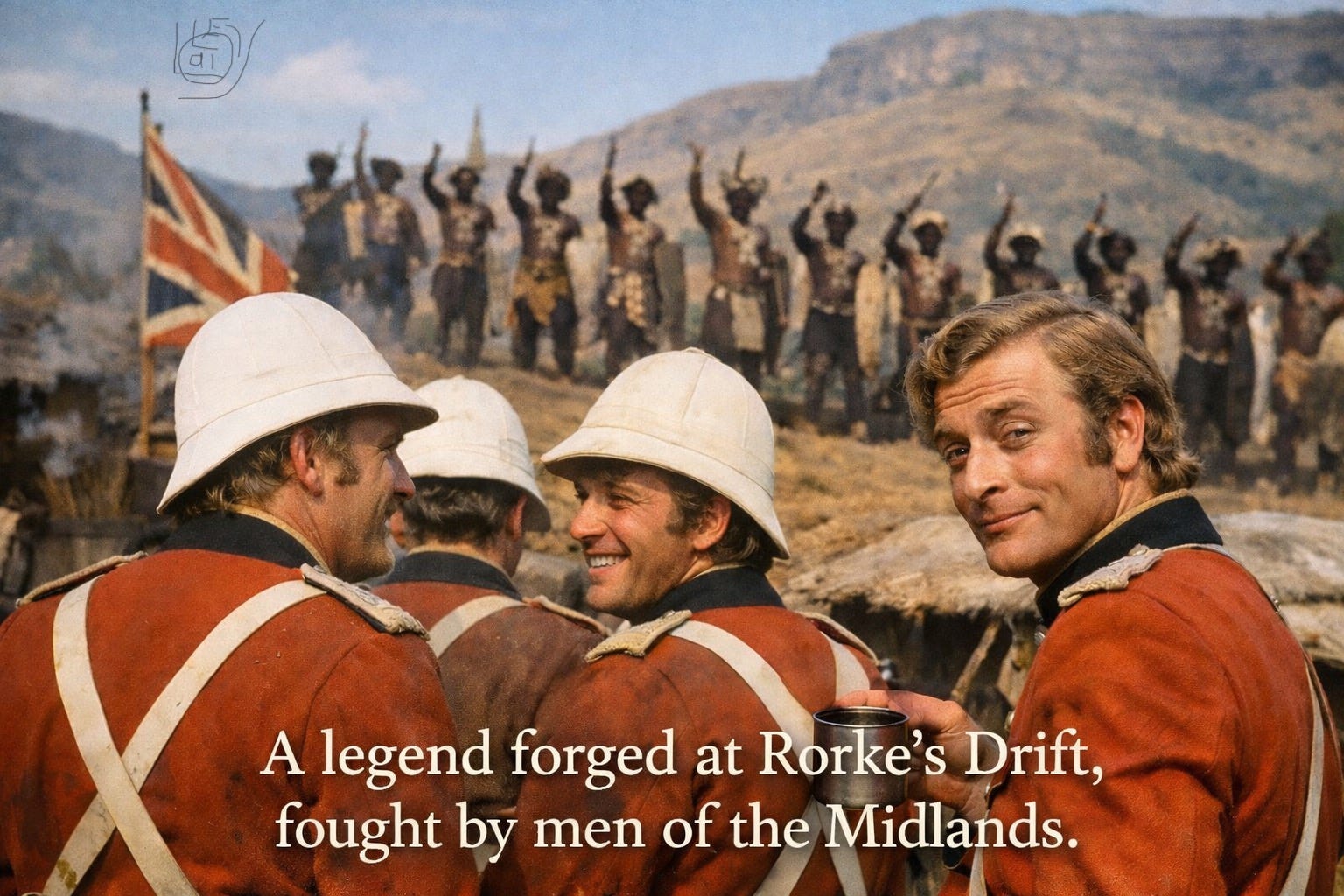
For many of us, the Christmas holidays arrive with a familiar rhythm. The television schedules soften, the days stretch, and somewhere between leftovers and low winter light, Zulu appears again. Not festive in theme, but ritual in presence. A film about courage, discipline, fear, and resolve, watched and rewatched until its lines are half remembered and its music instantly recognisable.
And it is a brilliant film. That should be said plainly, and without qualification.
But like all rituals, it repays being looked at again with adult eyes.
Zulu tells a true story, but not the whole one. And the parts it leaves out matter, not because they diminish British courage, but because they restore proportion, context, and respect, especially to the Zulu side of the story and to the men whose identities were later reshaped by myth.
The defeat Britain preferred to forget
The defence of Rorke’s Drift did not occur in isolation. It followed, within hours, one of the most devastating defeats in British imperial history.
Earlier that same day, the British Army was comprehensively destroyed at Battle of Isandlwana. Over 1,300 British and colonial troops were killed. Entire units were wiped out. Colours were lost. Modern rifles and artillery were defeated by disciplined Zulu manoeuvre warfare executed with extraordinary skill and courage.
For Victorian Britain, this was not merely a defeat. It was a humiliation. The assumption of imperial inevitability was shattered in a single afternoon.
Had Isandlwana been the sole focus of memory, the story of the Anglo-Zulu War would look very different today.
Why Rorke’s Drift mattered so much to Britain
Against that backdrop, Rorke’s Drift took on a significance far beyond its military scale.
In strictly strategic terms, it was a small, improvised defensive action. Around 150 British troops held a mission station and supply depot against an attacking Zulu force numbering several thousand. The defence was courageous, disciplined, and desperate. Nobody disputes that.
But it was not decisive. It did not reverse Isandlwana. It did not break the Zulu army. It did not alter the strategic balance of the war.
What it did do was provide Britain with something it urgently needed: a counterweight. A story of order after chaos. Courage after catastrophe. Discipline after humiliation.
The unprecedented award of 11 Victoria Crosses reflected genuine acts of bravery, but it also served a psychological purpose. It helped rebalance a narrative that had swung violently against imperial confidence.
This was not dishonesty. It was emphasis.
The Zulu force, and why it broke off
One of the most persistent misunderstandings concerns the Zulu attack itself.
The force that moved on Rorke’s Drift was not the main Zulu army. After the victory at Isandlwana, the Zulu force naturally fragmented, exactly as any victorious army would. Warriors returned to their regiments and homesteads. Others moved on with captured supplies and weapons.
A detachment, estimated at around 3,000 to 4,000 men, advanced toward Rorke’s Drift. From a Zulu perspective, it was a tempting secondary target, a lightly defended crossing and depot. But it was never worth unlimited loss.
When resistance proved unexpectedly stiff, the logic changed. Losses mounted, night fell, and the objective no longer justified the cost. Estimates suggest between 350 and 500 Zulu warriors were killed. Heavy losses for a secondary action.
Zulu warfare did not demand annihilation at all costs. There was no cultural or strategic imperative to fight to extinction. The withdrawal was rational, disciplined, and entirely consistent with having already achieved the day’s decisive victory.
This was not a failure. It was a calculation.
The men behind the barricades, and where they were really from
There is another quiet distortion left behind by time, and reinforced by cinema.
The regiment defending Rorke’s Drift was the 24th (2nd Warwickshire) Regiment of Foot. In 1879, it was a Warwickshire regiment in the literal sense. Its depot was at Warwick, and its recruiting heart lay firmly in the English Midlands.
The ranks were filled largely by working men from Birmingham, the Black Country, Warwickshire, Worcestershire, and the Severn Valley, alongside Welsh, Irish, and other British soldiers. The later Welsh identity of the regiment, cemented after the Childers Reforms of 1881, has been retrospectively applied to a battle that predated it.
At Rorke’s Drift, many of the accents behind the mealie-bag barricades would have sounded far closer to Birmingham or Bilston than to Brecon.
These were industrial men. Men used to heat, noise, machinery, long hours, and physical endurance. That background mattered. The defence was not just a military action, it was a feat of improvised labour under fire.
A Black Country man at Rorke’s Drift
If one figure quietly embodies this Midlands truth, it is William Reynolds.
Reynolds was born in Bilston, Staffordshire, in the heart of the Black Country. He was a working man, serving as a medical orderly with the Army Hospital Corps. Not an officer. Not a gentleman volunteer. Not a mythic figure.
During the fighting, Reynolds repeatedly exposed himself to intense fire to retrieve wounded men and bring them back into the makeshift hospital. When the hospital was set ablaze, he continued to carry the injured to safety through smoke, flame, and gunfire.
For this, he was awarded the Victoria Cross.
After the war, Reynolds returned not to fame or comfort, but to the Midlands. He died young, worn down by illness, and is buried in Wolverhampton, close to the industrial streets that had shaped him long before he ever saw Natal.
There is something fitting about that. One of the bravest acts of the Anglo-Zulu War was carried out not by an imperial archetype, but by a Black Country man whose courage was practical, unshowy, and relentless.
Where the film fits, and why it still works
Zulu is not propaganda. It is not crude. It is, if anything, unusually respectful of its Zulu characters for its time. The dignity afforded to the Zulu warriors, the restraint of the final salute, the absence of triumphalism, all of this matters.
But it is also a film made in a Britain coming to terms with the end of empire. It tells the story Britain wanted to remember, not the one it found hardest to face.
That does not make it wrong. It makes it partial.
Watching Zulu Properly
So perhaps the right way to watch Zulu now, as the Christmas ritual it has become, is not to discard it, but to complete it.
To admire the courage of the defenders, while recognising that the Zulu army had already delivered a far greater blow that day.
To honour the bravery of men from Birmingham, the Black Country, Warwickshire, Wales, Ireland, and beyond, without folding them into myths that came later.
To understand that Rorke’s Drift mattered so much because Britain needed it to matter.
History is not weakened by context. It is strengthened by it.
And Zulu, watched with that understanding, remains what it has always been: a powerful film about human courage under pressure, set within a much larger story that deserves to be told in full.
Several of the defendants at Rourkes Drift were from my part of Birmingham, Aston and Lozells….I first saw the film at the Palladium in Hockley as a child when it first came out…..and numerous times since then on the TV….including this Xmas….despite being able to narrate much of the text before they say it, every time I watch it there is some new detail that I haven’t spotted before….!