

When the Chief Constable is the one in the dock
Staffordshire’s Chief Constable faces a public misconduct hearing. Accountability matters, but accusations can damage a life before anyone decides whether they are true.

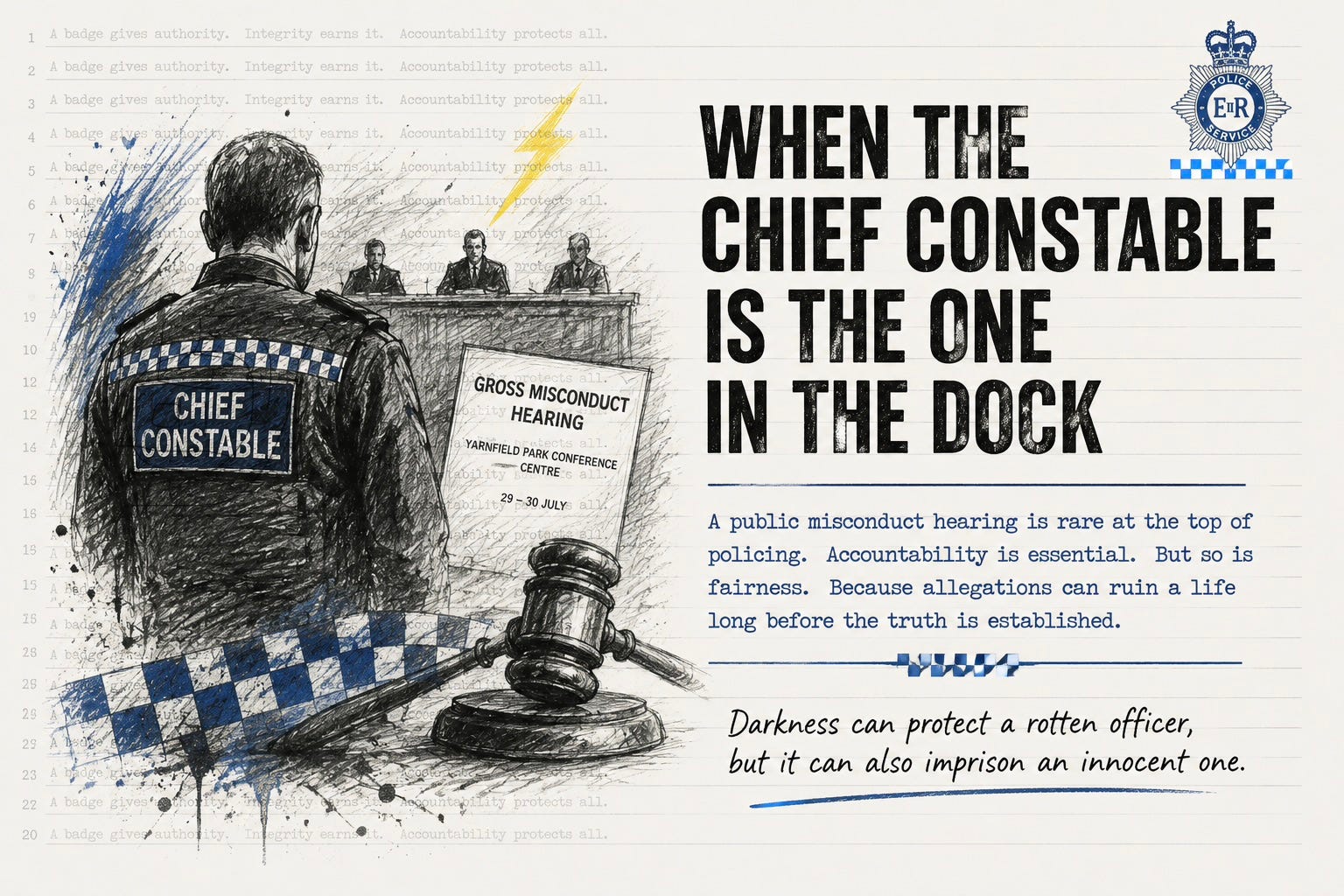
There are some invitations you open with excitement. A Buckingham Palace garden party. Centre Court at Wimbledon. Watching Walsall FC in their annual pre-season friendly with Aston Villa and seeing the Saddlers give them a walloping. It may require optimism, prayer and the temporary suspension of footballing reality, but that has never stopped us before. Then there are invitations which make you pause for rather different reasons: “Would you like to attend the public misconduct hearing of a serving Chief Constable?” Well, that is not a sentence I expected to encounter when I first became a columnist, but here we are.
Staffordshire Chief Constable Christopher Noble is due to face a public gross misconduct hearing at Yarnfield Park Conference Centre on 29 and 30 July. It is scheduled to sit from 10am until 5pm on both days, and members of the public and media may apply to attend. Noble faces allegations of gross misconduct, but they remain allegations. The hearing exists to decide whether they are proved, not to provide two days of public entertainment ending with the ceremonial toppling of a senior police officer. A hearing notice is not a guilty verdict, however quickly social media can assemble a jury, hear no evidence and return from its deliberations before the kettle has boiled.
The spectacle still feels remarkable. Once upon a time, Chief Constables were rather like snow leopards. Everybody knew they existed, most people had seen a photograph of one, but very few ever encountered one in the wild. They appeared at press conferences to explain what everybody else had done wrong. They did not normally occupy the chair reserved for the person being asked the awkward questions. The system is more open now, and I think that is progress. It is not that policing suddenly discovered misconduct. It is that the public is now more likely to see what happens when misconduct is alleged.
There have been some spectacular examples. Northamptonshire’s former Chief Constable Nick Adderley was dismissed without notice in 2024 after a public disciplinary panel found gross misconduct proved over false claims concerning his naval service. Other senior officers have been investigated, suspended or taken through disciplinary proceedings, with very different outcomes. That last point matters. Accountability cannot simply mean becoming better at making accusations. A decent system must identify and remove the rotters, however grand their title, while also protecting good officers from injustice, exaggeration and the assumption that an allegation becomes true merely by appearing in a headline.
I know something about the second half of that equation. A close friend of mine was a Chief Constable. I will not name him because he suffered quite enough pain when the episode was current, and I have no intention of reheating it for another public serving. He was suspended amid all sorts of allegations which, as events unfolded, proved to be unfair. I lived through part of it with him, not as a columnist looking for a story, but as a friend watching another human being’s world become smaller by the day.
I remember the conversations, but I remember the silences more. The anger, the bewilderment and the peculiar helplessness of seeing a man who had spent his working life making serious decisions suddenly unable to plan his own future because his career, reputation and peace of mind were sitting in somebody else’s in-tray. We imagine that people who reach the top of policing acquire an extra layer of armour. They do not. They go home. They worry. Their families worry. Friends ring without knowing what to say, while some people stop ringing altogether because even an unproved scandal can apparently be contagious.
My friend chose to keep a public diary so that anyone genuinely interested could see what was happening rather than relying upon gossip, fragments and carefully rationed official statements. That was an extraordinary act of courage. It also revealed the grinding language of such a process: allegation, referral, investigation, review, extension and another decision expected next month. Bureaucracy rarely carries a knife, but it can still cut somebody to ribbons.
Eventually, he was vindicated. Yet “vindicated” is one of those splendid words which sounds far more effective than it often is. His closing years in policing had been ruined, and so had much of the post-Chief Constable career he had every right to expect. Accusations arrive in enormous headlines. Vindication generally turns up months or years later in a few sober paragraphs below a story about a celebrity’s new kitchen. If a man is innocent, he should not merely be allowed to slip away through a side door with a muttered acknowledgment that nothing was proved. He should leave with his name intact and full access to his £1,000-a-day commissions. I am joking, of course. Well, mostly.
That experience did not persuade me that these hearings should be private. Quite the opposite. It persuaded me that they must be open, rigorous and visibly fair. Darkness can protect a rotten officer, but it can also imprison an innocent one. Most of the senior police officers I have known have been thoroughly decent people carrying responsibilities that would keep the rest of us awake until breakfast. Clearly, policing has produced some rotters too. Every profession does, although few give their rotters warrant cards and enormous operational powers. When serious allegations arise, rank must not become body armour.
Then comes my own little dilemma. Do I spend two complete days at Yarnfield, drinking industrial quantities of coffee, filling page after page with notes and returning home for Mrs Olley, the real editor, to glance at my work and declare: “That’s pants”? I merely wear the editor’s badge. Her judgement is quicker than any misconduct panel and offers considerably less prospect of appeal. As a columnist rather than a court reporter, two days is a sizeable commitment when the eventual decision may contain the real story.
Noble was suspended in August 2025 while independent investigations continued. The Commissioner described suspension as a neutral act carrying no indication of guilt, which is exactly how it must be treated. He is entitled to enter the hearing presumed innocent. If gross misconduct is proved, his rank must not save him. But if he is innocent, he must not be allowed to disappear quietly with his reputation permanently stained. He deserves to walk away with his name intact and, yes, access to his £1,000-a-day commissions.
Justice is not achieved simply by putting a Chief Constable in the dock. It is achieved by finding the truth, treating the person at the centre of the case as a human being and giving the eventual answer every bit as much prominence as the original accusation.