


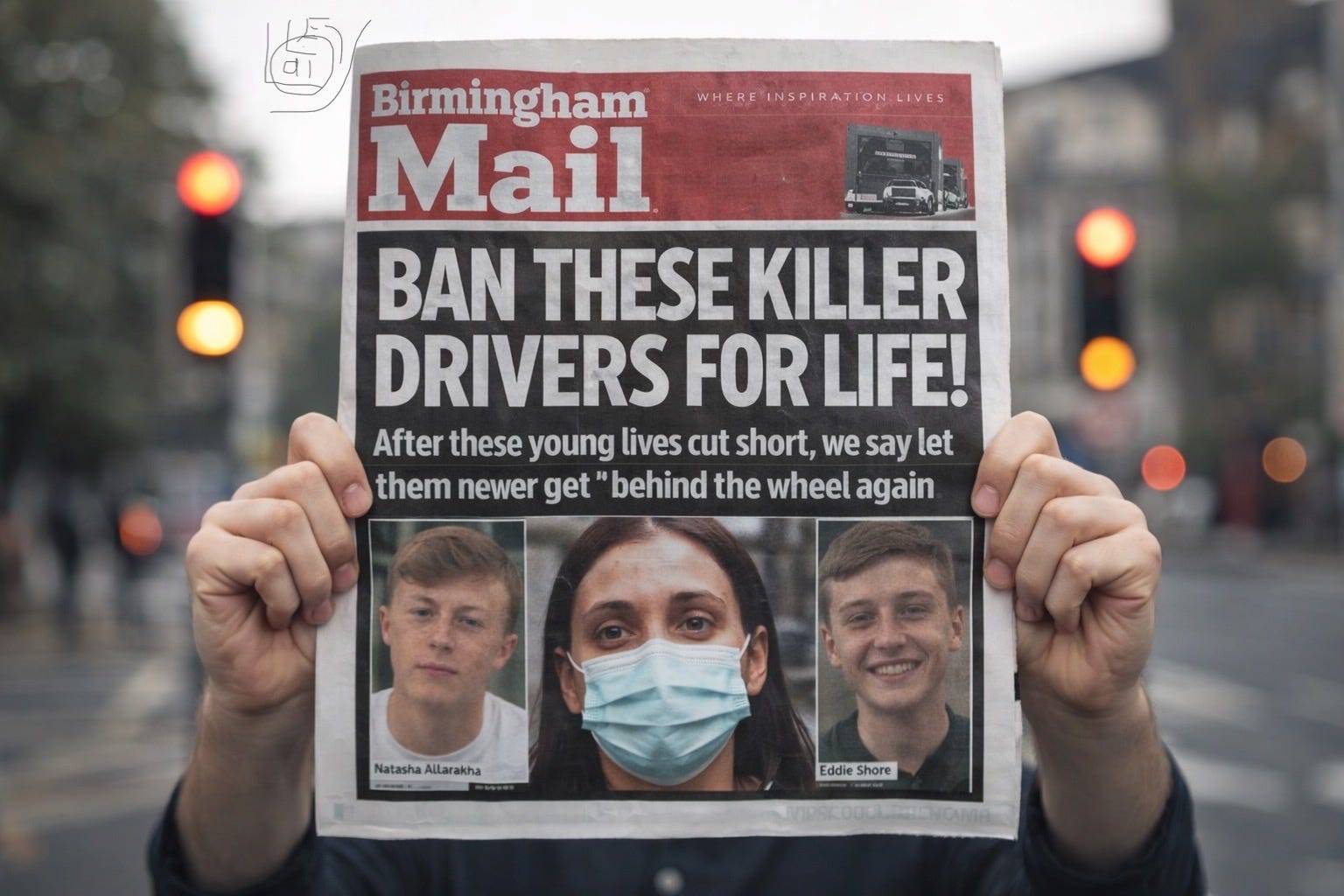
I spent part of my life as a columnist with the Birmingham Mail, so I know its traditions well. It has always been a paper rooted in the lived reality of the city, not just a conveyor belt for press releases or official statements, but a place where campaigns mattered and where injustice, once spotted, was pursued rather than politely noted and filed away.
That is why I was genuinely heartened to see the Mail now running a campaign calling for lifetime driving bans in the most extreme cases of dangerous driving. This is exactly the kind of thing regional newspapers used to do a great deal more of.
If you look at the piece circulating this week, you will see it is being driven by Graham Brown, the editor-in-chief. Graham is a good bloke, a serious journalist, and someone who understands that a newspaper’s job is not just to report outcomes, but to ask whether those outcomes make sense to the people who have to live with them.
The case he highlights is harrowing. A driver travelling at more than 90mph ploughs into a stationary car at traffic lights. Two teenagers die. Two more young people are seriously injured. Alcohol is involved. Lies are told. A long prison sentence follows. And yet, in time, the offender will legally be allowed back behind the wheel.
The Mail’s question is a simple one: why?
This is what newspapers are for
What the Birmingham Mail is doing here is not populism. It is not tabloid hysteria. It is something much more important: articulating a public instinct that the law currently struggles to acknowledge.
Most people, if asked plainly, do not frame this in terms of intent, culpability thresholds, or appellate guidance. They frame it in terms of trust. Why should society ever again be required to share its roads with someone who has demonstrated such catastrophic disregard for human life?
That is not a call for vengeance. It is a call for protection.
And this is where the Mail’s campaign dovetails perfectly with a wider problem in our justice system.
When theory overrides experience
Too much criminal justice policy in this country is shaped by people who live in a world of abstraction. Academics, senior lawyers, policy advisers, commissions. Intelligent people, often well-meaning, but increasingly distant from the everyday environments where harm actually occurs.
They speak a language of proportionality and rehabilitation. All of which has its place. But they are often deaf to something equally important: the collapse of public confidence when outcomes repeatedly defy common sense.
When someone drives at extreme speed, under the influence, through shared public space, the public does not see a philosophical puzzle. They see a broken social contract.
The academic instinct is to say: recklessness is not intent. The public instinct is to say: this person cannot be trusted again. Those are not incompatible positions, but our system currently treats them as if they are.
Driving is a privilege, not a right
We already accept permanent exclusion in other licensed activities. Pilots lose licences. Surgeons are struck off. Firearms licences are revoked for far less than a death. We do not agonise endlessly about the inner moral world of the offender in those cases. We focus on risk.
Driving, oddly, is treated as sacrosanct. As if the fact that many of us do it somehow softens the consequences when it is abused in the most extreme way.
The Birmingham Mail is right to challenge that assumption.
A welcome return to campaigning journalism
What delights me most about this campaign is not just its substance, but its spirit. This is what regional newspapers once did instinctively. They spotted something that jarred with public conscience and pursued it, not to inflame, but to force a conversation that institutions would otherwise avoid.
I am glad to see the Mail still has that enthusiasm. Glad to see an editor willing to put his name to a position. And glad to see a paper standing alongside pedestrians, cyclists, and ordinary drivers who simply want to feel safe in shared space.
This campaign deserves support, not because it is angry, but because it is rational. It asks whether our system has become so enamoured with theory that it has forgotten who it exists to serve.
If democracy means anything beyond elections, it means institutions listening when the public repeatedly says: this does not feel right.
On this issue, the Birmingham Mail is listening. And it deserves credit for doing so.