

Editor’s note:
This piece is written in good faith. It is not an attack on the Green Party, nor on the councillors who have worked hard to build credibility at local level. It is a critique of leadership choices, made from outside the party but with respect for the graft that underpins its recent progress. Disruption has its place. So does responsibility.
There is a moment in every political movement when disruption stops being useful and starts becoming indulgent. The trick is spotting that moment before it does real damage.
Zack Polanski may already have missed it.
I say that without hostility to the Green Party, and certainly without hostility to Green councillors. Quite the opposite. This is written out of respect for the people who have spent years building something fragile and serious at local level, and who now risk seeing that work undermined by a leader who appears increasingly to enjoy the sound of his own disruption.
The problem with confusing noise for progress
Polanski is clearly a disruptor. He is articulate, media-savvy, and comfortable in confrontation. He understands how to generate attention, how to provoke reaction, and how to position himself as a moral antagonist to the political establishment.
In opposition politics, those are useful skills.
But leadership is not performance art. And politics outside a London bubble is not a Twitter feed.
The danger for Polanski is that he is starting to behave as though the Greens are already a mass national movement, rather than what they actually are: a party whose real strength lies in painstaking local work, ward by ward, case by case, election by election.
That distinction matters.
What the Greens have actually achieved
Let us be clear about the Greens’ position, particularly in the West Midlands, which remains a bellwether for whether a party can translate ideas into power beyond metropolitan enclaves.
Across the former West Midlands County area, Birmingham, Coventry, Dudley, Sandwell, Solihull, Walsall and Wolverhampton, the Greens have 14 councillors. That includes 2 in Birmingham, 2 in Coventry, 1 in Sandwell, and 9 in Solihull, with none in Dudley, Walsall or Wolverhampton.
That is not nothing. It is real progress. But it is also fragile progress, and it has been earned the hard way.
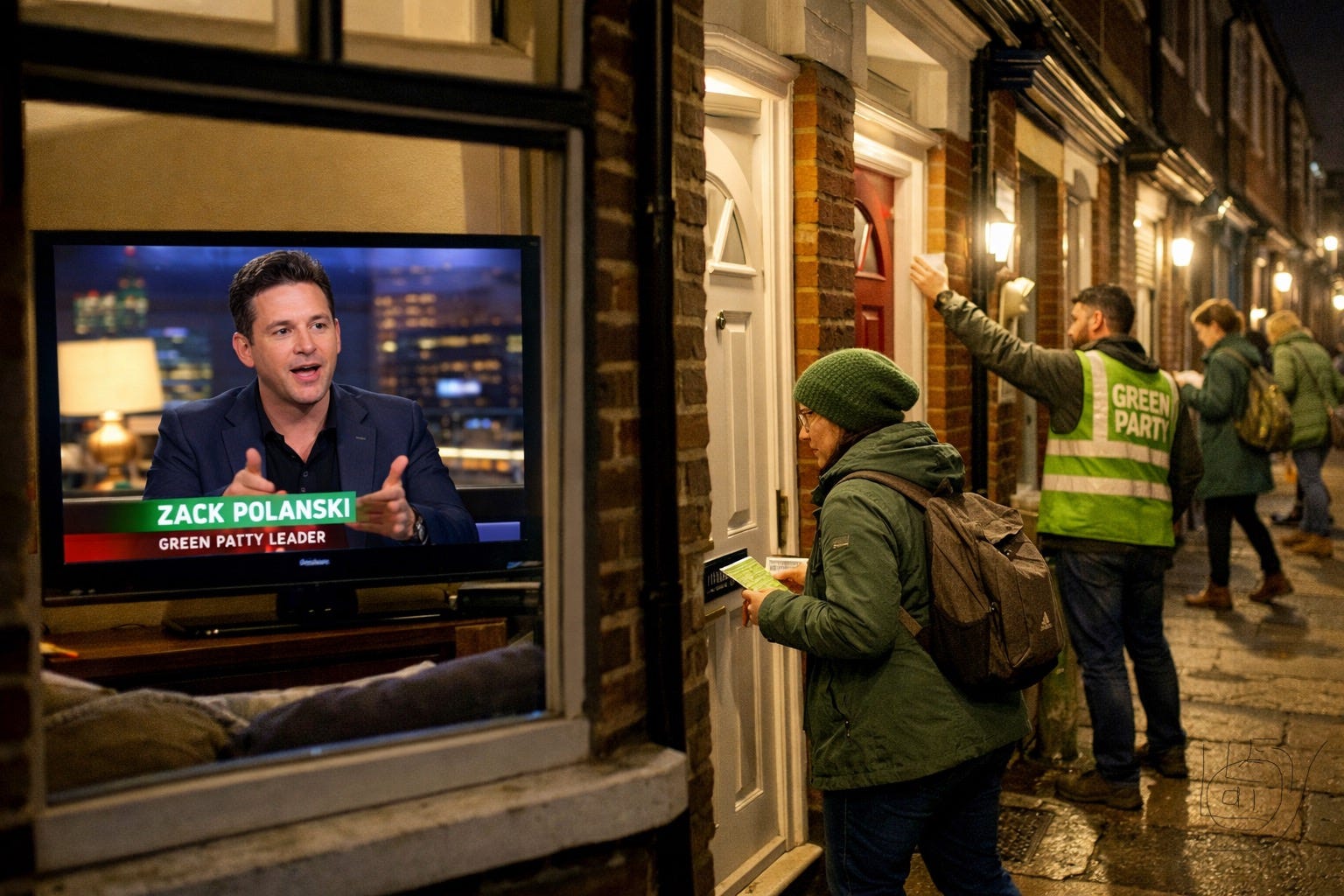
Those councillors did not win on national hype. They won through door-knocking, casework, credibility, and being taken seriously by residents who wanted competence, not theatrics. In places like Solihull, Green councillors have built a reputation for diligence and practicality, not ideological grandstanding.
That is the foundation Polanski is standing on.
Why the monarchy attack is a misread
Against that backdrop, Polanski’s decision to attack the monarchy, particularly around Christmas, looks less like bravery and more like misjudgement.
Polling in the UK is clear. Support for the monarchy has declined over time, but it remains the majority position. Roughly six in ten voters still support retaining it, and in the Midlands that support is at least as strong as the national average. This is not a fringe institution clinging on by its fingernails. It is still embedded in public sentiment, especially outside London.
That does not mean the monarchy is beyond criticism. But it does mean that treating abolition as an easy crowd-pleaser is a strategic error.
More importantly, timing matters. Christmas is one of the few remaining civic moments that cuts across politics, class and culture. Choosing that moment to launch an attack on the King does not look principled. It looks petulant.
And petulance is not a quality voters look for in people they might one day trust with power.
Who pays the price for this posturing
The real cost of Polanski’s approach will not be paid by him. It will be paid by local Green councillors.
Every time the national leader makes headlines for the wrong reasons, it lands on doorsteps. It becomes ammunition for opponents. It reinforces lazy caricatures of the Greens as unserious, extreme, or more interested in gestures than governance.
That is deeply unfair to councillors who have spent years proving the opposite.
Local Greens have worked hard to shed the image of protest politics and replace it with something more grounded: environmentalism tied to delivery, social justice tied to competence, idealism anchored in reality.
A leader who revels in being provocative for its own sake risks undoing that progress.
Is Polanski getting above his station?
This is the uncomfortable question.
There is a sense that Polanski is beginning to believe his own hype, that he is acting as though he already leads a party on the brink of national breakthrough, rather than one still painstakingly building credibility outside a few strongholds.
That kind of overreach is dangerous.
British politics is littered with figures who mistook attention for authority, and outrage for momentum. They burn brightly, dominate a news cycle or two, and then fade, leaving little behind but embarrassment for those who backed them.
The Greens cannot afford that.
They are not a viral movement. They are a slow-build party. Their success depends on trust, not noise.
The irony at the heart of this
The irony is that Polanski could be a genuinely effective leader if he chose to be.
There is space in British politics for a party that combines environmental seriousness with local competence, that speaks to cost-of-living pressures, housing, transport, and public services in ways that feel practical rather than preachy.
But that requires discipline. It requires choosing battles carefully. It requires understanding that not every moral position needs to be turned into a headline, and that some issues are best approached sideways rather than head-on.
Leadership is not about saying everything you believe. It is about knowing what to say, when, and why.
A message from outside the bubble
This is where Polanski needs to step outside his London bubble.
Politics in the Midlands, and in much of England, is more cautious, more pragmatic, and less forgiving of grandstanding. Voters may share many Green instincts, on climate, fairness, and community, but they recoil from what feels like self-indulgent radicalism.
Local Greens understand this. That is why they win where they win.
The tragedy would be if their leader did not.
Grow up, or get out of the way
This is not a call for silence or timidity. It is a call for maturity.
If Polanski wants to lead a party that governs, he needs to grow up a bit. He needs to recognise that leadership carries responsibility not just for ideas, but for the people implementing them on the ground. He needs to stop giving opponents easy headlines and start amplifying the quiet competence of his councillors.
If he cannot do that, then he risks becoming a liability.
The Greens have done the hard work.
They deserve a leader who does not undo it.