

When The School Gates Close, Birmingham Pays
Government advice says schools should not normally close in hot weather. So why were Birmingham families left to absorb the risk, disruption and cost?

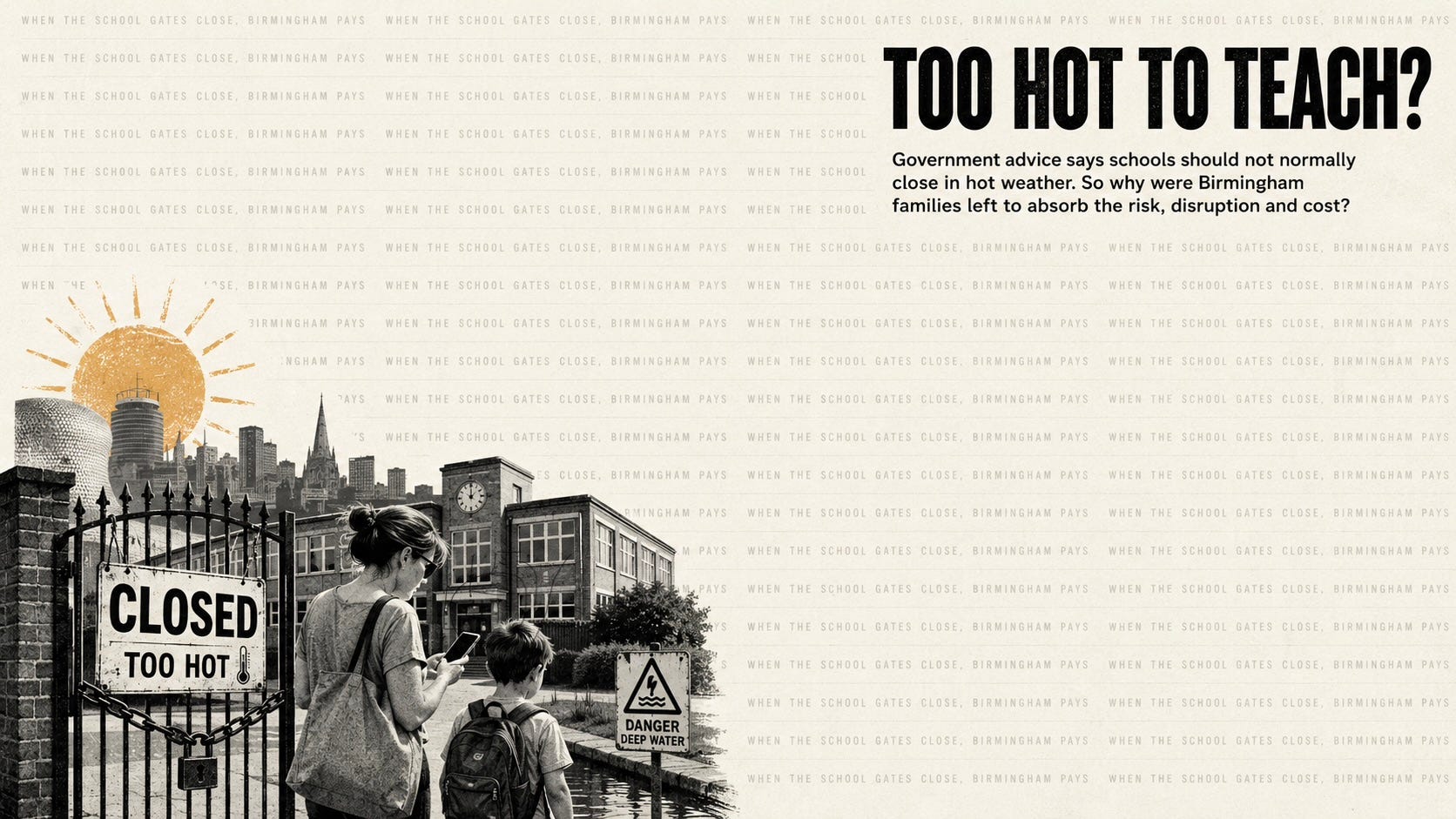
Yesterday, I had to cancel an appointment in Birmingham because the school attended by the child of the person I was due to meet had closed. Not because the city had flooded. Not because the roof had blown off. Not because an unexploded Luftwaffe bomb had been found under the staff room kettle. The school had closed because it was too hot..!!
Now, I am sure the official wording was nobler than that. It always is. Nobody ever says: “The grown-ups have had enough, the thermometer is being rude, and a bottle of chilled white is beginning to look like the more civilised option.” It is always about safety. It is always about wellbeing. It is always about protecting children. It is always presented as a solemn act of public duty, rather than another quiet surrender by a public institution that has discovered the key to the gate is easier to use than the tools of management.
But here is the awkward little point. The Government’s own advice says schools are not normally advised to close in hot weather. Not my advice. Not some Victorian headmaster’s advice. Not a fantasy from a man who thinks children should learn Latin in a wool blazer while being beaten with a cricket stump. The Department for Education says hot weather can usually be managed safely. Keep children comfortable. Relax uniforms. Provide water. Use shade. Adjust the day. Reduce physical activity. Manage the risk. In other words: open the school, use your head, and get on with it.
So the Birmingham question is simple. Why did schools close? Because this is not just a school matter. It is a city matter. When a school closes in Birmingham, the impact does not remain politely inside the education system. It lands on workers, businesses, appointments, clinics, shops, bus routes, care shifts, delivery rounds, office diaries, hospital rotas and families already juggling lives with bits of string and tired hope.
I lost an appointment. Multiply that across the city. How many meetings were cancelled? How many shifts became difficult? How many parents had to ring employers? How many grandparents were summoned? How many self-employed people simply lost income? How many children were suddenly unsupervised? How many households had to improvise because an institution that exists to provide structure, supervision and learning decided that the weather had made ordinary public service too complicated?
That is economic inactivity, Birmingham style. Not in a Treasury spreadsheet. Not in a Whitehall speech. It is the real thing: the quiet stopping of ordinary activity because the school gate has closed and everybody else has to absorb the shock. We keep being told the country has a productivity problem. Well, yes. It might help if the institutions that enable parents to work did not close at the rise of a thermometer.
This is not a new argument in Birmingham. I remember ringing Ed Doolan on BBC WM when I was a councillor, after the city had closed schools because of cold weather. Ed had Sir Tim Brighouse, then Birmingham’s Chief Education Officer, and Councillor Andy Howell on air. Andy was then the political education lead in the city, and I went for them both with the modest restraint for which I have always been internationally famous. To be fair, I had been out running that morning and had skidded around like Bambi on municipal ice. I did not mention that inconvenient little detail on air, obviously. A man must retain some dignity while making a public argument. Andy Howell, however, landed a low blow about me running in the mornings, and I have to admit, even now, it was a bloody good blow. I think they won that particular exchange. I was more or less chuckled off air.
But the point mattered then, and it matters now. I was arguing that closing schools was not a self-contained education decision. It was a city decision. It affected parents. It affected work. It affected transport. It affected the economy. It affected whether Birmingham functioned that day or quietly gave up because the weather had become slightly difficult. My argument, as I recall, even included the point that parents and teachers travelling to school would help mix the gritting material into the roads. It sounds faintly eccentric now, but it was not daft. Grit does not do its work in splendid isolation. Roads become safer when treated surfaces are used. A functioning city needs movement. It needs activity. It needs adults going about ordinary life, not every institution withdrawing at the first sign of discomfort.
Years later, I was told that Tim Brighouse and Andy Howell, by Andy himself, took that debate seriously enough to rein in school closures afterwards. Whether my call was the decisive moment or merely one noisy Birmingham prod among others, I do not know. But the lesson was the right one: schools should not close lightly, because the cost is carried far beyond the school gate. That is why yesterday’s heat closures feel so depressing. Birmingham has been here before. The city once seemed to understand that school closure creates economic drag, family chaos and civic weakness. Now, faced with heat rather than cold, we appear to be relearning the same lesson in reverse.
And that brings us to the most important question of all: what exactly was in the risk assessment? Was the risk assessment only about the temperature inside the school building? Was it only about whether classrooms were uncomfortable, whether staff were struggling, whether the school could manage lunch, lessons and supervision? Or did it also assess the wider risk created by closure? Because a proper risk assessment should not stop at the school gate.
Did anyone assess the risk to children suddenly released into a hot Birmingham day? Did anyone assess the risk of teenagers drifting towards canals, reservoirs, parks and unsupervised open spaces? Did anyone ask whether boys, in particular, might be placed at greater danger by being removed from school routine and left with heat, boredom, mates and stupidity? This is not just rhetoric. Children aged 13 to 17 are among those most at risk of drowning, and boys are at substantially higher risk than girls. Every summer, young people are told not to jump into open water. Every summer, someone thinks the warning is meant for someone else. Every summer, some family discovers that a few minutes of heat, bravado and bad judgement can end in horror.
Birmingham is not a postcard village with one duck pond and a tea room. It is a large, complicated city, with canals, reservoirs, parks, roads, bus routes, estates, alleyways and open spaces. A child sent home from school on a dangerously hot day is not automatically safer. They may be less safe. They may be away from supervision, away from routine, away from adults acting in loco parentis, and closer to the kind of unsupervised summer risk that schools are supposed to help contain. The school gate does not magically dissolve risk. It transfers it. It transfers it to parents. It transfers it to employers. It transfers it to the city. It transfers it to children themselves, which is often the worst possible place to leave it.
And this is where the chilled wine joke has its bite. Nobody is seriously saying the official risk assessment included the line: “Staff may prefer to be at home with a cold bottle from the fridge.” But the public is entitled to wonder, sometimes, whether institutional convenience is being dressed up as child protection. When closure is presented as the only responsible answer, when Government advice says schools should not normally close in hot weather, when parents are left to scramble and children are pushed into unsupervised time, the question becomes unavoidable. Who was really being protected? The children? The teachers? The school? The management? The risk assessment itself?
If the answer is genuinely “the children”, then show us the reasoning. Show us how closure made them safer outside the gates than inside. Show us how the danger of heat in the classroom outweighed the danger of unsupervised time in a city of canals, roads, reservoirs and teenage bravado. Show us how the impact on parents, work, appointments and the wider economy was considered. If that was done, fine. Let the school explain it. If it was not done, then this was not a full risk assessment. It was a partial one. It assessed the convenience and safety of the institution, while leaving Birmingham to absorb the risk outside.
And before the profession reaches for its smelling salts, this is not an attack on every teacher. Many teachers work hard. Many schools are trapped in poor buildings, bad ventilation, tired estates and underinvestment that has been ignored for years. Some classrooms in hot weather must be grim. Some pupils and staff will be medically vulnerable. There will be occasions when parts of a site are genuinely unsafe. But that is exactly why the decision should be explained with precision. If a building is unsafe, say so. If particular rooms cannot be used, say so. If staffing is the problem, say so. If vulnerable pupils require special arrangements, say so. Do not just wrap every closure in the same soft duvet of “keeping children safe”, because the phrase starts to lose meaning when nobody asks what happens to the children after they are sent away.
There is also a class issue here, because there always is. Sudden school closure is inconvenient for everyone, but it is not equally inconvenient. The parent with a laptop, a flexible employer, a cool house and a full fridge may cope. The parent on a care shift, a bus route, a cleaning contract, a hospital rota, a delivery round, a shop floor or a zero-hours arrangement may not cope at all. The school closes. The family absorbs the cost. The city loses activity. The official tone remains saintly. That is not good enough.
So yes, protect children from heat. Give them water. Let common sense breathe. Do not roast pupils in classrooms that feel like a kebab shop grill. Nobody sensible wants that. But do not pretend that closing a school automatically makes children safer. Sometimes, on a hot day in Birmingham, the safest place for a child is school.
And if a school cannot open when the Government says schools should normally remain open, then Birmingham deserves more than a soothing email. It deserves an explanation.