
Whitbread Used to Know How to Show Us a Good Time
From The Plough and Ipanema to TGI Fridays and Bar + Block, Whitbread once took risks on hospitality. Now the adventure seems to have left the building.

Prawn cocktail, steak and chips, Black Forest gâteau. And before anybody starts smirking, Black Forest gâteau was genuinely trendy. In those days being out meant something completely different. It meant you were out. Properly out. As a small boy in the 1960s I went to The Plough at Monkspath for a school chum’s birthday party. I cannot remember the lad’s name, which is a poor return for his hospitality, but I do remember his mom being absolutely lovely, and being astonished that I was inside a pub at all, even though we were actually in the private living quarters. Better still, I came away with an impressive Corgi toy car. The Plough is remembered locally as having become a Berni Inn by the late 1960s, before eventually becoming a Beefeater.
Years later The Plough was the full Berni experience. The prawn cocktail arrived, the steak was cooked on the grill in front of you, which really did feel revolutionary, and Black Forest gâteau completed the ceremony. I had one of my first proper dates with a woman there, possibly the first that really felt like a proper date, and, for the avoidance of doubt, it was not Mrs Olley. The Plough later became a Beefeater, but it never became just another restaurant to us. It was my mom’s favourite place for years and, when she died, we held her wake there. So one building contained a childhood party, a toy car, early romance, family meals and finally the gathering where we said goodbye to Mom. You will forgive me if I struggle to see that simply as a site on an asset register.
Then there was Ipanema on Broad Street. Now there was a place. I knew the premises as the old BRMB Radio Bar. Ipanema had life, colour, noise and staff who made you want to go back. I knew many of them well. I even managed to be racially abused in there once by a young fellow who informed me, in considerably less elegant language, that I was in what he regarded as an Asian premises. I was more amused than wounded by the idiocy of it. Unfortunately for him, I knew the door staff rather better than he did, so I arranged for him and his friends to continue their evening somewhere else. Job done. It did nothing to diminish my affection for Ipanema. Real places contain daft moments as well as lovely ones, which is probably why we remember them so much more fondly than anything dreamt up in a corporate branding meeting.
Whitbread once seemed very good at creating those places. The first British TGI Fridays opened on Hagley Road in Birmingham in 1986. That really was cool. My son later had a job there and I remember being slightly surprised, and rather impressed, that he had landed himself somewhere that still carried that sense of being special. Whitbread brought the idea here, grew it and eventually sold its UK business in 2007. Birmingham later got Bar + Block in Waterloo Street, launched in 2016 as a younger, sharper steakhouse idea. Coventry had Taybarns, the magnificent answer to how much one human being could eat when the price stayed exactly the same. Taybarns disappeared. Bar + Block is now going too. The futures kept arriving, then quietly becoming yesterday.
This is where I think less about the brands and more about the people who used to run Whitbread. Those guys and gals knew their stuff. They tried things. They backed ideas. They sometimes got them wrong, but there was adventure in it. They understood that hospitality is not merely moving food and drink from one side of a counter to the other. It is welcome, familiarity, surprise and the simple trick of making somebody think, “I like it here.” Modern Whitbread feels different. Read its strategy and you meet higher margins, higher returns, lower returning restaurants, capital allocation and a pure hotel business focused on Premier Inn. All legitimate. All sensible. All rather drab. I increasingly picture a room full of accountants who have never once ordered Black Forest gâteau for the sheer joy of it. Whitbread itself now says its plan is to become a higher margin, higher returning pure hotel business and leave its remaining branded restaurants behind.
Perhaps that is unfair. Premier Inn is a formidable business and Whitbread is entitled to concentrate on what it thinks will produce the best return. That is clarity, not confusion. But clarity can still lead somewhere dull. Rank offers a warning. J. Arthur Rank’s entertainment empire once meant Odeon, Pinewood and the famous gong, while the wider Rank family story also reached into flour milling and Hovis. The surviving Rank Group eventually sold its last non gambling asset, Hard Rock International, in 2007 and today centres on casinos, bingo and digital gaming. A much narrower thing than the name once suggested.
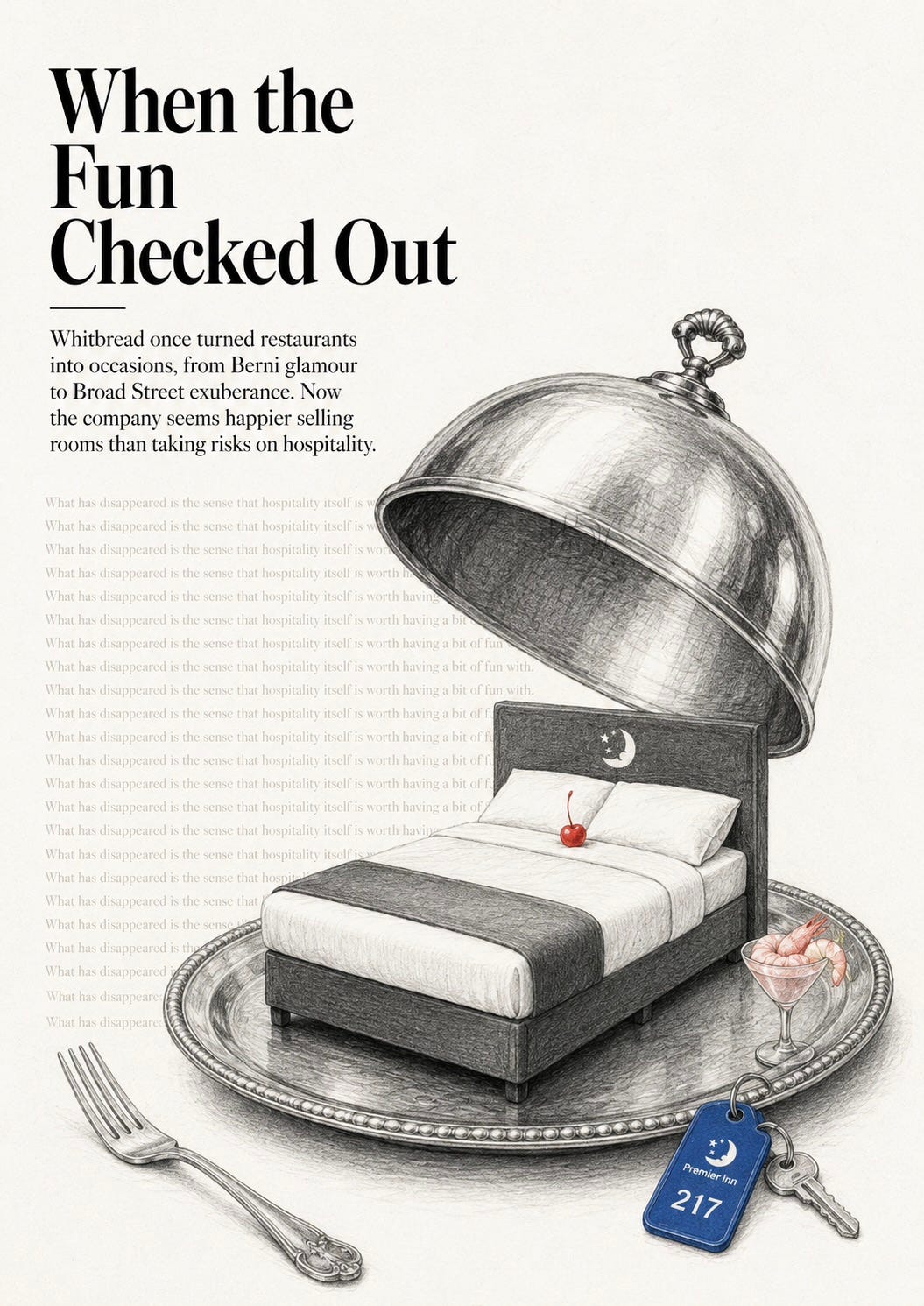
That is what bothers me about Whitbread. Not that it wants to make money. Of course it does. TGI Fridays was developed and sold. Costa was built into something enormous and sold to Coca Cola for £3.9 billion. Good luck to them. What has disappeared is the sense that hospitality itself is worth having a bit of fun with. The old Whitbread was prepared to have a go, to put a Brazilian bar on Broad Street, an American restaurant on Hagley Road or a steak cooked in front of you and make it feel like an event. The modern version seems increasingly content to calculate yield from bedrooms and feed the guest downstairs because breakfast is part of the package.
Maybe that is progress. But I still think of The Plough, my unnamed school chum and his lovely mom, the Corgi car, that first proper date that was definitely not with Mrs Olley, my mom’s wake, Ipanema, the BRMB Bar and my son somehow becoming one of the cool kids by working at TGI Fridays. Whitbread would probably describe all of that as legacy brand engagement.
I would simply call it hospitality.