

Who Owns Birmingham Now?
The high street has not simply declined. It has been bought, bundled and turned into a revenue stream.

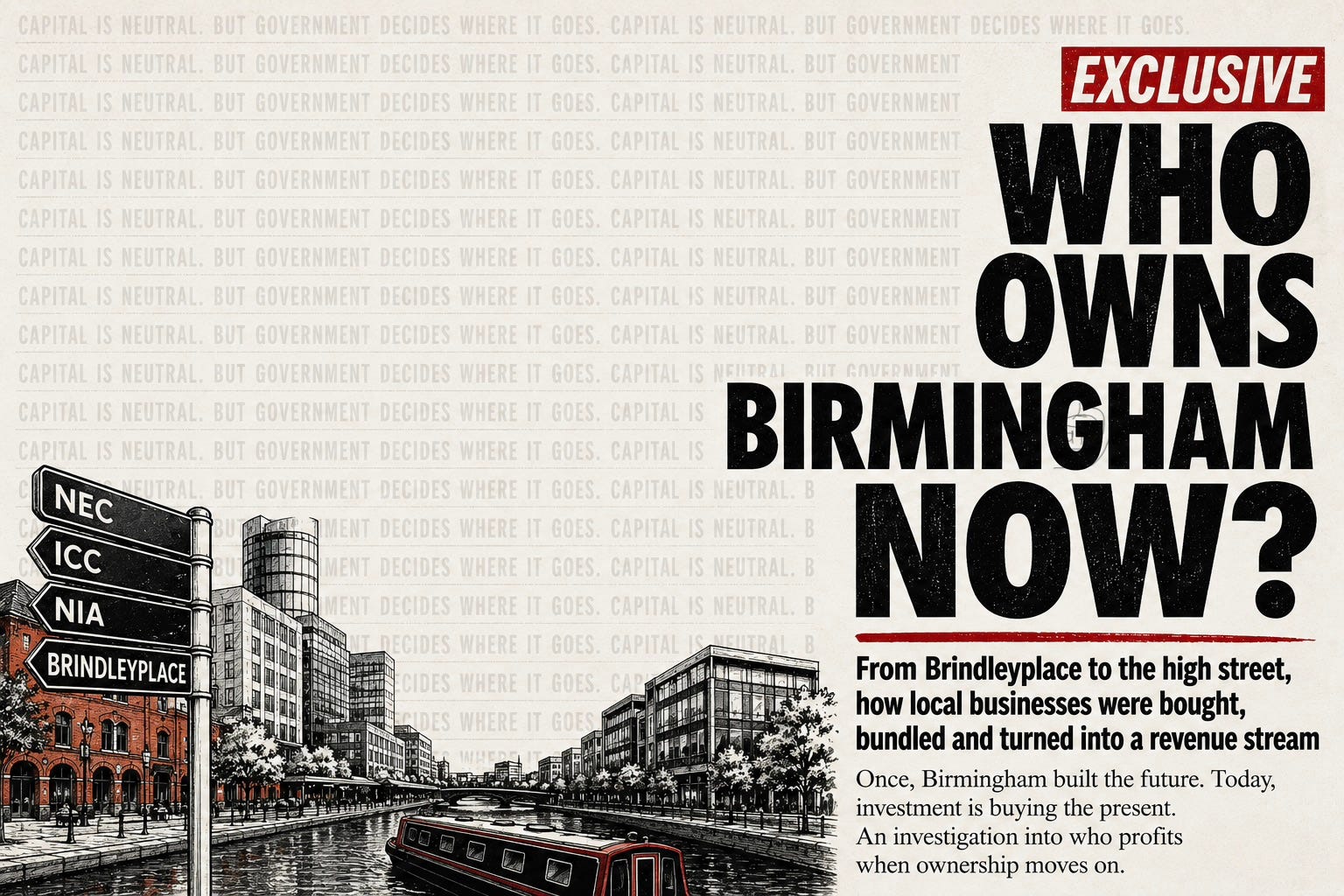
Walk down almost any Birmingham high street and at first glance everything appears reassuringly familiar. There is still a dentist. There is still a vet. There is still an optician. The local pharmacy remains. The nursery is still open. Cars still fill the car parks. Life appears to continue much as it always has. Yet something fundamental has changed. The signs above the doors may look the same. The staff behind the counters may still know their customers by name. The premises may even be occupied by the same people who worked there a decade ago. The ownership, however, is increasingly somewhere else entirely.
For decades we have talked about the decline of the high street. We have watched butchers disappear, greengrocers vanish and family-run grocery shops struggle against the rise of the supermarkets. Birmingham experienced that transformation as much as anywhere else. Even before the supermarket giants arrived, local chains had begun changing the way we shopped. Small independent retailers gradually gave way to larger operations. The process accelerated dramatically with the arrival of Tesco, Sainsbury’s, Asda and others. The weekly trip to the local shops became the weekly drive to the supermarket. The Co-operative movement played its own role in that evolution. Local societies such as the Ten Acres and Stirchley Co-operative Society eventually became part of larger societies. Yet there remained a sense of local ownership. Members elected representatives. Communities retained a connection, however imperfect, to the businesses serving them. One can make a reasonable case that the Co-operative movement often gave more than it took.
What is happening today feels rather different. The issue is no longer simply that businesses are becoming larger. The issue is who owns them. Many people assume the local vet is owned by a vet. They assume the local dentist is owned by a dentist. They assume the local undertaker is owned by a family that has been conducting funerals for generations. Increasingly, that assumption is wrong. Across Britain, and increasingly across Birmingham, local businesses are being acquired by larger groups, investment vehicles and financial structures whose interests are often far removed from the communities they serve. The familiar local business remains. The local ownership disappears.
That distinction matters. For much of Birmingham’s modern history, successful businesses were often built by people whose names appeared above the door. Marks and Spencer built a retail empire. Jack Cohen built Tesco. Birmingham itself was built by generations of manufacturers, engineers, merchants and industrialists who made things, sold things and employed local people. Today’s ownership structures are often more complex. A local business may ultimately be owned by a national group. That group may in turn be owned by a private equity fund. That fund may be backed by pension funds, institutional investors or overseas capital seeking returns. The customer sees a friendly local face. The ownership sits somewhere else entirely.
Now before anyone starts writing angry letters, let me make something clear. Capital is not the villain of this story. Money is neutral. Capital has no civic pride, no sentimental attachment to Birmingham and no framed photograph of Brindleyplace hanging above its fireplace. Capital does not care whether it invests in a veterinary practice, a housing development, a car factory, a shopping centre, a weapons manufacturer or a research laboratory. It simply follows opportunity. And that is where government enters the story.
Many years ago, during my time working around international investment linked to Kuwait and the Gulf, I remember being told that London, shorthand for Britain in many investment circles, was no longer the obvious destination for investment. Better returns, I was assured, could be found elsewhere. Libya was mentioned. Syria was mentioned. Other opportunities across the Middle East were attracting attention. Looking back, this may not rank among the greatest investment calls in history.
Britain remains one of the safest places on earth in which to invest. We possess a respected legal system, stable institutions, strong property rights and centuries of commercial credibility. Global investors continue to look at Britain and see a safe harbour for their money. The capital is there. The appetite is there. The question is where we direct it.
That brings us back to Birmingham. Birmingham had already shown that it could think big. The NEC had opened in 1976. The International Convention Centre and Symphony Hall followed in the early 1990s, with the National Indoor Arena forming part of the same wider civic confidence. These were not small projects. They were statements of intent by a city trying to move from its traditional light-industrial and engineering base towards a new economy built upon conferences, culture, leisure, professional services and international profile.
Sir Richard Knowles, better known across the city as Dick Knowles, was the Labour leader of Birmingham City Council during one of the most ambitious periods of modern civic renewal. He was not simply managing decline. He believed Birmingham needed a plan, and in Brindleyplace that plan found one of its clearest expressions. Yet this was not solely a Labour story. Birmingham’s progress during that period depended upon a degree of civic maturity that can sometimes feel absent today. Knowles found support from across the political divide, including Councillor Neville Bosworth, leader of the Conservative Group, an Edwardian-styled solicitor whose legal practice stood only a few hundred yards from the Council House. Bosworth represented a very different political tradition from Knowles, but both men shared something increasingly rare in modern politics: a belief that Birmingham’s success mattered more than party advantage.
They disagreed often. They competed vigorously. Yet when major opportunities arose for the city, they were capable of recognising a good idea and supporting it. The NEC, ICC, NIA and ultimately Brindleyplace emerged from a period when political opponents still understood that civic leadership sometimes meant looking beyond the next election. Younger readers may find this difficult to believe. Birmingham benefited as a result. Knowles, Bosworth and others helped create the foundations. The council shaped the opportunity, held the civic vision together and secured the wider political confidence needed to make major projects possible.
That is the point.
Capital came because civic government had prepared somewhere useful for it to go.
Brindleyplace worked because Birmingham City Council did the unglamorous work first. They assembled land, cleared dereliction, sorted infrastructure and gave investors confidence that the city knew what it wanted. That is civic leadership. Not cheerleading. Not press releases. The boring work of making a place investable.
We need that again. Smithfield is an obvious candidate. Perry Barr after the Commonwealth Games remains a major opportunity. The land around Curzon Street and HS2 presents another. These are places where capital would come if government created the foundations. Housing, transport links, planning certainty and skills pipelines. Capital does not need to be told what to do. It needs to be shown where to go.
More than thirty years later, Brindleyplace remains one of Birmingham’s premier commercial locations and one of the clearest examples of what happens when public leadership and private investment pull in the same direction. The lesson is simple. Capital will come to Britain. Capital will come to Birmingham. The question is what we invite it to do when it gets here. If government creates the conditions for housing, capital can build housing. If government creates the conditions for manufacturing, capital can build factories. If government creates the conditions for infrastructure, capital can build infrastructure. Yet if government fails to create those foundations, capital does not politely sit in the corner waiting for permission to be useful. It goes somewhere else.
Increasingly, that somewhere else is the everyday high street. It is easier to buy an existing veterinary practice than build a new car plant. It is easier to acquire a dental surgery than fund a housing estate. It is easier to purchase an opticians chain than create a new manufacturing sector. Building a factory is difficult. Buying a dentist is comparatively straightforward. The dentist is already there, along with the chairs, drills and waiting-room magazines nobody has read since 2018.
That does not mean Birmingham does not need vets, dentists, opticians, funeral directors, nurseries or car parks. Of course it does. These are essential parts of ordinary life. The problem comes when local services are turned into investment vehicles and the extra return is taken from the customer’s pocket. If your budgie is sick and the vet bill has doubled, you are not thinking about private equity, pension funds or international capital flows. You are thinking about your budgie and your bank balance. The budgie, for its part, is probably thinking about millet. Yet somewhere else, perhaps in an investment portfolio or a pension fund, that same bill may appear as a perfectly respectable return.
That is the uncomfortable truth. The same system that makes one person poorer at the counter can make another person richer on a balance sheet. This is not an argument against investment. Birmingham needs investment. Britain needs investment. The question is whether local and national government have lost the confidence to guide that investment towards the things we actually need: homes, factories, infrastructure, skills and lasting civic assets. The money exists. The investors exist. The appetite exists. What often appears absent is the civic vision that once directed that capital towards building something new.
The challenge now falls to a new generation of civic leaders. Birmingham’s political colours may have changed since the days of Knowles and Bosworth, but the underlying question has not. Can local government once again create the conditions that encourage investment into homes, infrastructure, skills and productive enterprise rather than simply the acquisition of existing assets? The answer matters not merely for investors, but for everyone who pays the bill.
Over the coming months I will be researching different parts of Birmingham’s modern high street to ask how far this process has gone. I will look at vets, dentists, opticians, funeral directors, car parks and other local services where ownership may no longer be as local as the sign above the door suggests. I suspect some of what we discover will surprise us. In the meantime, while government hesitates, the money still moves. And too often it moves into the places where ordinary people have the least choice: the sick pet, the aching tooth, the funeral, the parking notice, the childcare bill and the services we cannot easily refuse.
That is what I will be looking at.
Not simply the decline of the high street.
The buying up of it.