

Who Really Runs the City?
When a SAG appears to exert influence with consequences serious enough to remove a Chief Constable and attract sustained parliamentary attention, the issue ceases to be operational.

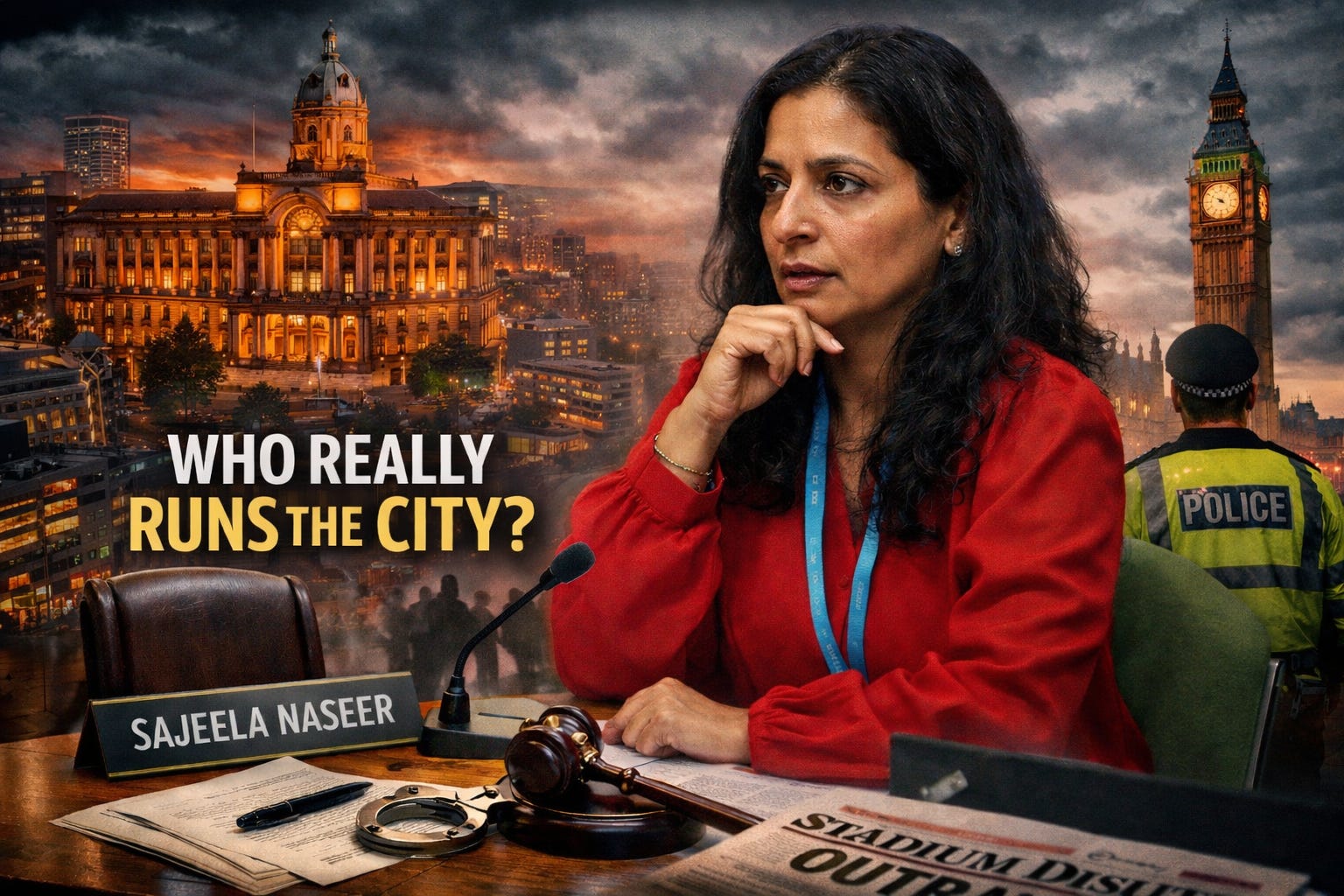
On 14 January 2026, Birmingham’s Licensing and Public Protection Committee met to consider what should have been a routine matter. Revised licensing fee structures. Pricing models. The mechanics of how regulation is paid for. The new structure was agreed with little drama.
That, on paper, should have been the end of it.
What drew attention to the meeting came only after the main business was concluded. El Diablo on X flagged what unfolded under Any Other Business, and it quickly became clear that this was where the real significance lay. The formal agenda had finished, but the most important moment of the meeting was still to come.
Because what surfaced under AOB was not a technical footnote, but a long-simmering governance issue that Birmingham has been struggling to contain. The subject was a Safety Advisory Group. Not just any SAG, but the one whose actions effectively barred Jewish supporters from attending a football match against Aston Villa. A decision that ignited national headlines, triggered parliamentary scrutiny, and set off a chain of events that ultimately ended the tenure of a Chief Constable.
This was that SAG.
The same SAG that dragged senior figures, including the Chief Constable himself, down to London on more than one occasion to account for its actions. The same episode that filled column inches across the national media and dominated broadcast news. The same controversy that led to repeated appearances before parliamentary committees.
And crucially, it was the same episode that saw Councillor John Cotton, Leader of the Council, alongside highly paid senior council officers, defending Birmingham City Council’s processes at a national level. Those officers, on substantial six-figure salaries with very generous defined-benefit pension arrangements, appeared before the Home Affairs Select Committee to answer concerns about the very SAG whose actions resulted in Jewish supporters being excluded from the match.
Senior civic leadership addressing the conduct of an advisory group whose influence had produced such extraordinary consequences struck many observers, both inside and outside Birmingham, as deeply unsettling.
That history matters. Without it, what followed makes no sense.
Safety Advisory Groups are advisory by design. They are not statutory bodies. They do not make decisions. They advise. Their legitimacy depends entirely on remaining within that advisory lane. When a SAG appears to exert influence with consequences serious enough to remove a Chief Constable and attract sustained parliamentary attention, the issue ceases to be operational. It becomes a question of democratic accountability.
Which is precisely why what followed under Any Other Business mattered so much.
During that part of the meeting, Councillor Barbara Dring, a former Chair of Licensing with long experience of how officer power operates, made a simple and entirely reasonable request. She asked that a report on the relevant SAG meeting be brought before the Licensing and Public Protection Committee.
Not a trial. Not a polemic. A report.
It was a measured request grounded in democratic common sense. If a SAG operating within the council’s orbit has already generated national controversy, parliamentary hearings, and the loss of a Chief Constable, then elected members have both the right and the duty to examine how that SAG operated, what advice it gave, and how that advice was handled.
The reaction around the table was immediate.
Officers visibly stiffened. The atmosphere changed. This was no longer about licensing fees. This was about whether something that had been carefully contained within the officer sphere was about to be examined in public by elected members.
The response fell to Sajeela Naseer, the senior officer responsible for Regulation and Enforcement. Her answer faltered. There was hesitation, recalibration, and it quickly became clear that she was not going to give Councillor Dring what she had asked for. Legal advice was invoked. Sensitivity implied. Boundaries drawn.
From the outset, a line was being held.
The significance of that moment was sharpened by the way the meeting was chaired. The committee is chaired by Councillor Diane Donaldson, a role that exists precisely to ensure scrutiny takes place and that officers are accountable to elected members in public forum. She allowed the questioning. She did not shut it down. Committees do not manage officers day to day, but they do control whether issues are examined openly or quietly buried. In this case, the door was left open.
And above this entire exchange stands Councillor John Cotton, Leader of the Council, whose role is central. He is not simply another councillor. He is the individual who has already given assurances to Parliament that accountability would follow and that the council would face this matter openly.
Evidence to Parliament is not casual. It creates an expectation that internal governance will align with what has been said externally.
This is why resistance to Councillor Dring’s request matters.
There are many reasons why a senior officer such as might not want a report on this SAG brought before committee. It could be embarrassing. It could expose blurred lines between advice and pressure. It could reveal informal practices that do not stand up well to daylight. It could raise uncomfortable questions about who knew what, and when. It could complicate legal positions. It could invite further scrutiny, locally and nationally.
In short, it could be deeply inconvenient.
But democratic governance does not exist to spare institutions inconvenience. It exists to ensure that power is exercised transparently and accountably on behalf of the public.
This is not about personalities. It is about control of information. When officers decide that elected members should not see something because it is deemed “too sensitive”, scrutiny becomes conditional and democracy becomes managed.
So this is where Birmingham now stands.
Will Councillor Dring succeed in her entirely reasonable request for a report on the SAG that barred Jewish supporters from a football match, dominated national headlines, and helped bring down a Chief Constable? Or will Sajeela Naseer succeed in holding the line and keeping the issue within the officer sphere?
And if the latter happens, a further question inevitably follows. How does that square with the assurances already given by Councillor John Cotton, Leader of the Council, to Parliament?
This meeting on 14 January 2026 was never really about licensing fees. It was about who decides what elected members are allowed to know, and when. It was about whether Birmingham is run for the convenience of its officer class, or for the citizens those officers are meant to serve through democratic structures.
That question has now been asked, in public.