

WHO’S REALLY IN CHARGE HERE? Inside the West Midlands’ £M Consultant Habit
The Combined Authority has top-paid bosses and £billions to manage, yet much of the expertise sits with outside firms. Why is regional government renting its own brainpower?

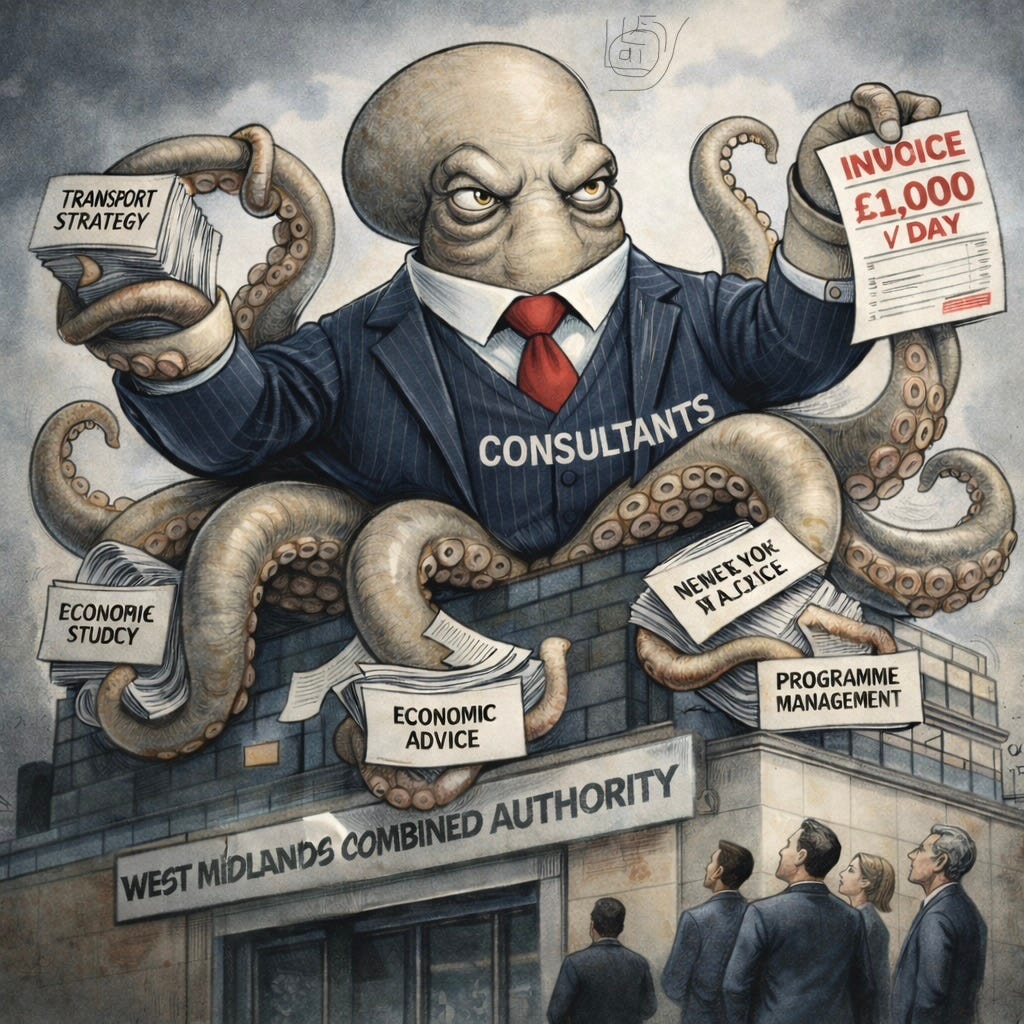
Modern government has developed a curious habit. It builds public institutions, funds them with public money, then hires private consultants to help decide what those institutions should do.
Nowhere is that pattern more visible than inside the West Midlands Combined Authority.
Created in 2016, the WMCA was designed to provide the strategic leadership once exercised by the old West Midlands County Council, abolished in 1986. It also absorbed functions historically associated with regional transport bodies such as Centro.
Today the authority sits at the centre of billions of pounds of public investment in transport, housing, regeneration and economic development.
In theory, it is the strategic brain of the region.
In practice, a noticeable portion of that brainpower appears to sit outside the organisation itself.
Procurement records reveal a recurring ecosystem of consultancies, infrastructure advisors, project managers and software providers that help design, analyse and deliver many of the authority’s programmes.
There is nothing improper about this.
But it does raise a perfectly legitimate question about how regional government now operates.
If the same expertise appears in public contracts year after year, is it really temporary?
Or is it permanent capability delivered at consultancy rates?
The Consultancy Ecosystem
Look through procurement notices and a familiar circle of suppliers begins to appear.
Engineering consultancy Arup turns up in transport feasibility work and net-zero programmes.
Infrastructure advisory firm Ridge and Partners LLP appears in metro consultancy and built-environment roles.
Project delivery specialists such as Waterman Aspen Limited support infrastructure programme management.
Digital governance systems are often supplied by companies like Civica UK Limited and enterprise software provider Unit4 Business Software Limited.
None of these firms are obscure. They are established professional service providers with long experience working with public authorities.
But the categories of work they deliver tend to recur.
Transport modelling.
Infrastructure planning.
Programme assurance.
Economic strategy.
Digital administration systems.
Individually these contracts may look modest. Tens of thousands here, a few hundred thousand there.
Taken together, they form a steady stream of consultancy spending around the machinery of regional government.
The Five-Year Pattern
The West Midlands Combined Authority manages substantial programme budgets through devolved government funding, housing investment funds and transport infrastructure programmes.
Annual programme spending frequently runs into hundreds of millions of pounds when major projects are included.
Within those budgets sits a smaller but persistent category of advisory and professional services contracts.
Procurement notices suggest that consultancy and specialist advisory contracts commonly range from around £50,000 to several hundred thousand pounds depending on the programme.
Spread across infrastructure planning, energy transition work, programme management, digital systems and economic analysis, those contracts accumulate.
A conservative estimate based on published procurement notices suggests that tens of millions of pounds have been spent on consultancy and professional services connected with WMCA programmes over the past five years.
The precise figure fluctuates because many contracts are awarded through framework agreements and project budgets rather than a single central category.
But the pattern itself is clear.
Consultants are a permanent presence in the regional development machine.
Who Are These Firms?
One detail that often puzzles readers when they first examine procurement records is the legal structure of some consultancy firms.
For example, Ridge and Partners LLP operates as a Limited Liability Partnership, or LLP.
An LLP is simply a legal structure commonly used by professional service firms such as lawyers, accountants, architects and consultants.
Instead of shareholders, the business is owned by partners who share profits and collectively manage the organisation.
There is nothing secretive about the structure. It reflects the traditional partnership model used by many professional professions.
What matters for public institutions is not the legal structure of the suppliers.
What matters is how often they are used.
Renting Expertise
There are sensible reasons why modern public authorities rely on consultants.
Combined authorities were deliberately designed as relatively lean organisations.
They do not employ large standing teams of engineers, economic analysts or infrastructure planners.
Consultancies allow them to purchase specialist expertise when needed.
A complex transport modelling exercise might require a team of specialists for six months but not indefinitely.
Consultants can also bring experience from projects across the country or around the world.
That external perspective can be useful when designing complex infrastructure programmes.
The argument for the consultancy model is simple.
Why maintain large permanent departments when expertise can be hired when required?
The Cost Question
That argument begins to wobble when consultancy contracts repeat year after year.
Senior consultants frequently charge day rates approaching four figures.
Over the course of a year, a specialist consultant could easily cost £180,000 or more in fees.
A permanent public sector employee with comparable expertise would typically cost far less.
When advisory roles recur across multiple programmes, critics begin to ask whether government is effectively renting its own capability at premium consultancy rates.
If the expertise is needed repeatedly, perhaps it is no longer temporary.
Perhaps it is structural.
The Senior Capacity Already Exists
This question becomes more interesting when one considers the internal structure of the West Midlands Combined Authority itself.
The authority already employs a substantial senior leadership team.
Like most large public bodies, it has a Chief Executive and executive directors responsible for transport, finance, strategy, housing and economic development.
Public transparency rules mean senior salaries are disclosed in annual accounts.
Recent figures indicate that the Chief Executive role has been remunerated at roughly the £200,000 level, with several executive directors earning well into six figure ranges once salary and pension contributions are included.
Taken together, the authority has invested significantly in executive leadership.
That leadership structure exists to manage large regional programmes.
Which raises an obvious question.
If the management layer is already in place, why not build more of the technical expertise inside the organisation itself?
Instead of commissioning consultancy work, those same senior leaders could oversee permanent teams of planners, engineers and analysts.
The Memory of Institutions
Earlier regional institutions operated differently.
Bodies such as the West Midlands County Council and the transport authority Centro employed large in-house technical departments.
Engineers and planners built decades of experience working on the region’s transport network and infrastructure.
That continuity created something valuable.
Institutional memory.
Professionals who had spent twenty or thirty years working on the same regional systems understood the infrastructure, the politics and the practical constraints of policy.
When work is outsourced, that knowledge often leaves when the contract ends.
Over time, public authorities risk becoming commissioners rather than practitioners.
They purchase expertise rather than owning it.
Politics and the Consultancy Habit
The consultancy ecosystem around the WMCA developed across different political administrations.
The authority’s first mayor, Conservative Andy Street, presided over a period of rapid regional investment and institutional expansion.
Large programmes required modelling, feasibility studies and programme assurance, much of which was delivered by external consultancies.
In 2024 the mayoralty passed to Labour’s Richard Parker, who inherited the same institutional machinery.
So far there has been no dramatic change in the model.
The reliance on external advisory expertise appears to be structural rather than partisan.
A Debate Beyond Party Politics
Criticism of consultant-heavy governance comes from very different political traditions.
The Green Party of England and Wales tends to argue that government has hollowed out its internal expertise and should rebuild permanent public sector capacity.
Meanwhile Reform UK often criticises consultancy spending as expensive bureaucracy funded by taxpayers.
Different philosophies.
The same suspicion of permanent consultancy dependency.
The Next Political Moment
The next mayoral election for the West Midlands Combined Authority is scheduled for 2028.
Local political landscapes have become increasingly volatile in recent years, with traditional party loyalties weakening and new political movements gaining traction.
If current polling trends continue nationally, future regional elections may not resemble those that first created the metro mayor system.
Whether that affects the West Midlands remains to be seen.
But if the consultancy model becomes part of the political conversation, future candidates may find themselves answering a fairly simple question.
Why does regional government repeatedly buy the same expertise from outside?
The Architecture of Regional Government
None of this suggests that the WMCA has acted improperly. It operates within public procurement rules and publishes contract notices accordingly.
Consultants often bring valuable expertise.
But the pattern visible in procurement records raises a broader question about how regional institutions should be designed.
If the authority already has a senior leadership structure capable of managing complex programmes, it may also have the capacity to build more permanent expertise beneath that leadership.
Instead of commissioning expertise.
It could own it.
That approach might create stronger institutional memory, deeper regional knowledge and potentially lower long term costs.
Or it might prove that consultancy flexibility really is the most efficient model.
Either way, the question deserves to be asked.
Because the future of the West Midlands will depend not only on how much money is invested in infrastructure and regeneration.
It will depend on where the expertise shaping those investments actually resides.
Inside the institution.
Or just outside its doors.
Don't ask me, the obvious answer is that they don't have any brains or ideas of their own.
In 2025 it was found that WMCA consultants or staff were conducting a site visit in Bordesley, for the Metro extension from Digbeth to the B'ham City FC's ground. Slight snag the route being planned was to the old BCFC ground, not the stadium envisaged / planned near Adderley Park Station (on the old B'ham Wheels site). The staff etc were not aware of the new stadium. Gives one concern about the WMCA on such a "flagship" project are planning for the past!