


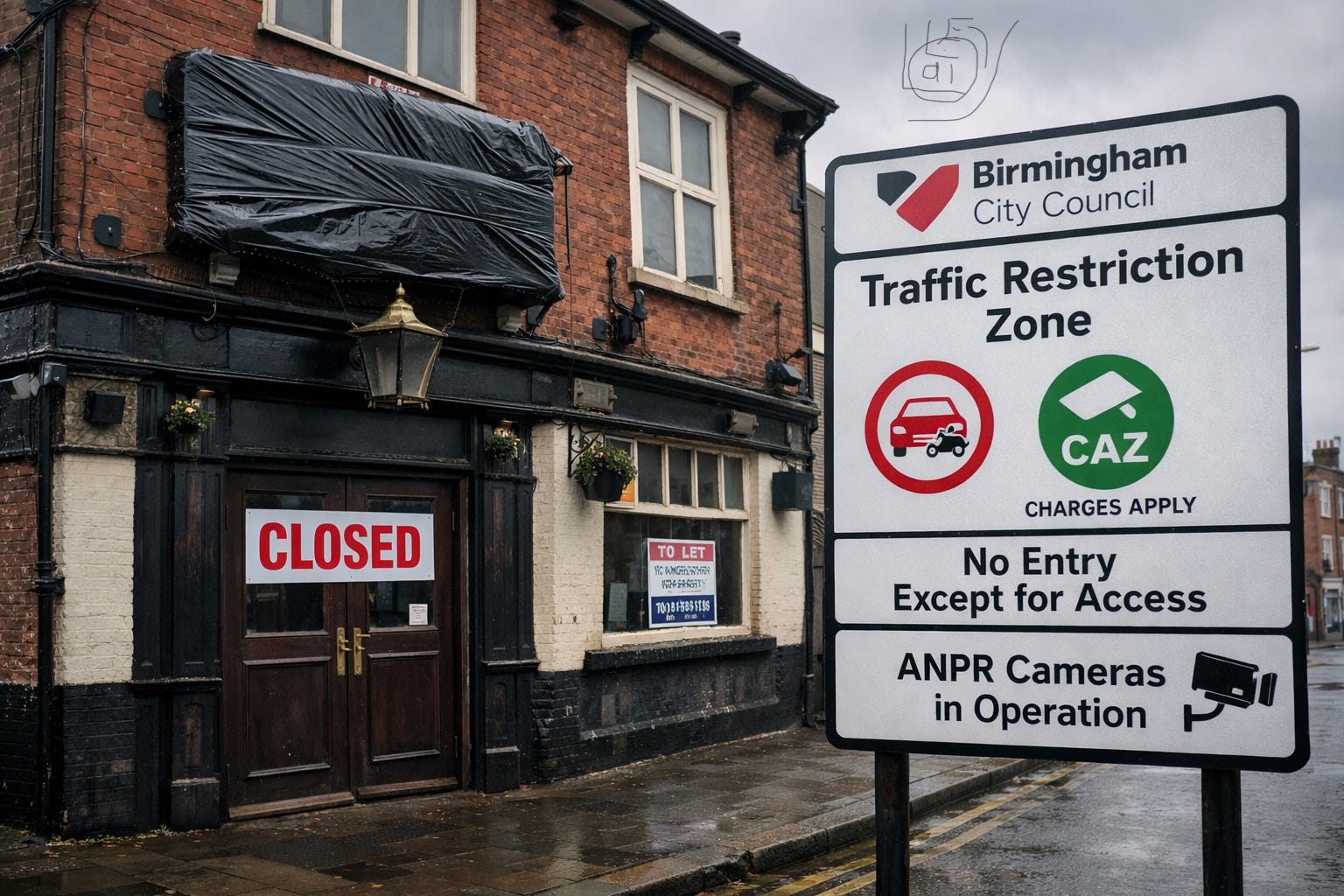
There is a curious habit in British public life that repeats itself with depressing regularity. Businesses stay silent while bad policy is being designed. They stay silent while it is consulted on. They stay silent while it is imposed. And then, when the damage is done and the shutters are coming down, they finally ask why nobody spoke up sooner.
The answer is simple. They were afraid to.
This article is about that fear. Where it comes from, why it is misplaced, and why nowhere illustrates it better than pubs and hospitality in Birmingham and the wider West Midlands.
The Silence of the Big Players
Large companies, especially those with bricks in the ground, tend to tell themselves a comforting story. Stay neutral. Keep your head down. Don’t get involved in the politics of the day. One council is Labour, the next Conservative, another some fragile coalition. Best not upset anyone. Best to “work constructively with stakeholders”.
In reality, this is not neutrality. It is dependency.
Big pub companies depend on councils for licences, planning permissions, pavement licences, outdoor seating, noise enforcement, late hours, temporary event notices, and a thousand small discretionary decisions. Somewhere along the line, this practical relationship has morphed into something psychological. A belief that if a councillor is annoyed, retribution will follow.
But let us be honest. That fear is largely imagined.
Most councillors are not kings. They do not represent the settled will of the people. In local elections, they are often elected on turnout so low that 15 to 20 percent of the electorate actually voted for them. Many hold office less because of popular enthusiasm than because of public disengagement.
Yet when business stays silent, those councillors begin to believe they are unchallengeable. Smugness sets in. Self importance follows. And policies drift further away from lived reality.
Trade Bodies That Don’t Trade Blows
If individual companies stay quiet, trade bodies are often worse.
Chambers of commerce, hospitality associations, and umbrella groups exist to represent members’ interests. Members pay handsomely for that representation. But when policies begin to hurt, many of these bodies retreat behind platitudes.
Private meetings. Warm words. “Engagement”. “Dialogue”.
What they rarely do is stand up publicly and say, this is wrong.
Some bodies appear more concerned with staying on the Christmas card list of the Leader of the Council than with defending the businesses that fund them. Others are so frightened of losing access that they confuse proximity to power with influence over it.
And when trade bodies won’t speak, councils hear only themselves.
Birmingham’s Clean Air Zone: A Case Study in Quiet Failure
Nowhere is this clearer than Birmingham’s Clean Air Zone.
The CAZ has been a disaster for many small businesses, particularly in hospitality, logistics, trades, and independent retail. It increased costs overnight. It made it harder for customers to travel into the city. It punished older vehicles disproportionately. And it did all this in a city that already struggles with footfall, fragmented transport, and declining high streets.
Which major business body stood up, publicly and loudly, to oppose it?
Very few.
Most watched profits evaporate while hoping the policy would quietly be tweaked, softened, or forgotten. Some even took council money in advisory or consultancy roles, creating an obvious conflict between challenging policy and being paid to “support delivery”. No names need to be mentioned. The point is structural, not personal.
The result was predictable. The policy rolled on. Businesses absorbed the cost. Councillors declared success.
From Boardrooms to Bar Stools
This brings us to pubs.
Pubs sit at the sharp end of all of this. They are hyper local, licence dependent, labour intensive, and acutely sensitive to footfall. They also carry cultural weight in a way warehouses and offices do not.
Big pub companies have mostly stuck to the old script. Keep neutral. Don’t antagonise. Don’t take positions. Let the trade bodies handle it.
Smaller independents behave differently. They have less to lose, or at least less illusion about what they can lose. They tend to speak up only when things are already close to the edge. Which is why, when you see pubs publicly barring MPs or putting up political signs, it is usually a sign of desperation, not ideology.
This is not new. Wetherspoons famously broke ranks during the Brexit debate. Tim Martin distributed Leave material in his pubs, much to the irritation of some staff and many commentators. He was criticised for politicising hospitality.
Yet here is the irony. By never chasing popularity, Wetherspoons gained it. It remains mocked on social media by people who nonetheless “pop in” for a cheap pint and a decent meal. Consistency, even when unpopular, builds credibility.
Why Silence No Longer Works
The idea that staying quiet protects business is outdated.
Policies are now too sweeping. Clean Air Zones, traffic filters, licensing restrictions, planning rules, late night levies, public space protection orders. These are not minor regulatory tweaks. They reshape how cities function.
If business does not challenge them early, it is complicit in the outcome.
And silence does not buy safety. Councillors who are determined to impose “nutty traffic schemes” will not reward quiet compliance. They will simply move on to the next idea, emboldened by the lack of resistance.
A West Midlands Reality Check
The West Midlands is full of capable businesses, sensible operators, and grounded managers who understand how cities actually work. Yet their collective voice is strangely absent when policies are being pushed that make it harder for motorists to drive around their own city, harder for customers to reach venues, and harder for staff to get to work.
This vacuum is then filled by ideology.
Councillors convince themselves they are leading opinion when in fact they are operating in an echo chamber. They mistake silence for consent.
Time to Speak, Before the Shutters Fall
This is not an argument for partisanship. It is an argument for backbone.
Corporations are allowed to have views. Hospitality is allowed to defend itself. Trade bodies are supposed to earn their subscriptions.
If pubs can no longer afford to stay open, if footfall continues to fall, if councils continue to regulate without consequence, then perhaps the question should be turned around.
Instead of asking why pubs might ban MPs, perhaps we should ask why MPs and councillors have made themselves unwelcome in the first place.
Because one thing is certain. Staying quiet has not worked. And the bill for that silence is already being paid.